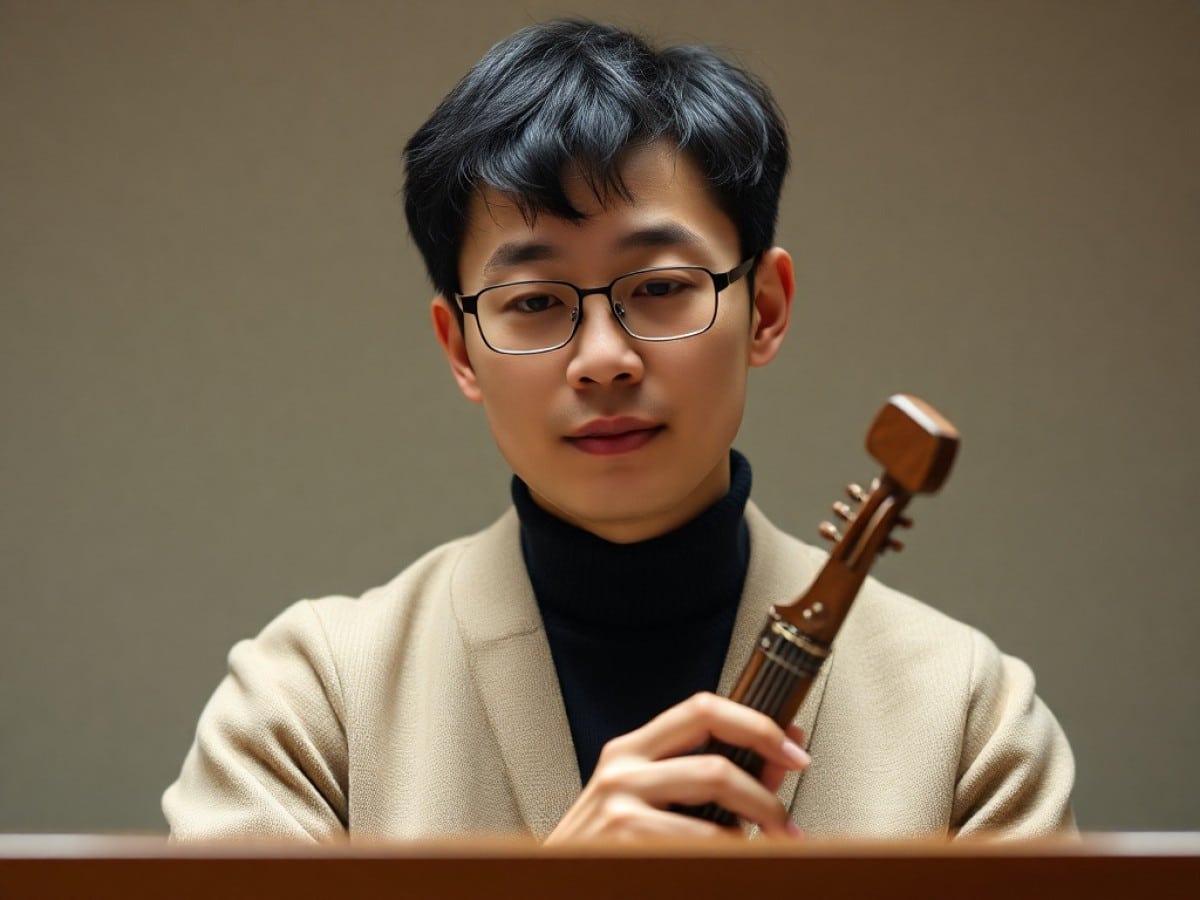
As one of the 265 million people who watched Squid Game, Netflix’s most popular series to date, the haunting tones of a child’s recorder at the end of the first season might still echo in your mind, transforming the mundane setting of an elementary music classroom into a chilling prelude to violence.
These eerie sounds were created by composer Jung Jae-il, whose career is marked by his ability to turn the familiar into the foreboding. He expertly twists elements of innocence and grace into ominous signals of terror.
In April, following a global tour with sold-out shows at the Barbican in London and Carnegie Hall in New York, Jung is set to make his first appearance in Australia at the Sydney Opera House. There, he will conduct a 41-member orchestra performing his compositions for Parasite, the most awarded non-English language film at the Oscars.
At 43, Jung, a Seoul Jazz Academy alum, has mastered multiple instruments including piano, guitar, bass, drums, traditional Korean percussion, and even the musical saw. Interestingly, for Squid Game, he chose an instrument he had not yet mastered.
-
Join us every Saturday morning for a selection of must-read articles and pop culture tidbits.
Contrary to what might be expected, it was Jung himself, not a child, who played the haunting opening theme of the show. Initially, he thought he would be replaced by a professional recorder player after the first recording.
“I’m not a professional recorder player,” he admitted through an interpreter. “We tried to enhance it with auto-tune later, but the director, Hwang Dong-hyuk, felt the artificially perfected version didn’t sound quite right.”
The theme that made it to the final cut of Squid Game was a masterpiece of intentional imperfection, characterized by thin, piercing notes interspersed with sharp, unintended squeaks. These sounds, produced by an amateur struggling for control, became a sonic metaphor for the desperation of the show’s doomed contestants. This deliberate embrace of the recording’s flaws contrasts starkly with the usual pursuit of digital perfection in music scores.
Jung’s path to music composition was unconventional. At 15, he joined a rock band and has never formally studied music composition. His approach is heavily influenced by improvisation, a method he embraced while working on the score for Parasite.
“I was in total despair,” he revealed about his initial struggles with traditional composition methods while working on Parasite. “One day, I just started improvising in front of my computer, and that material was approved by [director] Bong Joon Ho. That experience made me realize that perhaps improvisation is my true calling, despite it seeming unconventional.”
If Squid Game used the distorted sounds of childhood, Parasite employed the precise structures of baroque music to underscore themes of class conflict, contributing to a sharp critique of contemporary Korean society. Parasite was the first South Korean film to win the Palme d’Or at Cannes and the first non-English language film to win Best Picture at the Academy Awards, with Bong also receiving Oscars for Best Director and Best Original Screenplay.
These achievements catapulted Jung from a studio-bound musician to a globally recognized composer.
“After my involvement in Squid Game and Parasite, my music became known worldwide, even if my name did not,” he commented.
In 2025, his third collaboration with Bong – a sci-fi comedy titled Mickey 17 – was released, featuring grand compositions performed by the London Symphony Orchestra. The soundtrack, with its swirling waltzes, added a disturbingly elegant touch to scenes depicting what was essentially a human replication factory.
In December, his new orchestral piece, Inferno, premiered with the Seoul Philharmonic Orchestra.
“Had I been formally trained at a conservatory, I doubt I could have composed something like Inferno,” he stated. “Starting with a blank slate allows me to draw on all the music I’ve absorbed since childhood—from rap and heavy metal to rock and avant-garde. Ultimately, having no predefined musical identity is what defines me.”
As he prepares for upcoming projects, including a venture with Burning director Lee Chang-dong and a new album with Decca Records, Jung is increasingly focusing on live performances as a way to counter the rise of artificial intelligence in music. His move to the stage is not just a celebration of his successes; it’s a deliberate effort to preserve the human essence of music.
“We are navigating uncharted waters,” he noted. “AI poses a real challenge to the creative process in music. It’s crucial that we continue to champion what only humans can achieve.”
For Jung, this uniquely human element is found in the raw, the improvised, and the errors no machine would consider making and no technology could enhance.
By emerging from behind the scenes, he offers his audience a bold affirmation: the person at the piano is not an algorithm, but a human, crafting art in the shadows.
-
Parasite: Live in Concert will be performed at the Sydney Opera House on April 24 and 25.
Similar Posts:
- Leipzig Orchestra Stuns at Proms: Nelsons and Faust Deliver Breathtaking Performance!
- Stunning Performance: Danish National Symphony Orchestra Electrifies Royal Albert Hall!
- CB Symphony Dazzles: Yamada Leads Trombone Into Fujikura’s Sonic Depths!
- Stunning New Album by Mäkelä and Paris Orchestra: A Fresh Take on Berlioz and Ravel!
- Classical Roots of Pop Music: How Icons Were Shaped by the Classics

Fatima Clarke is a seasoned health reporter who bridges medical science with human stories. She writes with compassion, precision, and a drive to inform.