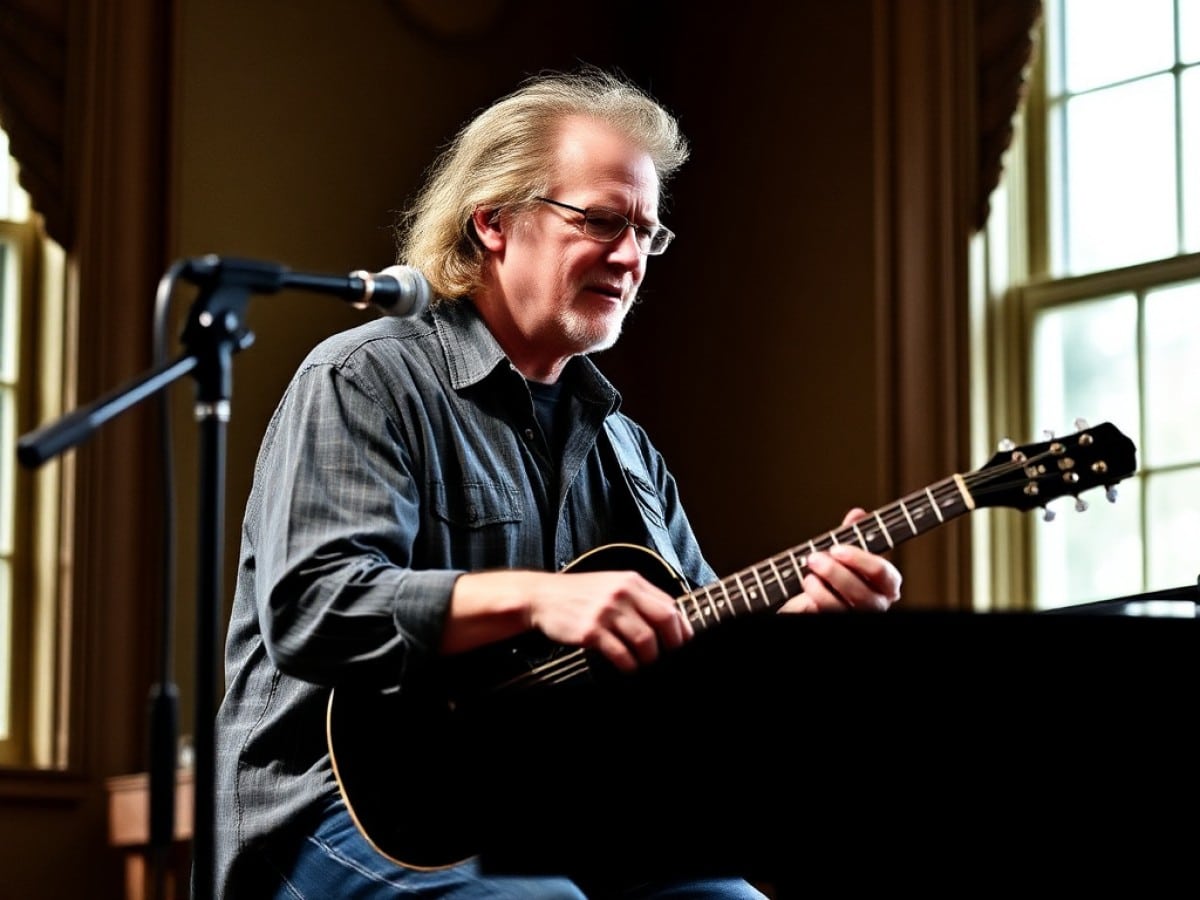
Bruce Hornsby, speaking from his residence in Williamsburg, Virginia—one of America’s oldest settlements—recalls an unusual childhood memory. On the eve of his ninth birthday, while at school, news broke of JFK’s assassination. Unlike the typical somber reactions, his classroom burst into cheers, a reaction that left young Hornsby startled. “I was really alarmed and confused / Watching the children parroting parents’ views,” he reflects in a song from his latest album, ‘Indigo Park’.
Until recently, Hornsby’s songs have seldom been autobiographical, which means many details of his life remain relatively unknown. His most famous track, ‘The Way It Is’, comments on societal issues, shaped by his liberal upbringing in a still-segregated Southern community. During the 1960s, when local resistance to integration was strong, Hornsby’s aunt emerged as a notable advocate for civil rights.
Following his initial success, Hornsby continued to pursue his musical interests, often away from the mainstream spotlight. Nonetheless, he has experienced a resurgence of popularity in his early 70s, marked by the release of four studio albums over five years. He’s now a frequent guest on prominent American podcasts, such as The Adam Friedland Show, sharing the lineup with figures like Gavin Newsom and Zohran Mamdani. Despite his long career mostly outside of mainstream critical circles, Hornsby finds his current recognition more preferable to being overlooked.
Known for his dry humor and a bit of quirky innocence, Hornsby’s home studio in Williamsburg is adorned with influences that span a wide musical spectrum. From a provocative poster of Leon Russell to the avant-garde compositions of Elliott Carter and Ligeti, alongside jazz greats like Bill Evans and Bud Powell, his inspirations are eclectic. Hornsby, eager to share, attempts to show these through his iPad, though technical glitches interrupt his tour.
Hornsby’s formal music education includes studying jazz in Miami, a class below Pat Metheny, and a brief period at the prestigious Berklee College in Boston. When he turned 40, the birth of his twin sons motivated him to seclude himself for six months to enhance his piano skills, particularly his left hand. In some respects, he mirrors the pop version of Keith Jarrett, with a deep appreciation for the simple beauty of American rock and folk. He calls these the “white note songs,” but is equally captivated by the dissonant allure of atonal music. His latest album, ‘Indigo Park’, introduces what feels like a new genre of pop, blending unsettling chromatic tones with gratifying resolutions. “I wish you were reviewing it instead of doing an interview!” he tells me enthusiastically.
Raised in a Christian Science environment, Hornsby moved to LA in his twenties, collaborated with artists like Sheena Easton, and wrote for Huey Lewis. He spent time as an unofficial member of the Grateful Dead in the early 90s, a stint marked by his avoidance of the tragic fates that befell many of their keyboardists, thanks to his sober lifestyle. Over the years, his music has often carried a political edge, from critiquing Reaganomics in ‘The End of the Innocence’, a collaboration with Don Henley, to performing a satirical piece on Donald Trump in 2006, which Trump surprisingly enjoyed. However, Hornsby now steers clear of political satire. “I think it takes a very clever person to write a song about Trump – or Gavin Newsom, if that’s your persuasion – and make it somehow artful,” he reflects.
Asked whether the growing attention has influenced his music, Hornsby responds, “Hmm, I just thought, ‘This is giving me chills, to write about my life in this way.’” His entire musical journey seems dedicated to chasing those spine-tingling moments—be it through melodic lines or chord transitions. Yet, he relies not solely on his own reactions to gauge a song’s impact. Whenever Hornsby thinks he might have crafted something special, he drives to the center of Williamsburg, seeks out his older brother Bobby—a construction manager who built Bruce’s large white weatherboard house—or a close friend, and plays the new piece in his car. But it’s not just their feedback he’s after. “What’s more important than their reaction is my reaction,” he notes. “Because something very real happens when you listen to music through someone else’s ears. It’s palpable, almost psychological. The atmosphere in the room just shifts.”
Describing ‘Indigo Park’, Hornsby calls it “an old bastard looking back on life.” While the music might sound youthful and free of boundaries, themes of time and mortality are pervasive. One track was inspired by a vivid dream featuring his late father, a moment so poignant that Hornsby struggles to discuss it without becoming emotional. He shares another dream where his father befriended Aaron Dessner from The National, smiling as he recalls his father’s vibrant personality. Hornsby fondly remembers a specific comfort his father offered to those feeling betrayed or misunderstood: “He used to say, ‘Eff ’em all but six – five for the pallbearers and one to piss on the grave.’”
Despite the demanding schedule, Hornsby continues touring extensively, alternating between solo piano performances in East Coast music halls during winter and playing with his band, the Noisemakers, at festivals in warmer months. “I can’t believe I’m doing so many dates,” he admits, slightly overwhelmed. “This time, I’ll be more cautious with backstage interactions. I have to be careful these days. If you come backstage, I’ll let you in.”
Similar Posts:
- Newsom Slams Trump in AP Interview: Calls Climate Inaction ‘Doubling Down on Stupid’
- Unlocking Emotion: Bluey’s Composer Reveals How Music Can Stir Deep Feelings
- Yorke Dance Project Triumphs: Modern Milestones at Linbury Theatre Shines!
- Rock Stars’ Secrets Revealed: From Burps to Wisdom, What Ageing Musicians Teach Us!
- Rebecca Clarke Triumphs at Wigmore Hall: A Pioneering Female Composer’s Resonant Evening

Fatima Clarke is a seasoned health reporter who bridges medical science with human stories. She writes with compassion, precision, and a drive to inform.