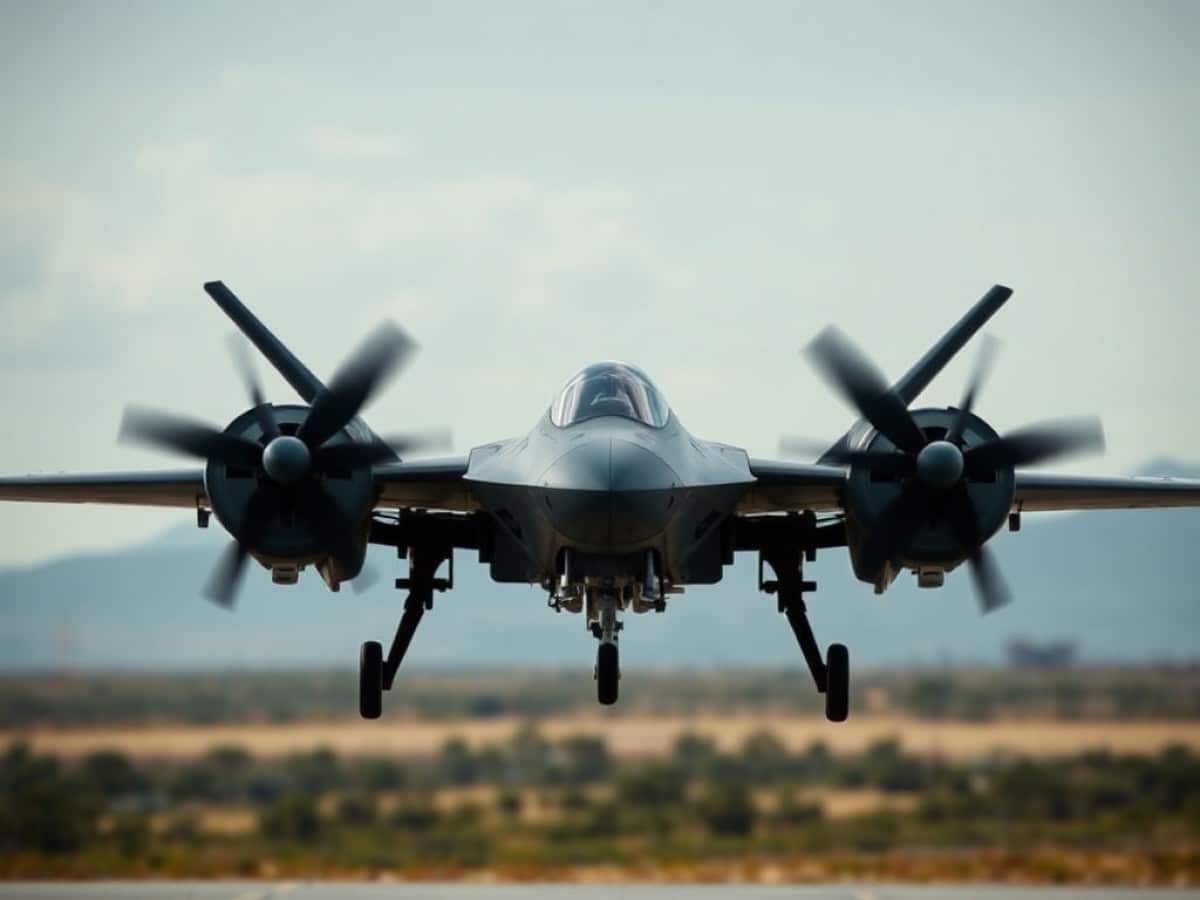
Recently, airmen from the U.S. Air Force successfully conducted multiple flights with a semi-autonomous jet-powered combat drone, advancing the capabilities of the Collaborative Combat Aircraft (CCA) initiative.
At Edwards Air Force Base in California, the Air Force’s Experimental Operations Unit engaged in hands-on trials with the YFQ-44A, a drone developed by Anduril, as part of an initiative to implement the principles of the new Warfighting Acquisition System, according to an Air Force announcement last Thursday.
Previously, the Air Force’s approach involved drones piloted entirely by humans. Now, according to Jason Levin, Anduril’s senior vice president of engineering for air dominance and strike in an October 2025 statement, “the aircraft is flown without any direct manual control by an operator.”
Mark Shushnar, vice president of autonomous airpower at Anduril, revealed in a social media post last Thursday that the experimental unit’s recent tests involved launching, recovering, and cycling the aircraft for multiple flights, managing all aspects from pre-flight preparations to post-flight maintenance, including weapon loading and unloading.
According to Shushnar, the operations team utilized ruggedized laptops to upload flight plans, control the drone’s taxi and takeoff autonomously, handle in-flight tasks, and manage data after the flight, eliminating the need for a traditional large base setup.
Shushnar also noted that the YFQ-44A drone is designed for easy maintenance with minimal personnel. A small team of EOU maintainers, after only a few days of training, managed to prepare the aircraft for repeated sorties efficiently.
This exercise represents a shift towards “operator-driven experimentation” to expedite the development of new capabilities, as highlighted by the recent Air Force release.
Col. Timothy Helfrich, the acquisition executive for fighters and advanced aircraft, emphasized the benefits of integrating operators from the EOU with acquisition professionals, creating a dynamic feedback loop that balances operational and acquisition risks in real-time.
The entire operation was carried out by EOU airmen in collaboration with the Air Force Material Command’s 412th Test Wing, perfecting procedures for deploying and sustaining the CCA under the Warfighting Acquisition System in challenging environments, according to the announcement.
The announcement further stated that the primary goal of the EOU is to centralize operators in the development process, ensuring that the CCA system is practical for future conflicts by incorporating the insights and needs of warfighters from the outset.
In April 2024, the Air Force announced that Anduril and General Atomics were chosen to design and produce the first batch of drone wingmen. Anduril commenced flight tests in October 2025 and declared the production of the YFQ-44A Fury CCA in March 2026.
General Atomics started their ground testing in May 2025.
Although it remains unclear how many YFQ-44As have been ordered by the Air Force, it is known that the service aims to deploy at least 1,000 CCAs for various missions, including strike operations and flying in formation with manned aircraft such as the F-22, F-35, and F-47 fighter jets.
Despite the development of aircraft by both Anduril and General Atomics, the Air Force may decide to proceed with production from only one of these companies. A decision is expected later this year.
Similar Posts:
- Air Force Initiates Ground Tests on Anduril’s Advanced Combat Drone
- Air Force’s Drone Wingmen Take Flight: Groundbreaking Tests Begin!
- US Air Force Considers Northrop Grumman’s Autonomous Drone: A Leap for CCA Program!
- Revolutionary Development: US Air Force to Establish Dedicated Drone Wingman Squadrons
- F-22 Raptor Teams Up With Avenger Drone: A Pioneering Combat Flight Test!

Jamal Peterson reports on defense, aerospace, and tech policy. With a military background and a strategic mind, he dissects complex subjects with clarity, offering readers sharp, reliable insights.