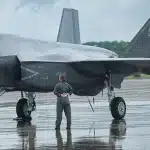
In a recent flight demonstration on October 21, the operator of a Lockheed Martin F-22 Raptor stealth fighter effectively controlled an MQ-20 Avenger unmanned aircraft, showcasing advanced cooperation between human pilots and drones, as reported by the drone’s manufacturer, General Atomics.
A spokesperson for the U.S. Air Force Air Combat Command, speaking to Defense News, explained that the trial was an industry-led proof-of-concept showcasing both manned and unmanned aircraft teaming operations. “The integration of unmanned and manned systems significantly broadens the operational capabilities for controlling air space,” the spokesperson noted.
The MQ-20 is engineered for stealth and is capable of carrying both weapons and smaller drones within its internal compartments. It features advanced engine technologies that minimize radar and infrared detection, allowing it to breach hostile air defenses and deliver up to 3,000 pounds of precision-guided munitions, according to its manufacturer.
C. Mark Brinkley, a spokesperson for General Atomics, told Defense News, “General Atomics is uniquely positioned as we have operational uncrewed jets that serve as testbeds for these kinds of experiments.”
“Equipped with sophisticated mission autonomy software, the MQ-20 Avenger acts as an excellent surrogate for collaborative combat aircraft, allowing us to pioneer and lead in this field,” Brinkley added, referring to the aircraft by its acronym CCA.
The flight test was a collaborative effort led by Lockheed Martin Skunk Works, in partnership with General Atomics and L3Harris, showcasing not only the aircraft’s capabilities but also the versatility and adaptability of Lockheed’s pilot-vehicle interface technology.
OJ Sanchez, vice president and general manager at Lockheed Martin Skunk Works, stated to Defense News, “This initiative showcases our broad and unique expertise in advancing the future of air combat, where pilots in single-seat jets can command drones through simple, intuitive cockpit interfaces.”
The MQ-20 is designed to augment the stealth capabilities of the F-22 Raptor, which is a highly secretive, supersonic multirole stealth fighter described by the U.S. Air Force as unparalleled by any existing or projected fighter aircraft.
“We are eager to advance the capabilities of F-22 teaming ahead of the official deployment of CCA fleets,” Brinkley mentioned. “The F-22 is expected to play a pivotal role in manned-unmanned teaming operations, and we are positioned to initiate this now,” he continued.
Throughout the test, the F-22 pilot operated the Avenger drone using a tablet interfaced with innovative platforms provided by L3Harris, which included two L3Harris Software‑Defined Radios and the BANSHEE Advanced Tactical Datalinks.
The BANSHEE system is engineered for controlling multiple drones in swarm operations and can also be used for managing cruise missiles.
Brinkley concluded, “We’ve been investing in uncrewed jets for 17 years. This test is just another milestone in our long commitment to forward-looking aerospace innovations.”
Similar Posts:
- Navy’s Massive Drone Deal: Top Five Defense Contractors Secure Lucrative Contracts!
- Boeing’s MQ-28 Ghost Bat Debuts: See the Future of Drones at Farnborough Airshow!
- Air Force’s Drone Wingmen Take Flight: Groundbreaking Tests Begin!
- Air Force Initiates Ground Tests on Anduril’s Advanced Combat Drone
- Lockheed’s New Lamprey Drone: Clings to Ships Underwater, Revolutionizes Surveillance

Jamal Peterson reports on defense, aerospace, and tech policy. With a military background and a strategic mind, he dissects complex subjects with clarity, offering readers sharp, reliable insights.