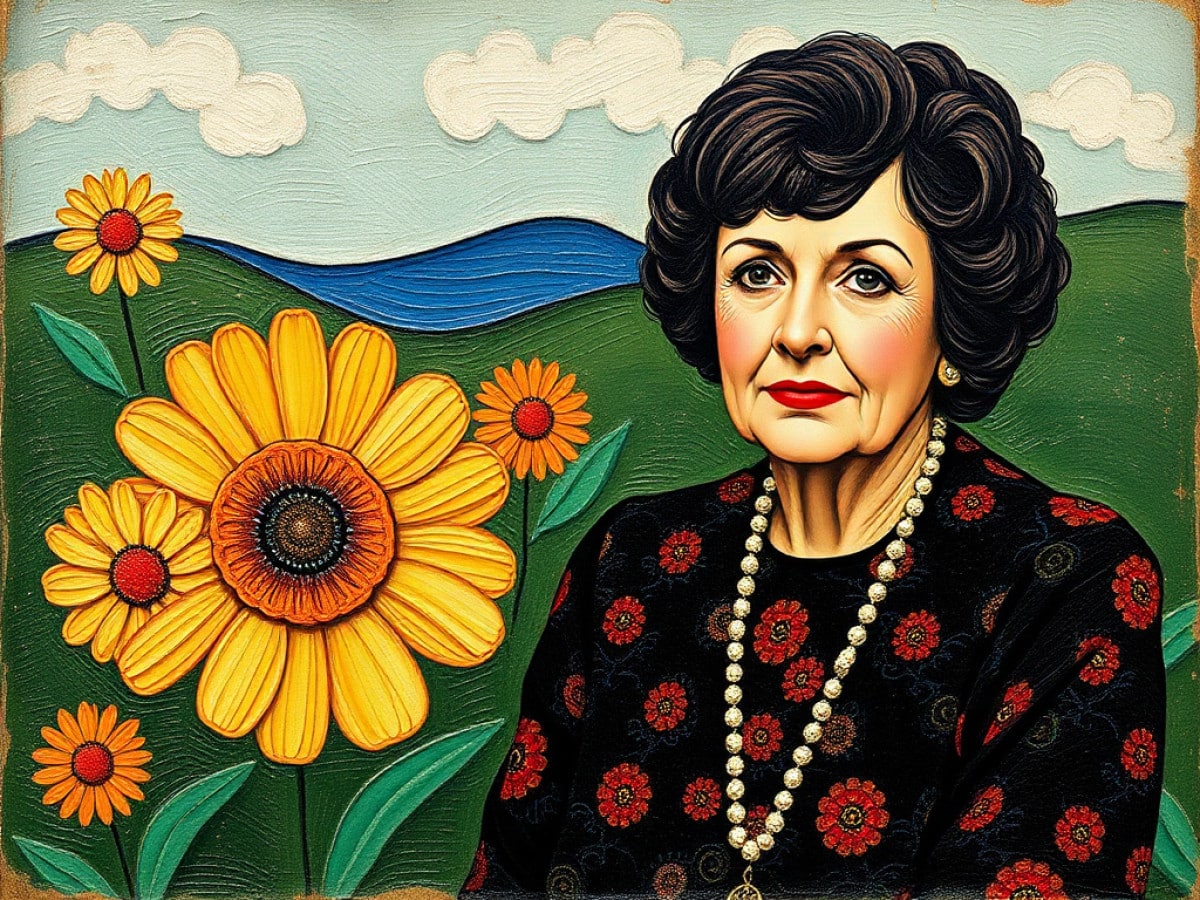
Throughout her life, the art of Beryl Cook was often trivialized by critics, viewed merely as playful or overly simplistic.
However, a significant retrospective of Cook’s art in Plymouth, the city she called home, aims to reframe her as a noteworthy artist who adeptly recorded an era of dramatic social shifts.
Reevaluating Beryl Cook’s Contributions
“This exhibition marks a pivotal moment for Beryl Cook,” explained Terah Walkup, curator at the Box, where the exhibition ‘Pride and Joy’ is being set up. “The entire venue is bursting with life and color.”
As a tribute to one of Cook’s favorite patterns, Walkup and many other staff members were seen wearing leopard print while preparing the exhibit.
“Beryl Cook didn’t just create caricatures,” Walkup noted. “She portrayed communities and identities that were often sidelined, doing so with warmth, skill, and sincerity. Her pieces from the 1970s through the 2000s celebrate themes like working-class joy, body positivity, and queer culture.”
Timely Exhibition and Cultural Recognition
This exhibit is particularly timely as 2026 marks the 100th anniversary of Cook’s birth and it is also fifty years since a feature in the Sunday Times catapulted her into the spotlight following her initial gallery showing in Plymouth.
The event also aligns with Plymouth’s bid to be named the UK city of culture, a city more commonly associated with its maritime history than its artistic scene.
Having moved to Plymouth in 1968, Cook was inspired by the city for four decades until her death in 2008 at the age of 81. The local pubs, streets, and the lido often featured in her vibrant works.
The ‘Pride and Joy’ exhibition showcases over 80 of Cook’s paintings, along with seldom-seen sculptures, textiles, and items from her personal archive including photographs, sketches, and letters.
Themes of Identity and Representation
One section of the exhibition focuses on identity and representation, emphasizing how Cook painted individuals often marginalized due to their gender, class, sexuality, or body type.
A particularly striking 1972 painting titled ‘Bar Girls’ depicts two women enjoying pints of beer together—a provocative scene at a time when some pubs still refused to serve unaccompanied women. “These women are fully enjoying their pints and each other’s company, not as a joke but as a celebration of their presence in that space,” said Walkup.
“She celebrated her subjects without mockery, painting people who occupied spaces boldly and unapologetically. There’s something deeply important and joyfully radical about this approach,” she added.
Exploring Cook’s Process and Influences
Another section reveals Cook’s diligent process, where she drew inspiration from various media sources including local news and newspapers.
The ‘influences and impact’ section shows how Cook’s style was influenced by diverse sources, from cheeky seaside postcards to the works of renowned artists like Amedeo Modigliani and Pieter Bruegel the Elder.
Deputy leader of Plymouth city council, Jemima Laing, praised Cook for putting Plymouth on the cultural map. “She painted our sailors, shoppers, pubs, and people for over 40 years with genuine warmth and humor. While critics may have overlooked her, the public adored her, and now she’s receiving the critical acclaim she truly deserves,” Laing said.
Laing also mentioned that larger-than-life sculptures of some of Cook’s characters would be displayed around the city as a tribute from Plymouth to an artist who consistently celebrated its people.
Julian Spalding, a writer and former museum director, expressed his pleasure over the recognition of Cook. “She represents one of the highlights of British painting, akin to a modern-day William Hogarth or Thomas Rowlandson,” he commented.
“When I once asked her if she ever wanted to paint something upsetting, she replied, ‘No. If I thought it would make a difference, maybe. But I don’t.’ It was joy that fueled her creations,” he added.
-
Beryl Cook: Pride and Joy opens at the Box in Plymouth on Saturday, 24 January 2026 and will continue until 31 May.
Similar Posts:
- Revolutionary Beauty: Discover the Bold Art of Anna Ancher in This Stunning Review!
- Iconic LS Lowry’s “Going to the Mill” Fetches Stunning Price at Auction
- Live Beyond 100: Discover Secrets from a Show Featuring Rotten Fruit and Robots!
- Exploring the Abyss with Emin: A Homoerotic Saint and Bold Political Art – This Week’s Highlights
- Exmoor’s Celebrated Nature Writer Hope Bourne: New Exhibition Honors Her Legacy

Fatima Clarke is a seasoned health reporter who bridges medical science with human stories. She writes with compassion, precision, and a drive to inform.