
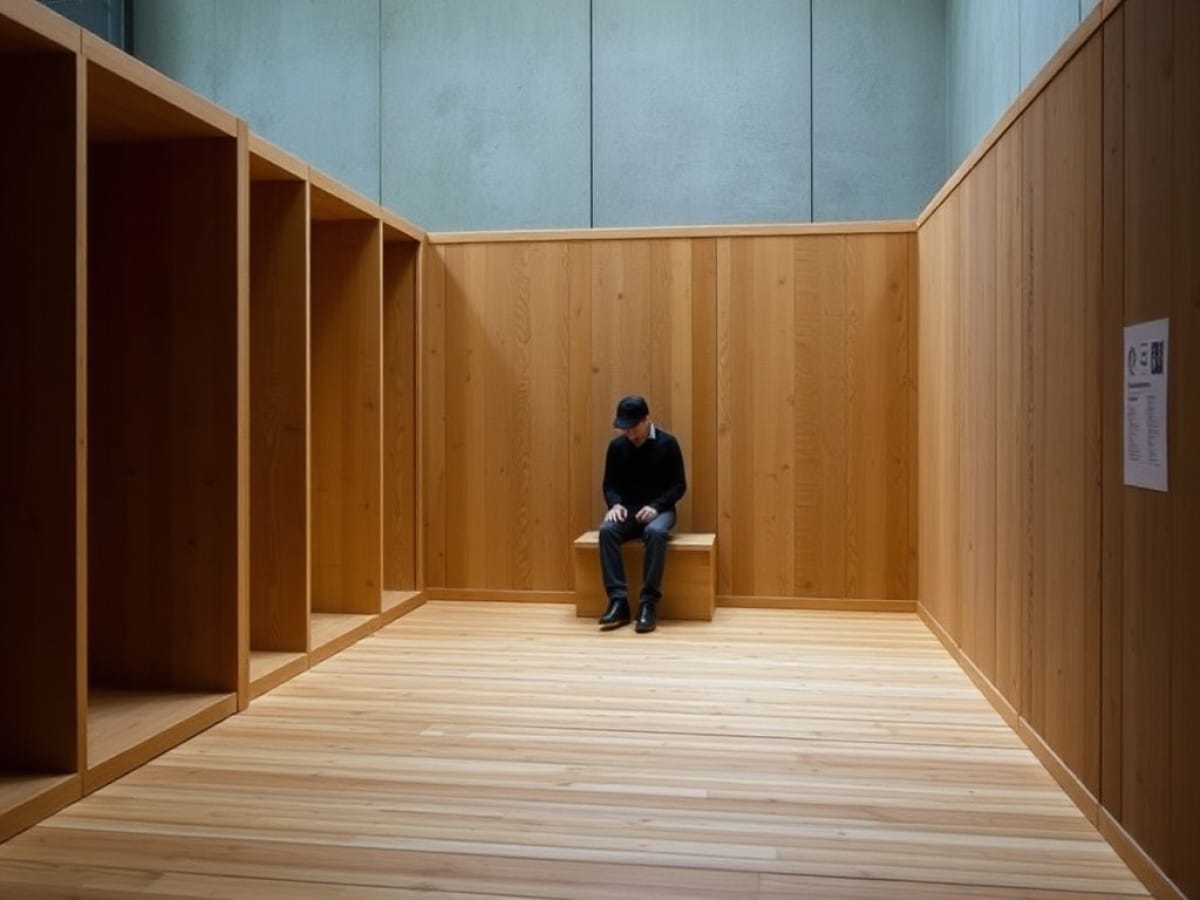
From 30 September 1978, for a full year, Tehching Hsieh confined himself to a small wooden enclosure measuring 11ft 6in by 9ft. During this period, he abstained from talking, reading, or engaging with any form of media. A friend would visit daily to provide him with food and manage waste disposal.
It’s essential to note that Hsieh chose this confinement voluntarily. As a Taiwanese-American artist, he specializes in performance art, often involving extended periods of endurance-based ‘actions.’ Renowned artist Marina Abramović has even referred to him as a “master” of this art form. Following the completion of his Cage Piece in 1978, Hsieh embarked on another year-long endeavor in 1980 called the Time Clock Piece, where he punched a time clock every hour, every day, for a year.
Whenever I discuss his art with others, reactions range from awe to disbelief. Why would someone willingly undergo such rigorous discipline and repetition for such an extended time? “The art I create reflects my understanding of the world,” Hsieh explains. “It’s my way of marking time’s passage, which is essentially what life is about. It’s a universal experience that levels us all, regardless of our daily activities or societal status. We are all just passing time.” Hsieh shares these thoughts while seated at Dia Beacon, a museum part of the Dia Art Foundation in upstate New York, just days before the opening of his major retrospective, Lifeworks: 1978-1999.
Born in 1950 as one of 15 children in Nanzhou, Taiwan, Hsieh never completed his formal education. During mandatory military service in the early 1970s, he began exploring painting but quickly developed a fascination with performance art. His inaugural performance, Jump, was executed in 1973 and saw him leap from a second-floor window, resulting in broken ankles. Facing the conservative landscape of Taiwan at the time, Hsieh was drawn to the United States as a place to expand his artistic practices. In 1974, after securing a job cleaning on an oil tanker, he disembarked in Philadelphia and made his way to New York.
As an undocumented immigrant with limited English proficiency, Hsieh found work in cleaning and kitchen staff roles. He felt somewhat isolated due to his status, yet he doesn’t believe this significantly influenced his shift towards performance art. “My influences were more literary and philosophical—Kafka, Dostoevsky, existentialism. However, lacking a passport or social security number in the U.S., I was ineligible for grants and had to fund my art independently. Despite these challenges, I continued creating. Initially, I thought I needed to seek out ideas, but I soon discovered that I could express deep concepts using my own body, even though I don’t consider my work autobiographical.”
Opting for painting would have been a simpler choice, but Hsieh was captivated by the realm of conceptual art, prompting him to strategize performances based on carefully crafted concepts and rules. Each of his initial five projects spanned one year, reflecting the concept of life cycles—each year representing a complete orbit around the sun. While the term “durational” is commonly associated with his type of art, Hsieh prefers to emphasize that duration can be as brief as six minutes. “The year as a unit is a universally recognized measure,” he notes.
Perhaps his most challenging project was the One-Year Performance of 1981-1982, which involved living outdoors for an entire year without entering any building, vehicle, or shelter. On one occasion, while being filmed by a friend, he was arrested for vagrancy. In the video, NYPD officers can be seen as he resists, exclaiming, “I cannot go inside!” That winter proved to be New York’s coldest in a century. A video montage at Dia Beacon captures the harsh reality of his experience: washing in the Hudson River, sleeping in parking lots, and trudging through deep snow. One of the gallery walls displays a series of maps of downtown Manhattan, marking his routes, the changing temperatures, and places where he stopped to rest.
In person, Hsieh is compact and impeccably dressed. He exudes a quiet modesty, downplaying the rigor and dedication required for his year-long projects. He’s also ambivalent about the accolades from the art world. “This was my unique way of making art. I relished the intellectual freedom it provided. I never aspired for wealth or fame, nor did I see myself in competition with anyone else.”
Hsieh occasionally uses his phone to look up translations for words he
Similar Posts:
- Exploring the Abyss with Emin: A Homoerotic Saint and Bold Political Art – This Week’s Highlights
- Mother Vera Review: A Cinematic Triumph That Redefines Drama!
- Puerto Rico Emergency Expanded: Officials Respond to Persistent Heavy Rainfall
- Renowned Artist Freda Hayes Passes Away at 78: A Look Back at Her Influential Career
- Barbara Hepworth’s Iconic Sculpture Saved! A Masterpiece Preserved for the Nation

Fatima Clarke is a seasoned health reporter who bridges medical science with human stories. She writes with compassion, precision, and a drive to inform.


