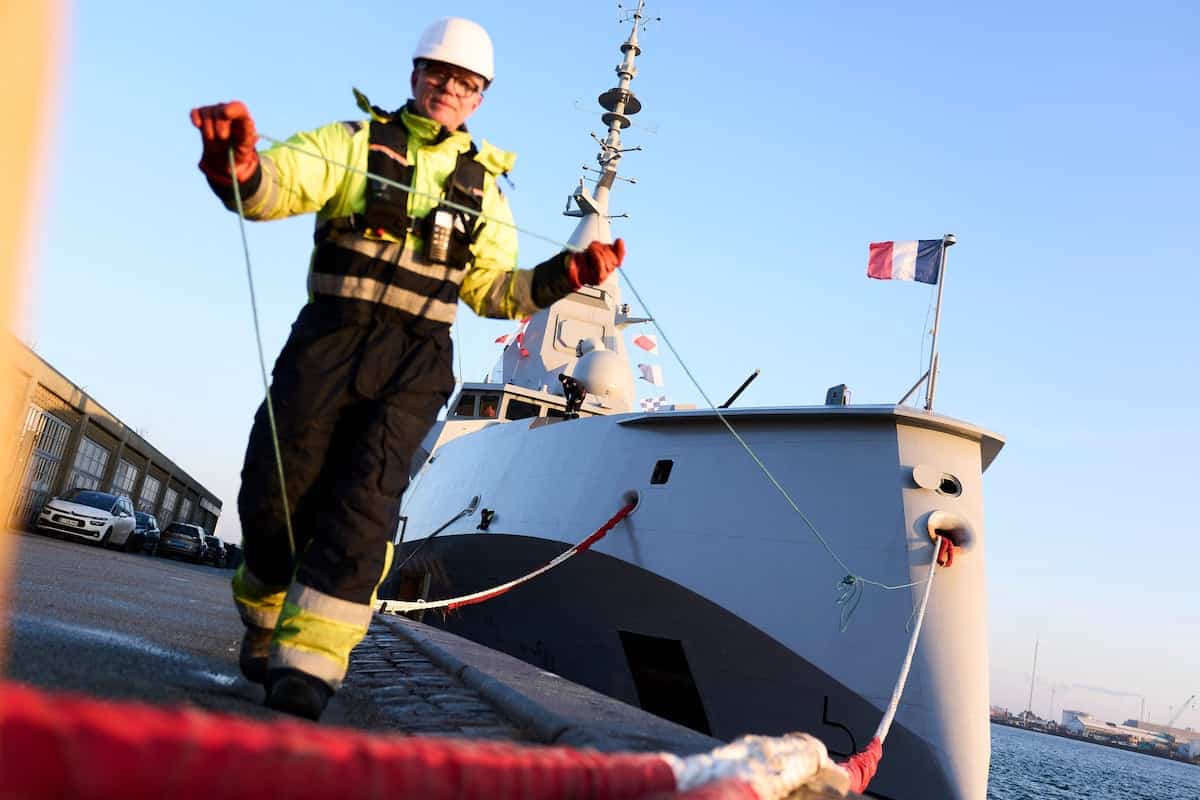
PARIS — The French Navy has confirmed an order for a fifth Defense and Intervention Frigate (FDI), featuring a distinctive inverted bow, from the Naval Group. This vessel is the last of its kind presently planned for construction for the navy.
The contract for the fifth frigate was finalized in late March, with delivery scheduled for 2032, according to an announcement by the French Armed Forces Ministry. This follows the order of the fourth ship in December, with both ships set to be constructed at the Naval Group’s facilities in Lorient, located in the western region of France.
Naval Group’s CEO, Pierre Éric Pommellet, expressed gratitude for the renewed trust from the Ministry of the Armed Forces. He emphasized the company’s commitment to equipping the French Navy with superior naval capabilities to uphold France’s sovereignty.
Upon completion, the last FDI will round out France’s ambition to maintain a fleet of 15 top-tier frigates—a number determined by fiscal limitations. Admiral Nicolas Vaujour, the French Navy commander, has previously stated that ideally, 18 frigates would be necessary for an effective naval force. Despite this, proposals from some members of parliament have suggested expanding the series to include up to eight ships.
Originally budgeted at €4.28 billion ($4.9 billion) in 2019, the program for the five frigates has been delayed, pushing the delivery of the fifth ship to three years beyond its initially planned date of 2029. Challenges such as industrial issues with the first unit, the impact of the Covid-19 pandemic, delays in weapon integration, and the need to rearrange production schedules to accommodate an order from Greece have contributed to these delays.
The inaugural ship of this class, named Amiral Ronarc’h, was launched in October and has been actively deployed. In February, it joined the naval formation around the aircraft carrier Charles de Gaulle in the North Atlantic to conduct operational testing of its radar systems, electronic warfare capabilities, and overall combat systems.
The performance of the FDI in challenging maritime conditions has been noteworthy, with the crew of the Amiral Ronarc’h testing the ship’s performance in Atlantic waters characterized by Sea State 6—defined by the World Meteorological Organization as “very rough” with wave heights between four and six meters.
The FDI, measuring 122 meters in length and displacing about 4,500 tons, is somewhat smaller than other new-generation frigates being developed in countries like the U.K., Spain, Italy, and Germany. Designed for high-intensity warfare, it is equipped with Exocet anti-ship missiles, Aster air-defense missiles, MU90 torpedoes, and a 76 mm cannon. It also features the Thales Sea Fire radar, which comprises four fixed panels.
Naval Group is currently vying for a Swedish contract to build four frigates, with a decision anticipated in the near future. France has highlighted its capability to deliver a fully armed and operational frigate by 2030, which aligns with the Swedish government’s timeline for initial deliveries. In October, Naval Group noted that its yard could produce two FDI frigates annually.
In contrast, in August of the previous year, Norway opted for the United Kingdom’s Type 26 frigate, constructed primarily by BAE Systems, over the smaller French design.
Additionally, Greece recently exercised an option for a fourth FDI frigate, adding to its initial order of three ships. In March, Greece dispatched its first frigate of this class, the Kimon, to Cyprus.
The first two French ships in the series will be fitted with 16 vertical launch cells due to prior budget decisions; however, ships three through five will feature 32 cells, mirroring the Greek configuration. Plans are also in place to upgrade the first two frigates to double their launch cell capacity at a later date.
The frigates are described by France as fully digital, equipped with substantial computing power to process data collected by onboard sensors, and supported by a redundant data center.
Similar Posts:
- Sweden Opts for France’s FDI Frigates: Potential Mega-Deal Worth $4.2 Billion
- Sweden’s Frigate Decision Looms: France Eyes 2030 for Naval Upgrade
- Germany Ditches F126 Frigate for MEKO Warships: Cost Overruns and Contractor Issues Force Shift
- US Navy Cancels Constellation Frigate Program: Two Half-Built Ships Scrapped!
- German Navy Eyes TKMS Frigates: A Plan B for the F126 Warship Woes

Jamal Peterson reports on defense, aerospace, and tech policy. With a military background and a strategic mind, he dissects complex subjects with clarity, offering readers sharp, reliable insights.