The Transformation of Bogotá’s Central Cemetery
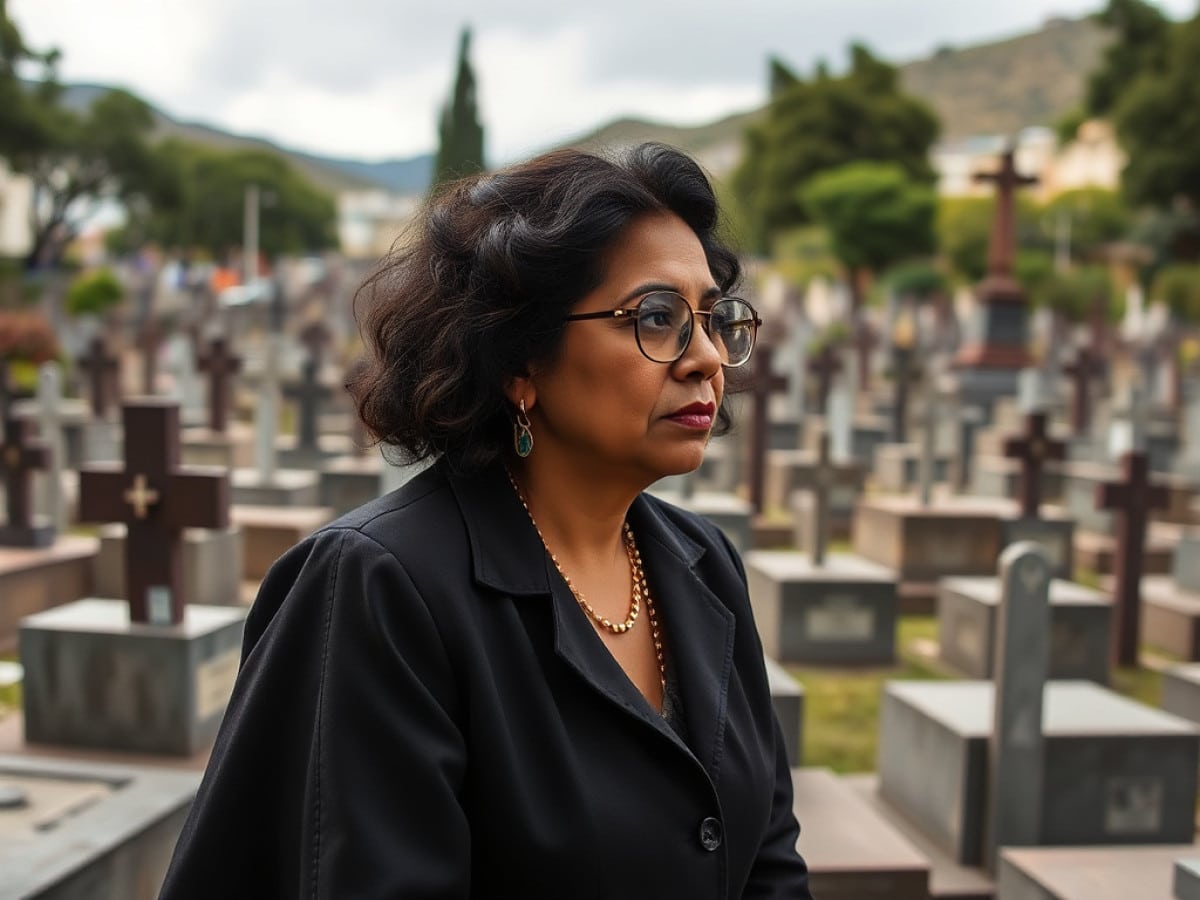
Located in the heart of Bogotá’s Central Cemetery is a columbarium, constructed in 1943, originally intended to serve as the final resting place for the indigent and unidentified. This site, once forgotten and deteriorating, was revitalized in 2009 by Beatriz González, a prominent Colombian artist who passed away at the age of 93. González adorned each of the 8,957 gravestones with silkscreen prints, featuring one of eight distinct silhouetted designs depicting two figures carrying a corpse. Her work, titled “Auras Anónimas” (Anonymous Auras), stands as a somber tribute to the countless unnamed individuals who fell victim to Colombia’s prolonged periods of political unrest and narcotic conflicts.
Beatriz González: A Career in Art
For over six decades, González’s art, which includes prints and paintings, explored themes of power and societal conflicts. She often utilized images from various media sources such as illustrated encyclopedias, postcards, sensationalist newspapers, religious calendars, and pamphlets. Her early works, which depicted everyday and tragic events, include a notable series from 1965 titled “Los Suicidas del Sisga.” This series of three paintings, inspired by newspaper images of a suicidal couple, portrays the lovers in vibrant, flat colors, with the man wearing a hat and the woman a headscarf, sharing a bouquet of flowers.
In an interview with Tate in 2015, González expressed her fascination with the “plain quality of the printed image and the simplification of facial features, which appeared almost distorted.” Her artistic inspiration also came from unconventional sources such as naively painted scenes on buses, popular stamps, and stickers available at the Pasaje Rivas. Over time, González shifted her focus towards historical painting, not out of an interest in the original masterpieces—which she rarely saw in person—but rather in what she described as “third world reinterpretations of universal images,” commonly replicated in inexpensive prints.
Artistic Innovations and International Exhibitions
By 1970, González began painting on second-hand furniture sourced from junk markets in Bogotá, commenting on taste and the western culture obsession prevalent among her middle-class peers. Her works from this period include a vivid reimagining of the Mona Lisa on a mirror stand, and a rendition of Filippo Lippi’s 15th-century Madonna and Child on a dresser. In 1978, representing Colombia at the Venice Biennale, she showcased a kitschy reinterpretation of Édouard Manet’s 1863 “Le Déjeuner sur l’Herbe,” painted on a large curtain, titled “Telón de la Móvil y Cambiante Naturaleza” (Backdrop of a Moving and Changing Nature). This marked the beginning of her experiments with paintings on folded fabric.
González’s work took a distinctly political turn in the 1980s, particularly after the 1985 M-19 guerrilla siege on the Palace of Justice in Bogotá, a harrowing event that left nearly a hundred people dead. This incident inspired her 1987 work “Señor Presidente, Qué Honor Estar Con Usted en Este Momento Histórico,” a series of paintings based on a press photograph of the then-president Belisario Betancur, which in one version replaces ceremonial flowers with a charred body. González remarked that this event “lifted a veil,” profoundly transforming her approach to art.
Personal Life and Legacy
Born on November 16, 1932, in Bucaramanga, Colombia, Beatriz González was the daughter of Clementina Aranda Mantilla and Valentín González Rangel, a local liberal politician. After initially studying architecture at the Universidad Nacional de Colombia in Bogotá, she traveled to Europe, returning to her hometown in 1955 to work as a window dresser. She later resumed her education in art at the Universidad de los Andes in Bogotá, completing her degree in 1962. González quickly found success, holding her first solo exhibition in 1964, and continued to be active in the art world both as an artist and curator.
From 1989 to 2004, she served as the chief curator at the Museo Nacional de Colombia and participated in numerous international exhibitions. Her work has been celebrated in retrospectives around the world, including at the KW Institute in Berlin, the Reina Sofía in Madrid, and the Pérez Art Museum in Miami. González’s influence and contributions to the art world were further recognized in an upcoming retrospective at the Barbican Art Gallery in London.
Beatriz González, a trailblazer in Colombian art, passed away on January 9, 2026. She leaves behind a son, Daniel, and two grandchildren, Antonio and Valentina. Her work continues to inspire and provoke thought about the complexities of Colombian society and the broader human condition.
Similar Posts:
- Frank Bowling’s Quest for the Sublime: Stunning Review at Fitzwilliam Museum, Cambridge!
- Shocking Display of Racial Brutality: ‘African Guernica’ Exhibited Next to Picasso’s Iconic Work
- Colombia Crisis: Indigenous Groups Stand Against Guerrillas Forcing Child Recruitment
- London Art Scene Alert: Exclusive Bob Dylan Painting Exhibition Opens!
- Nan Goldin’s Electrifying Exhibit: Sex, Smoke, and Silence Unveiled!

Fatima Clarke is a seasoned health reporter who bridges medical science with human stories. She writes with compassion, precision, and a drive to inform.