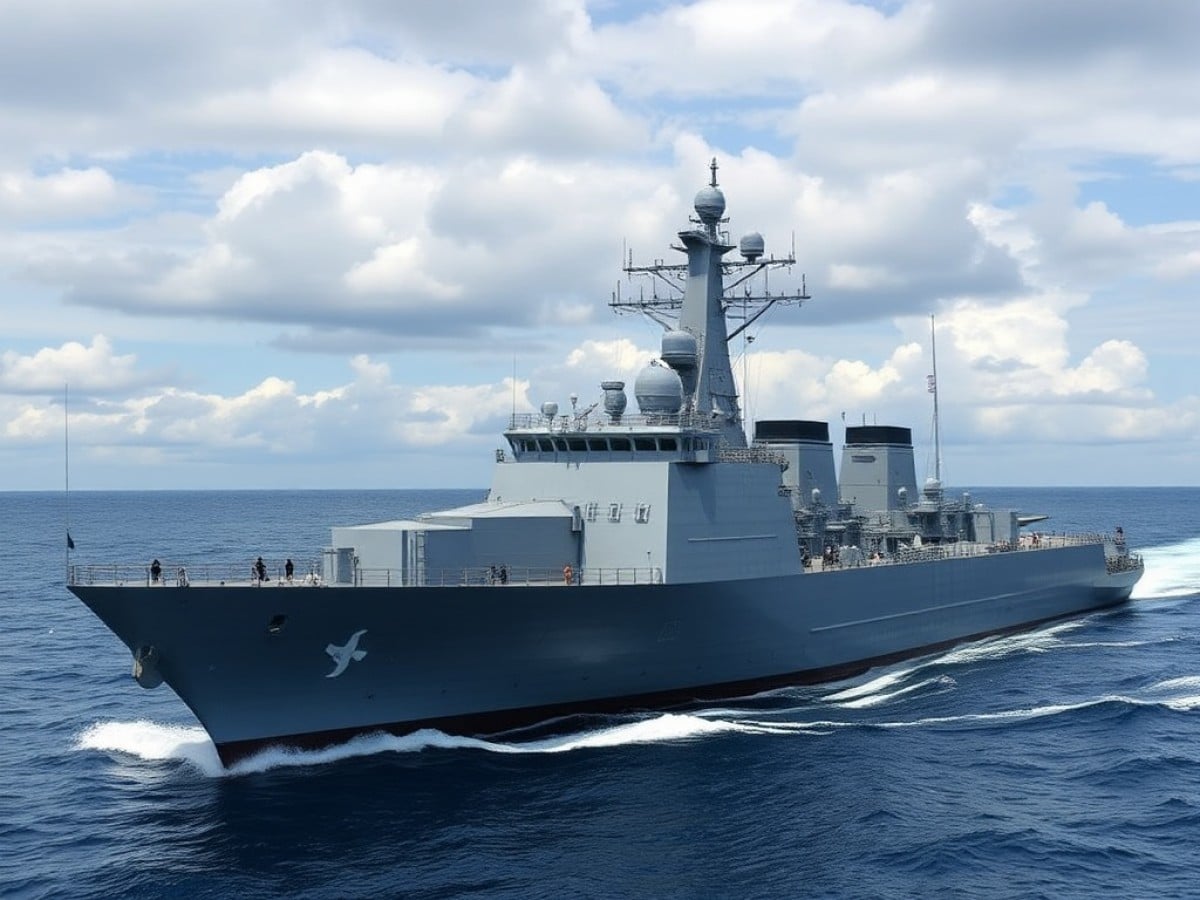
MANILA, Philippines — In response to its dwindling number of surface combat vessels, Australia is taking steps to prevent its naval fleet from shrinking to its smallest size since the Second World War.
As part of Project Sea 3000, Australia has partnered with Japan to purchase three enhanced Mogami-class frigates for the Royal Australian Navy (RAN). This agreement was formalized by the defense ministers of both nations on board the JS Kumano in Melbourne at the beginning of this month.
This deal marks Japan’s most significant defense export to date and represents a substantial uplift for its maritime construction sector, while also promoting deeper strategic cooperation with Australia.
The construction of the three 4,800-ton frigates will be undertaken by Mitsubishi Heavy Industries (MHI) in Japan, with the first vessel expected to be completed by December 2029.
An additional eight frigates are scheduled to be constructed in Western Australia. The total cost of this shipbuilding initiative is projected to reach up to A$20 billion (US$14.4 billion) over the coming decade, which is twice the estimate from two years earlier.
According to Minister for Defence Industry Pat Conroy, “This procurement represents the quickest acquisition for the Royal Australian Navy during peacetime. Our collaboration with Japanese and Australian industrial entities aims to secure what might be the most advanced general-purpose frigate globally.”
In an interview with Defense News, Rear Admiral Stephen Hughes, the RAN’s Head of Naval Capability, stated, “This is a transformative acquisition from a capability standpoint. The Mogami class will elevate us technologically by a whole generation, impacting not just the combat systems but also the operational and crewing strategies of these highly automated vessels.”
Additional contracts have been awarded to Japanese firm NEC for nine types of equipment, including sonars and UNICORN integrated masts, and to Rolls-Royce for MT30 gas turbines.
These new frigates are critically needed as the RAN currently operates only ten surface combatants – three Hobart-class destroyers and seven Anzac-class frigates. The latter will be replaced by the new Mogami-class ships.
Hughes dismissed any suggestions of a decline in naval capabilities, stating, “We are transitioning from a current force with a certain level of capability to a more capable and diverse force. It’s not about the number of ships; it’s about their capability.”
Hughes highlighted that the Mogami-class ships will be significantly larger and more capable than the Anzac class, and will also be able to spend up to 300 days at sea annually.
These vessels will be equipped with a variety of armaments, including ESSM Block 2 surface-to-air missiles in a 32-cell Mk 41 vertical-launch system, deck-mounted Naval Strike Missiles, MK 54 lightweight torpedoes, and a SeaRAM.
Additionally, the frigates will feature advanced Japanese systems and sensors, such as the combat management system, sonar, and UNICORN mast.
Hughes mentioned that the goal is to minimize Australian-specific modifications to avoid delays in delivery.
He added, “We selected the optimal ship that seamlessly integrates with the operational needs of the Australian navy.”
Ultimately, the collaboration between Australia and Japan will result in a combined fleet of 35 Mogami-class frigates.
Similar Posts:
- Australian Submariners’ Close Encounter: Tense Moments with Iran Warships Unveiled!
- Italy’s $4.2 Billion Naval Boost: State Firms to Construct Two Advanced Destroyers
- Navy Set to Launch Construction of Two ‘Trump Class’ Battleships: Find Out More!
- US Navy Cancels Constellation Frigate Program: Two Half-Built Ships Scrapped!
- German Navy Eyes TKMS Frigates: A Plan B for the F126 Warship Woes

Jamal Peterson reports on defense, aerospace, and tech policy. With a military background and a strategic mind, he dissects complex subjects with clarity, offering readers sharp, reliable insights.