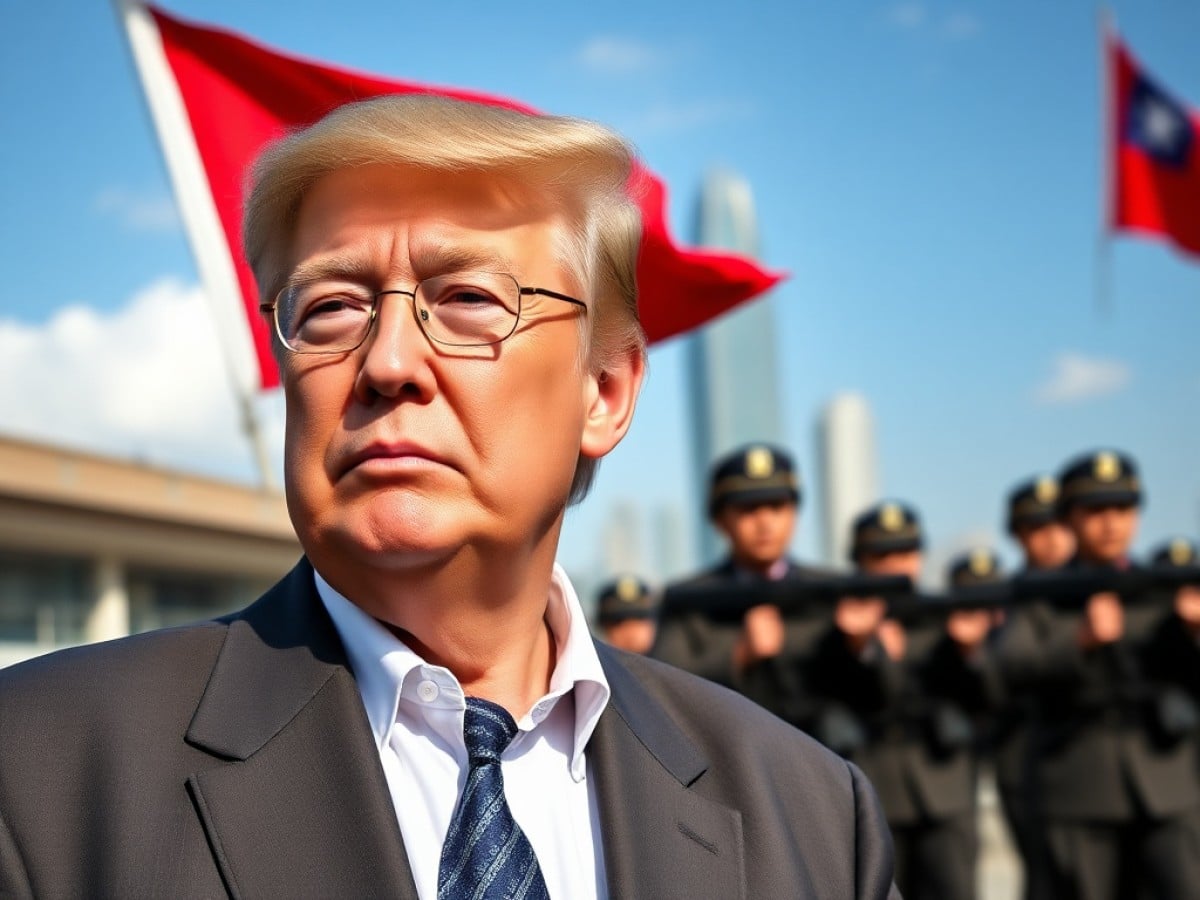
NEW TAIPEI CITY, Taiwan — President Donald Trump of the United States has yet to approve a significant $14 billion arms deal intended for Taiwan, which is seen as a potential adversary to Beijing in military terms. His hesitation followed a meeting in May with Chinese President Xi Jinping, who has expressed strong opposition to U.S. military support for Taiwan.
However, on July 15, the U.S. House of Representatives approved legislation that earmarks $500 million in Foreign Military Financing for Taiwan. This move is part of a broader strategy by U.S. policymakers who view Taiwan and other Pacific Rim nations as crucial counterbalances to the military ambitions of China.
The allocation of half a billion dollars in the fiscal year 2027 appropriations bill doesn’t specify funding for any particular weaponry, but analysts interpret it as a clear indication that the Republican-led Congress prioritizes Taiwan’s defense, particularly in the event of a potential attack by China’s significantly larger military forces. This suggests a commitment by Washington to proceed with at least some previously agreed arms sales.
“This $500 million in Foreign Military Financing signifies that Congress continues to support Taiwan’s security robustly following the discussions between Trump and Xi, and it illustrates a legislative intent to maintain military aid to Taiwan without being restricted by ongoing White House negotiations with China,” explained Huang Chung-ting, an associate research fellow at the Institute for National Defense and Security Research in Taipei.
RELATED
Trump’s approval of the appropriations bill would suggest a continued commitment to arms sales to Taiwan, despite the uncertain status of the substantial $14 billion package, according to analysts.
Foreign Military Financing, typically involving grants or loans, is intended for U.S. allies to acquire weapons, military training, or other related services.
“The nature of foreign military financing involves the mechanisms of payment but does not dictate whether the weapons are actually sold or transferred,” stated Sean King, vice president of Park Strategies, a political consultancy in New York.
Trump has not officially cancelled any previously agreed but not yet fulfilled U.S. arms sales to Taiwan, which means that the new congressional funding could be applied towards these existing agreements. U.S. arms sales to Taiwan have a history spanning over four decades, with payment and delivery timelines often extending several years. As of April, there were still 30 types of weapons systems partially undelivered, as per the Taiwan Security Monitor, a research initiative by George Mason University’s Schar School of Policy and Government.
The most recent approval came in December for a $11.1 billion package, which includes M109A7 self-propelled howitzers, the high mobility artillery rocket system (HIMARS), Javelin anti-tank missiles, and unmanned attack aircraft systems. In May, Taiwan’s Cabinet allocated a special budget to fund these purchases.
“In my view, the Trump-Xi meeting led to a political pause rather than a complete cessation of arms sales to Taiwan, specifically targeting new transactions awaiting approval,” added Huang.
“This delay likely involved a combination of Trump’s negotiations with China, a review of available weapons stockpiles, and internal scrutiny within the White House, and cannot be attributed to a single cause,” he observed.
The appropriations bill is still pending review by the U.S. Senate before it can be presented to President Trump for his signature.
China asserts its sovereignty over Taiwan, which governs itself, and has not ruled out the use of force to reclaim the island if necessary. In recent years, China’s People’s Liberation Army has stepped up its military drills around Taiwan, especially in the strait that separates the two by 160km (100 miles).
After his meeting with Xi, Trump mentioned that delaying the arms deal served as a “good negotiating chip.” However, in June, the U.S. State Department reaffirmed its longstanding policy that arms sales to Taiwan do not require Beijing’s approval.
Experts believe the White House will only announce the decision on the $14 billion arms package after Trump and Xi’s planned meeting in September in the United States, as stated by Washington officials.
“It appears that Trump is postponing a public declaration until after Xi’s visit to avoid being perceived negatively at the event,” mentioned Doug Barry, a professor at The George Washington University and former communications director with the U.S.-China Business Council.
“The lack of a public announcement is rather unusual,” he added.
Similar Posts:
- Taiwan’s Foreign Minister Reveals: Chinese Pressure on Nations Over Island Now ‘New Normal’
- “America First” Strategy: Fast-Tracking Arms to Taiwan, But Only Theoretically
- Taiwan Arms Show: Vendors Promote Budget-Friendly Weapons for Maximum Impact
- US Delays Arms to Europe Amid Iran Conflict: Inside Sources Reveal
- Trump Proposes $892.6 Billion Defense Budget: Real-Term Reductions Spark Debate!

Jamal Peterson reports on defense, aerospace, and tech policy. With a military background and a strategic mind, he dissects complex subjects with clarity, offering readers sharp, reliable insights.