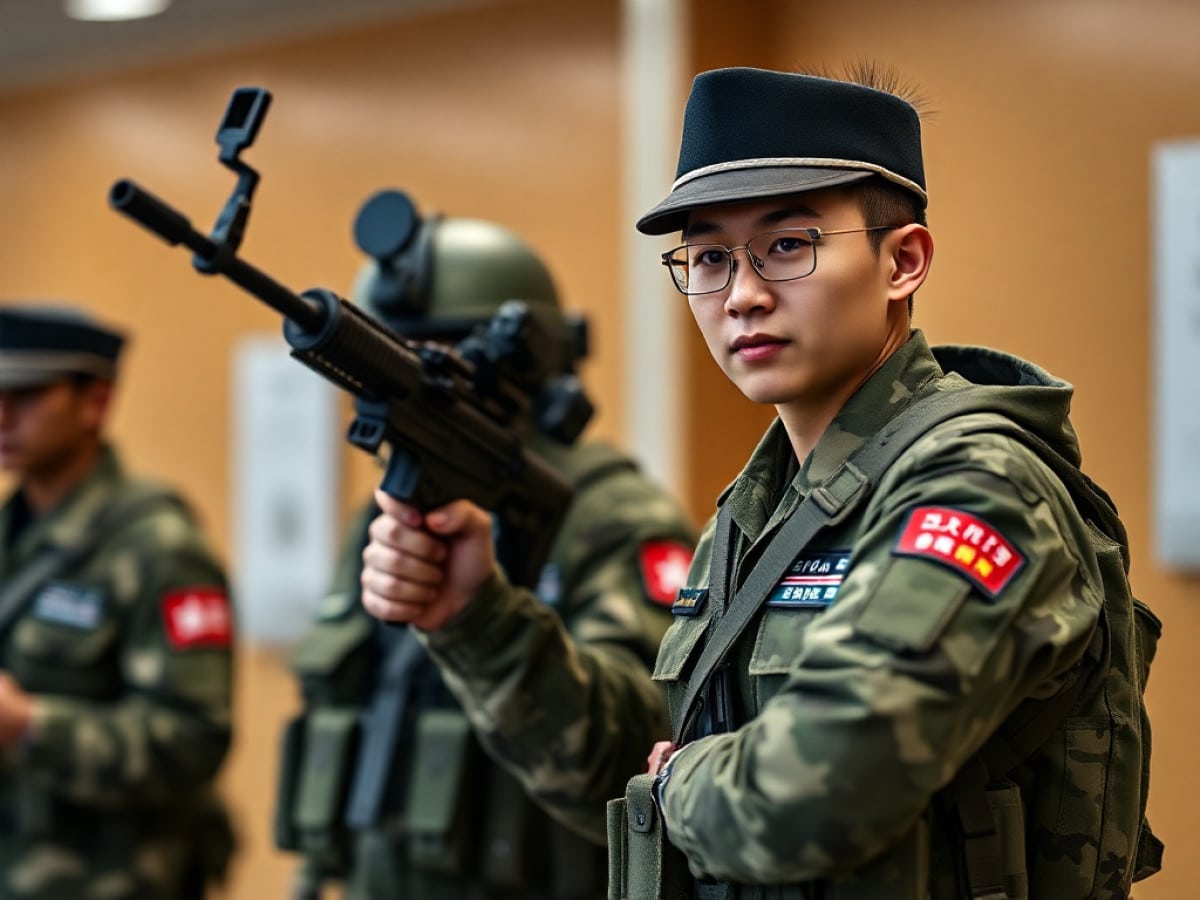
NEW TAIPEI CITY, Taiwan — Defense experts suggest that a new U.S. policy focusing on accelerating arms sales to nations that are proactive in their defense efforts and hold strategic value to the U.S. could enable Taiwan to acquire sophisticated weaponry more swiftly than before.
The policy, which was initiated by President Donald Trump on February 6, is broad and does not specifically mention any country or provide detailed criteria for assessing potential arms recipients. However, analysts believe that Taiwan is likely covered under this policy due to its alignment with the policy’s broader objectives.
Alexander Huang, a professor at a Taiwanese university and chair of the Council of Strategic and Wargaming Studies in Taipei, explained, “The core principle behind the U.S. policy is to prioritize military support for countries that actively contribute to their own defense. Taiwan currently meets this criterion.”
The strategy developed by the White House aims to bolster American arms production through increased sales while ensuring the U.S. has the capacity to support its allies and partners, particularly by promoting greater responsibility sharing.
The policy stipulates avoiding delays in arms distribution that could affect the operational readiness of allies and favors prioritizing countries that have invested in their own defense capabilities, hold a crucial strategic position, or contribute to the U.S. economy.
Experts indicate that Taiwan plays a vital role as an unofficial yet strong ally within the chain of U.S. allies in the Western Pacific, such as Japan and the Philippines, which collectively counter China’s maritime ambitions.
Nathan Attrill, a senior China analyst at the Australian Strategic Policy Institute, noted, “The shift in strategy from a first-come-first-served basis to one based on strategic importance and defense contributions could lead to Taiwan receiving critical systems more quickly and reduce bottlenecks, which is significant from an operational standpoint.”
Denny Roy, a senior fellow at the East-West Center in Hawaii, pointed out the lengthy timelines currently associated with arms deliveries, which often provoke strong reactions from China. Beijing views Taiwan as part of its territory and has not dismissed the use of force to achieve reunification, and it disapproves of U.S. arms support to Taiwan.
“The existing process is slow, complex, and attracts significant attention from the People’s Republic of China, increasing the likelihood of a forceful response driven by nationalistic sentiments,” Roy explained.
In December, Taiwan announced plans to purchase a substantial $11.1 billion U.S. arms package, which includes HIMARS rocket systems, a move that was strongly criticized by Beijing.
However, experts believe that the new U.S. arms sales strategy does not necessarily change the likelihood of U.S. intervention if China were to attack Taiwan. The U.S. has traditionally maintained a policy of strategic ambiguity regarding its potential responses. Meanwhile, China has intensified its naval and air exercises near Taiwan since August 2022.
Chen Yi-fan, an assistant professor in the Diplomacy and International Relations Department at Taiwan’s Tamkang University, mentioned, “The American First Arms Transfer Strategy does not clarify Trump’s approach to strategic ambiguity.”
Chen also suggested that the U.S. government might prioritize other regions or allies over Taiwan, such as Ukraine, Israel, NATO countries, and key Asian allies including Japan, South Korea, and the Philippines.
Attrill added, “If this strategy expedites the delivery of military equipment and enhances Taiwan’s defense capabilities, it could strengthen deterrence by making a rapid Chinese victory less likely. However, any decision to intervene would still rely on presidential judgment and the assessment of escalation risks.”
Roy further commented that the strategy’s emphasis on strengthening the American defense industry might be perceived negatively in Taiwan if it appears that U.S. arms sales are self-serving and exploitative.
In response to inquiries about the new strategy, a spokesperson for Taiwan’s Ministry of National Defense stated in late February that the ministry had not yet reacted publicly to Trump’s policy and declined to comment further. Similarly, the U.S. Department of Defense did not respond to requests for information.
Similar Posts:
- US Congress Funds Taiwan Defense: Is Trump’s Hesitation Over?
- Taiwan’s Foreign Minister Reveals: Chinese Pressure on Nations Over Island Now ‘New Normal’
- Taiwan Arms Show: Vendors Promote Budget-Friendly Weapons for Maximum Impact
- China’s Military Bets Big on AI: Falling Behind US in Arms Race
- Thailand’s Shift to China: How It Strains US Alliance, Tests Treaty Boundaries

Jamal Peterson reports on defense, aerospace, and tech policy. With a military background and a strategic mind, he dissects complex subjects with clarity, offering readers sharp, reliable insights.