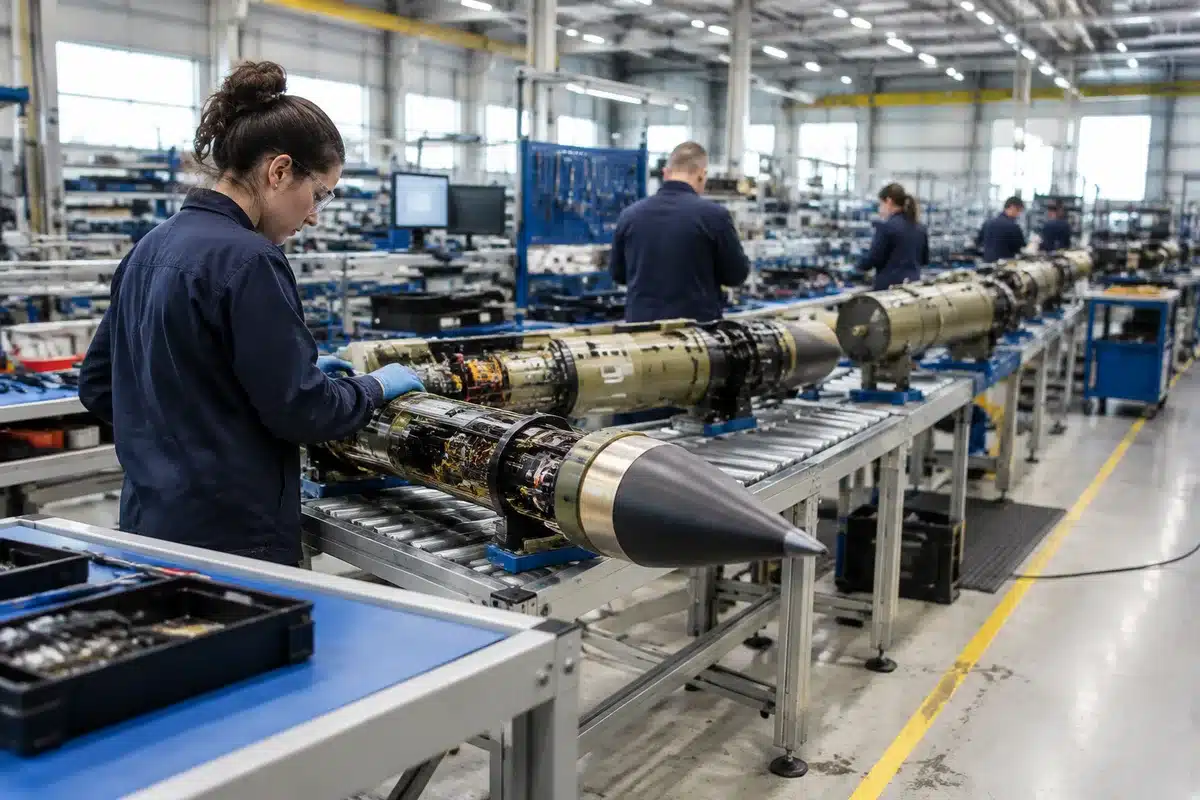
Boeing said Monday that it has finalized a seven-year contract aligned with the Pentagon’s Acquisition Transformation Strategy, formalizing an approximately $14.7 billion “undefinitized” agreement that enables the company to substantially expand production of the Patriot Advanced Capability-3 Missile Segment Enhancement (PAC-3 MSE) seekers—effectively tripling output.
Steve Parker, who leads Boeing Defense, Space & Security, noted in the company release that early investments and an intense focus on quality and program execution have set Boeing up to ramp up seeker deliveries to levels not seen before in the near term. He added that Boeing employees take great pride in the part they play in defending U.S. and allied forces, civilians and critical infrastructure around the globe.
The finalized arrangement builds on a framework agreement that was disclosed in April and schedules production over a seven-year period. That timeline parallels Lockheed Martin’s own effort to accelerate output of the PAC-3 MSE all-up round.
In January, Lockheed announced a parallel seven-year framework intended to push annual PAC-3 interceptor production from roughly 600 units to about 2,000.
Boeing said work on the seeker components began right away after the framework announcement and that assembly and finalization of the seekers will take place at its facility in Huntsville, Alabama.

These PAC-3 seekers are designed to detect and track incoming threats and then guide interceptors to defeat a wide spectrum of targets, including ballistic missiles, hypersonic weapons and hostile aircraft.

When a seeker locks onto a target, the interceptor—using a two-pulse solid rocket motor and built for high agility—maneuvers into position and destroys the threat by direct kinetic impact rather than detonating a warhead.
Monday’s contract announcement arrives amid growing debate within the U.S. defense community about the cost-effectiveness of using expensive interceptors to counter relatively inexpensive munitions, a question that has gained attention over the past eight months following Iranian munitions use during Operation Epic Fury.
The news also comes after a busy stretch for Boeing: last Tuesday the Navy tapped Boeing to develop the F/A-XX sixth-generation carrier fighter under a development deal reported to exceed $20 billion, and the Air Force placed a $2.38 billion order for 22 additional F-15EX Eagle II aircraft on the same day.
Military Times reporter Michael Scanlon contributed to this report.
Similar Posts:
- Boeing Unveils Affordable Radar Seeker: Revolutionary Use of Standard Components
- US Air Force Strikes $2.38B Deal: Boeing to Supply 22 F-15EX Jets!
- $131 Billion Deal Sealed: Boeing to Ramp Up F-15 Production, Modernization
- Lockheed Martin Receives Key Patriot Interceptor Parts: General Motors Delivers First Batch!
- US Secures $22.9 Billion Raytheon Deal: Boosting Tomahawk Missile Production!

Jamal Peterson reports on defense, aerospace, and tech policy. With a military background and a strategic mind, he dissects complex subjects with clarity, offering readers sharp, reliable insights.