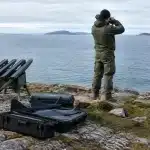
ONBOARD LIFTBOAT ROBERT, North Atlantic (AP) — A remarkable discovery has been made on the Continental Shelf in the waters off the northeastern United States. Hidden beneath the ocean’s floor, scientists have confirmed the existence of a vast reservoir of freshwater, a secret kept by the earth for millenniums. This revelation comes at a critical time as concerns over freshwater scarcity are heightened by the impacts of climate change and rising sea levels.
Expedition 501, a multi-national effort that includes over a dozen countries and cost $25 million, ventured 20 to 30 miles off the shore, drilling into what is believed to be a freshwater aquifer extending from New Jersey to Maine. This underwater freshwater source is among several around the globe that may provide future solutions to the increasing water demands.
Last month, journalists from the Associated Press boarded a supply boat from Fall River, Massachusetts, and traveled seven hours to reach the drilling platform to observe and report on this significant undertaking. Here are some insights gathered from the visit:
Exploring Underground Oceans for Freshwater Solutions
The potential benefits of accessing these undersea freshwater reserves are immense, yet the challenges of extraction and governance are significant. Despite these challenges, the urgency for new freshwater sources is growing rapidly.
According to the United Nations, in just five years, the world’s demand for freshwater will surge, driven in part by the needs of data centers and other technology-driven facilities. In 2018, Cape Town in South Africa nearly exhausted its water supplies during a severe drought, highlighting the critical need for additional sources. South Africa and other regions around the world are believed to also have offshore freshwater reserves, which could help alleviate some of these pressures.
Additional examples include Canada’s Prince Edward Island, Hawaii, and Indonesia, where freshwater stress coexists with potential undersea aquifers.
The Discovery Began Serendipitously
Nearly half a century ago, a U.S. government vessel conducting a survey for minerals and hydrocarbons inadvertently discovered traces of freshwater in multiple boreholes along the East Coast seabed.
This initial finding piqued interest but it wasn’t until 2015 when a groundbreaking study using electromagnetic technology by the Woods Hole Oceanographic Institution and the Lamont-Doherty Earth Observatory mapped the aquifer’s contours and estimated its salinity, revealing a “massive offshore aquifer system.” This discovery set the stage for Expedition 501, funded primarily by the U.S. National Science Foundation and the European Consortium for Ocean Research Drilling.
Continuous Drilling Reveals More than Expected
The drilling operations, conducted from the Liftboat Robert, proceeded around the clock for three months. The vessel, typically used for servicing offshore oil platforms and wind farms, was equipped to lower massive pillars to the seafloor to stabilize above the water. Initially, scientists hoped to confirm the aquifer’s capacity to potentially supply a city like New York for centuries. What they found was an even larger resource.
The first drilling site showed water with a salinity of 4 parts per thousand, which is less than the ocean’s average but still above the U.S. freshwater standard. However, as the operation continued, they found locations with water salinity at or below 1 part per thousand, some even less, indicating potentially drinkable water.
Proceed with Caution
While the prospect of drinkable undersea water is promising, extensive analysis is necessary to ensure its safety and usability. Scientists must determine the water’s origins and age, which will influence whether it can be considered a renewable resource and used sustainably.
___
Reported from Seekonk, Massachusetts, by Woodward.
___
The Associated Press is supported by the Walton Family Foundation for coverage of water and environmental policy. The content is solely the responsibility of the AP. For more environmental coverage by AP, visit
Similar Posts:
- Scientists Discover Hidden Freshwater Reserves Beneath the Ocean: New Hope for a Thirsty World
- Mystery of the Ocean Unraveled: Listen to the Oldest Known Whale Recording!
- Megalodon’s Predecessor: Monstrous Ancient Shark Dominated Australian Waters
- US Energy Secretary Orders Oil Company: Restore Operations Off California Coast Immediately!
- Trump Administration Secures More Offshore Wind Leases: 4 New Energy Projects Announced!

Morgan Ellis is an investigative journalist passionate about environmental policy and corporate accountability. With a background in climate science and years of reporting for nonprofit media, Morgan brings depth, clarity, and purpose to every story.