Maria Reva’s masterfully crafted and original debut novel presents a challenge for any reviewer trying to avoid spoilers. Reluctantly, I must reveal a turning point which is central to the experience of the novel. It features a stunning twist midway that significantly alters the trajectory of the narrative. Initially, the novel seems to follow the path of a traditional story.
At the heart of the plot is Yeva, a solitary figure with an obsession, who travels across the Ukrainian countryside in her modified camper to save endangered snails. Her goal is to encourage them to reproduce, yet she often discovers that they are the last of their species, known as endlings. The term ‘endling’, which I learned from this book, was first used in the 1990s to denote the last surviving individual of a species, marking a poignant end to a biological lineage—a concept as ancient as life itself, exemplified by creatures like the aurochs, dodos, and Tasmanian tigers.
Yeva’s work, rather than fostering new life, has her bearing witness to the extinction of species, turning her into something akin to a palliative care provider for nature. Despite the bleakness of her mission, the narrative injects a surprising amount of humor, particularly in Yeva’s frustrations with the lack of attention given to snails compared to more charismatic animals:
Unlike pandas, those clumsy, attention-grabbing creatures that monopolize conservation efforts, or other beloved large animals like orcas and gorillas, snails do not evoke the same affection. They aren’t like koalas, which despite their cute appearance are aggressive and disease-ridden, nor are they like otters, which despite their plush toy-like exterior, have a darker side in their interactions with other animals.
As Yeva watches species vanish, her own mental stability begins to fray. Financially strained, she supplements her income by working for a dubious company that arranges “romance tours”. Still smelling of her shabby camper, Yeva attends these gatherings, boosting the attendance at events filled with foreign men enticed by exaggerated claims about Ukrainian women: “the secret of the Ukrainian Woman may be genetical. Invasions and wars led to fruity intermixing … Imagine an entire country of beautiful and lonely women! … This is where you, Western Man, enter.”
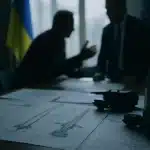
It’s during these tours that Yeva meets two sisters, Nastia and Sol, who, inspired by their activist mother, aim to expose the sexist underpinnings of the marriage industry by planning to kidnap some of the suitors. These events draw in Pasha, a Ukrainian expatriate from Vancouver, who is not just looking for love but is also trying to connect with his artistic roots in his homeland.
For the first 100 pages, the novel moves swiftly, filled with wit and insightful reflections. It begins as a light-hearted caper reminiscent of a film by the Coen brothers, but with a distinct Eastern European flavor and a feminist angle. Suddenly, the narrative is upended by Russia’s full-scale invasion of Ukraine.
The invasion’s impact is so profound it not only disrupts the lives of the characters but also fractures the structure of the novel itself. It’s akin to an abrupt interruption in a play, where an off-stage calamity is announced to the audience.
Acknowledging this disruption, the novel shifts gears dramatically. What seemed to be the conclusion of the story at page 136 is followed by an entirely different version of the narrative. We discover that after her critically acclaimed collection of short stories, Good Citizens Need Not Fear, Reva had started and abandoned a draft of Endling. Discussing her discomfort with her chosen themes with her agent during a time of peace, she later finds herself paralyzed by guilt and a critical inner voice as war rages near her grandfather’s home in Kherson.
Rather than detracting, this narrative interruption intensifies the story’s emotional impact, drawing the reader closer into a more personal and urgent dialogue with the author. In the wake of the invasion, the continuation of the characters’ journey, particularly Yeva’s dilemma over pursuing a potential mate for her lone snail or ensuring the safety of the kidnapped men, reflects a stark choice between life and art in the face of war.
Throughout the latter part of the book, Reva’s increased intrusion into the narrative enriches the connection between the reader and her story, allowing her to share her personal ties to Ukraine and her reflections on the war’s influence on her writing. Although not all elements resonate perfectly—the captured men’s passivity being one—the narrative strongly affirms the value of storytelling in tragic times.
Similar Posts:
- Olympic Mascots Face Climate Threat: Beloved Color-Changing Critters at Risk!
- Patti Smith’s “Bread of Angels” Review: A Wild Ride with the Poet of Punk!
- Ancient Whale Uncovered: Pokémon-Faced Creature with a Predator’s Bite!
- John Irving’s “Queen Esther” Disappoints: A Lackluster Follow-Up to “The Cider House Rules”
- Dream State by Eric Puchner: Dive Into an Epic Journey of Paradise Lost!

Fatima Clarke is a seasoned health reporter who bridges medical science with human stories. She writes with compassion, precision, and a drive to inform.