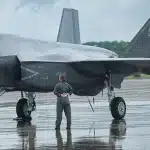
The U.S. Navy has issued contracts for the creation of Collaborative Combat Aircraft (CCA) drones to notable defense firms including Anduril, Lockheed Martin, General Atomics, Boeing, and Northrop Grumman.
These CCAs are unmanned systems intended to be deployed from aircraft carriers to enhance the Navy’s capability in executing airstrikes over water and to support crewed fighter jets also launched from carriers. The project is currently in the initial phase of development.
Information about these contracts was revealed through a presentation from the Naval Air Systems Command’s (NAVAIR) Program Executive Office for Unmanned Aviation and Strike Weapons (PEO U&W), initially reported by Breaking Defense.
A representative for the Navy confirmed the accuracy of the details provided in the presentation to Military Times.
“Our collaboration with the U.S. Navy in conceptualizing designs for their next-generation collaborative combat aircraft leverages our extensive expertise in naval aviation and advanced autonomous systems,” stated Northrop Grumman in a communication with Military Times.
“Our ongoing investments in autonomous technologies are robust. We have developed ‘Beacon,’ an autonomy ecosystem that allows our partners to test and improve their technologies. Moreover, our commitment to optimizing the production of these systems has yielded significant reductions in time, processes, and costs,” the company added.
Anduril also confirmed their contract win in a message on the social platform, X.
“Anduril is honored to be chosen by the U.S. Navy to create designs for carrier-suitable Collaborative Combat Aircraft (CCA). We are dedicated to crafting an aircraft that addresses the unique requirements of the Navy swiftly and on a grand scale,” the company stated.
The Navy describes the CCAs as essential “force multipliers” meant to aid manned fighter aircraft in combat, noting the drones will help reduce risks to human pilots.
“The Navy’s proactive approach to incorporating various types of uncrewed jets, paralleling the Air Force’s CCA initiatives, is a strategic decision that reduces significant risks and capitalizes on the extensive progress and investments already in place,” explained C. Mark Brinkley, spokesperson for General Atomics, to Military Times.
Brinkley further noted that General Atomics presented conceptual designs for future carrier-capable CCAs last year, building upon the YFQ-42A CCA designed for the Air Force, now modified for naval operations.
“With our creation of the EMALS launch system for Ford-class carriers and our extensive experience in carrier-based unmanned aircraft operations with both the U.S. Navy and international partners, adapting our technology for the Navy is a logical progression,” added Brinkley.
Though specific operational details for the drones remain under wraps, they are expected to fulfill a “loyal wingman” role. This follows a recent Air Force test where manned fighters controlled drones in combat maneuvers during training exercises.
According to the presentation, the drones are also designed to be cost-effective and versatile, capable of adapting to various types of military operations.
These contracts are part of a broader initiative by the Pentagon to expand its unmanned systems. On July 10, Secretary of War Pete Hegseth issued a memorandum urging for increased production of military drones and their rapid deployment across all branches of the armed forces.
“Achieving drone dominance is as much about process as it is about technology. The modern battlefield requires an innovative procurement strategy that closely integrates manufacturers with our frontline forces,” Hegseth emphasized in the memorandum.
As the Navy focuses on modernizing its capabilities and addressing its shipbuilding challenges, it continues to prioritize drone technology, with the private sector playing a key role in advancing these efforts.
Earlier this year, HavocAI unveiled a 38-foot unmanned vessel named the Seahound, while Saronic Technologies acquired Gulf Craft, a shipbuilder based in Louisiana, aiming to establish a production hub for autonomous vessels.
Recently, the Navy has also implemented mixed reality technology on an aircraft carrier and guided missile destroyers to enhance maintenance efficiency at sea. Furthermore, it introduced the Modular Attack Surface Craft program, likely to include unmanned surface vessels equipped with missiles.
Similar Posts:
- Air Force’s Drone Wingmen Take Flight: Groundbreaking Tests Begin!
- Revolutionary Development: US Air Force to Establish Dedicated Drone Wingman Squadrons
- US Air Force Considers Northrop Grumman’s Autonomous Drone: A Leap for CCA Program!
- Air Force Initiates Ground Tests on Anduril’s Advanced Combat Drone
- Air Force Boosts F-47 Range for Pacific Dominance: A Strategic Combat Upgrade

Jamal Peterson reports on defense, aerospace, and tech policy. With a military background and a strategic mind, he dissects complex subjects with clarity, offering readers sharp, reliable insights.