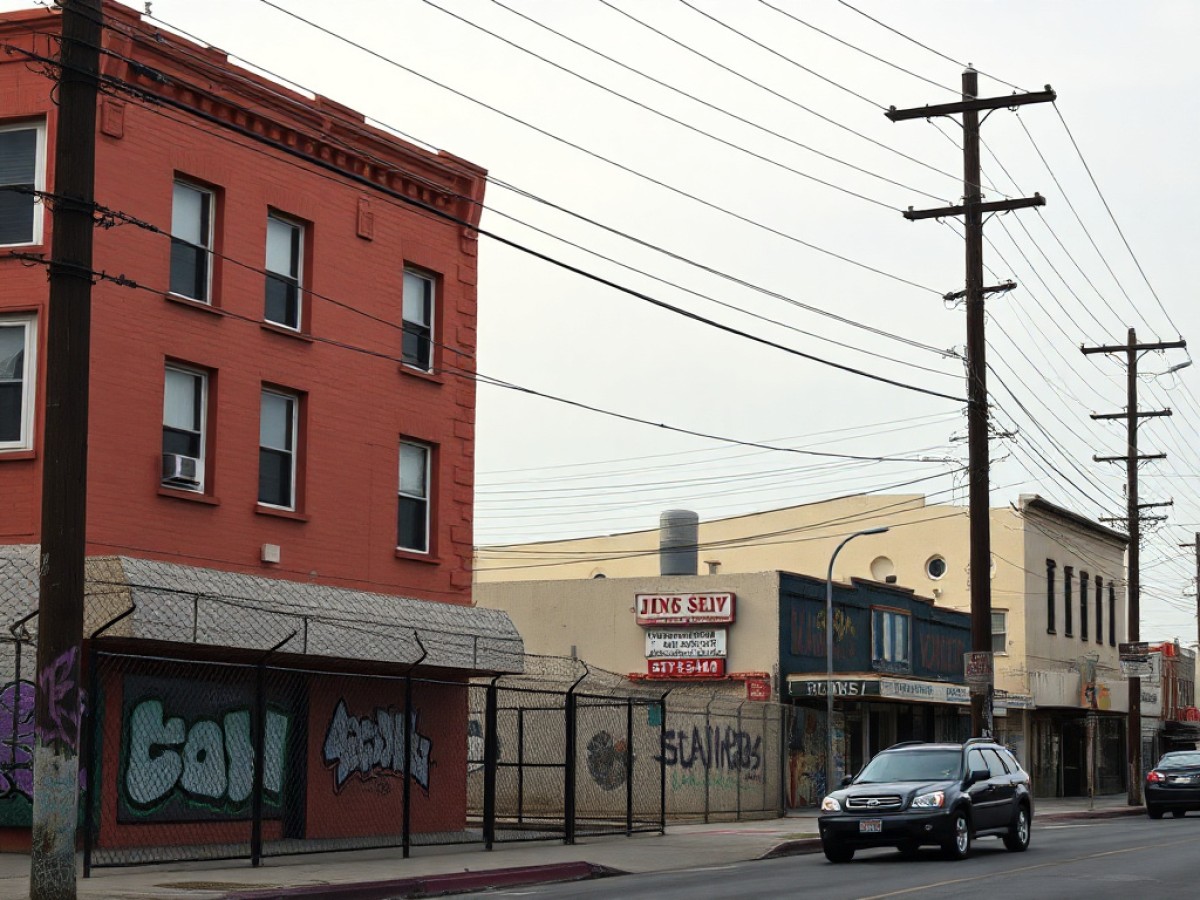
Initial impressions of these photographs suggest they capture commonplace buildings in a typical urban setting. Each image is taken from the street, enclosed by bold, dark power lines and poles, and surrounded by barriers of barbed wire, street art, and posters that create layers of depth. Above, small glimpses of blue skies and lush palm trees hint at the Californian environment. The scenes are notably deserted, with immaculately clean streets, save for some residual oil marks on a parking space. An eerie silence permeates the images.
The buildings in these images are devoid of windows, or have them concealed with boards or shutters, enveloped in darkness. In a solitary image, a door remains enigmatically open, revealing a security door with intricate iron bars, and further inside, a neon arrow sign beckons viewers inward. These photographs play on the viewer’s inherent curiosity, with only the titles hinting at the hidden activities inside—descriptions like “12 stalls, 1 leather bunk bed, outdoor garden, 1 water fountain, 1 barber’s chair, glory-hole platform, Chinese decor” provide tantalizing clues.
These images were captured by American artist Dean Sameshima, in a series named Wonderland, during the years 1995 to 1997. They portray the queer sex clubs and bathhouses of Silver Lake, clandestine havens camouflaged within the ordinary, where the community could gather discreetly. At the time of these photos, Sameshima was in his early twenties, and the AIDS crisis had deeply impacted the queer population in Silver Lake. His photographs reflect a poignant awareness of vulnerability and nostalgia, a premonition of the erasure of these spaces, akin to the disappearance of the individuals who once frequented them. The titles disclose that at least three of these establishments were shut down in 1995. His work serves as a means to process and document the loss and mourning.
By day, these venues of secret night-time rendezvous—ranging from warehouses and industrial units to nondescript storefronts—are remarkably ordinary and functional. A bakery sign looms behind one; another club that used to occupy 1800 Hyperion blends into a residential block. It’s questionable whether the neighbors were aware of its nature. One building is coated in a nondescript, muddy grey, bearing no identifying marks. These are buildings you might walk past every day without a second glance, unless, like Sameshima, you were intimately involved as both observer and participant. His photographs are acts of devotion, tied to a specific era and locale, yet they withhold from the judgmental scrutiny of mainstream society. These sites have also experienced surveillance and police raids, a stark reminder that sometimes being unseen is necessary for survival.
A total of seven sex club photographs are displayed, strategically spaced along the gallery’s white walls, mimicking the rhythm of moving from one location to another in a vast city like Los Angeles. The prints, all originals from the 1990s, extend horizontally, offering broad, sweeping views similar to those seen from a car window. They introduce voids within the urban environment, integral yet isolated parts of the city’s architectural and historical fabric, concealed out of necessity.
Tucked away is a set of photographs showcasing well-known cruising areas in two public parks after dark (Griffith Park and Harbor City Recreational Park). These images adopt a straightforward, unembellished style, contrasting sharply with Kohei Yoshiyuki’s intimate flash photography of nighttime sexual encounters in Tokyo’s parks during the 1970s. Sameshima’s approach is as understated as a wet tea bag. Captured again in the gentle warmth of daylight, his park images are devoid of people. Instead of clandestine encounters, it’s the quiet, natural tranquility of these small, secluded areas, shielded by foliage and speckled sunlight, that captures the attention. They could even be ideal for a peaceful picnic, oblivious to their other uses. Yet, they are fraught with the tension between visibility and safety, exposure and secrecy, public existence and private desires. By extracting the sexual element from these cruising spots, they simply exist as part of the everyday fabric. And yet, in one image, a small, telling detail emerges on the ground among the stones—a discarded blue condom wrapper.
Wonderland offers a profound insight into Sameshima’s deliberate, unpretentious method of documenting and representing communities, emphasizing the significance of communal spaces as bastions of freedom and autonomy. His technique is particularly striking in contrast to Catherine Opie—who began capturing California’s queer community at the same time and is currently featured at the National Portrait Gallery. Opie’s portraits are bold, loud, and unapologetic, often harsh—Sameshima’s work, in contrast, finds strength in the unseen and a melancholic beauty in a lone condom wrapper. It presents a more layered, open-ended view of queerness, presence, and belonging, celebrating the ephemeral, radical nature of pleasure, even when it’s hidden in the underbrush.
Similar Posts:
- 1970s New York Like Never Before: Stunning Street-Level Photos Revealed!
- Nan Goldin’s Electrifying Exhibit: Sex, Smoke, and Silence Unveiled!
- Mary Nolan’s Stunning Photos Revealed: A Journey Through Nostalgia and Overlooked Artistry
- Stunning Visuals: See the Week’s Best Photos Captured by AP Photojournalists
- Captivating Photos: Stephen Shames’ Intimate Look at the Black Panthers

Fatima Clarke is a seasoned health reporter who bridges medical science with human stories. She writes with compassion, precision, and a drive to inform.