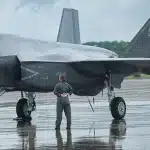
Enhanced Strike Capability for Sweden’s Air Force
MONTREAL — Sweden is set to enhance its military reach with the ability to perform extended range strikes, as the integration of the Taurus cruise missile from Germany into its Gripen aircraft is slated to occur sooner than initially anticipated, according to the Swedish Air Force’s top official.
“We’ve adjusted our priorities and synchronized the efforts of our defense industry, the FMV, and the Air Force to maximize overlap, which has allowed us to move our timeline forward. I anticipate that our operational capabilities will be realized much sooner than we had originally thought,” Major General Jonas Wikman, commander of the Swedish Air Force, revealed in a discussion with Defense News.
FMV refers to the Swedish Defense Materiel Administration.
A February report by the agency indicated that the initial operational capability for the Taurus KEPD-350, a cruise missile launched from the air, on the JAS39 Gripen C/D, was initially projected for 2028.
Due to the sensitive nature of the project, officials withheld specific dates for the missile’s integration. The Taurus missile was developed by Taurus Systems GmbH, a joint venture between Germany’s MBDA Deutschland and Sweden’s Saab.
The missile is capable of delivering a 481-kilogram warhead and is designed to take out reinforced or underground facilities of various dimensions from distances exceeding 500 kilometers, according to details from the manufacturer’s website.
Wikman described the upcoming deployment of this missile as “a significant advancement” that will also reshape the air force’s strategic doctrines and operational methodologies.
“This capability is crucial as it marks our first foray into deep-strike and offensive counter-air capabilities. Previously, our focus was predominantly on defense, but this signifies a significant strategic pivot,” Wikman explained.
He also noted that Sweden has received extensive support from Germany in enhancing its long-range offensive capabilities.
Saab has previously shown images of the Gripen equipped with the Taurus missile, and a model of the aircraft in this configuration was even showcased at the FIDAE defense fair in Chile back in 2016.
Yet, there had been no instances of live-fire trials involving the missile on the aircraft.
Sweden adopts a unique strategy in upgrading its Gripen jets by eschewing the typical mid-life update in favor of a continuous capability enhancement approach, with significant updates scheduled every three years.
According to Wikman, this strategy is feasible primarily because of two reasons: firstly, Saab’s role as a national manufacturer empowers it to manage a closely-knit industrial network that can swiftly adapt technologies as operational demands evolve. Secondly, Saab has recently overhauled the avionics architecture in the Gripen E, which distinguishes the flight-safety critical software from the combat mission software, thus facilitating easier and quicker enhancements in combat efficiency, as per the engineers at the company.
Similar Posts:
- Swedish Air Chief Discusses Future Warplane, Gripen’s Role in Combatting Drones
- Ukraine’s New Power: Gripen Jets Armed with Long-Range Meteor Missiles
- Ukraine Upgrades Air Force: Buys 20 New Gripen Jets, Sweden Accelerates Donation of Older Models
- Saab to Lead Development on Sweden’s New Flagship Fighter Jet: A Glimpse into Advanced Warfare Tech
- Ukraine’s Game-Changer: Gripen-Meteor Combo Could Outmatch Russian Glide Bombs!

Jamal Peterson reports on defense, aerospace, and tech policy. With a military background and a strategic mind, he dissects complex subjects with clarity, offering readers sharp, reliable insights.