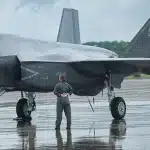
In a recent development this August, the Department of Energy together with the Air Force successfully executed the inaugural tests involving the deployment of unarmed B61-12 nuclear gravity bombs from an F-35A, announced by the laboratory responsible for nuclear weapons oversight.
Sandia National Laboratories, in a statement released on Thursday, disclosed that it conducted several flight tests from August 19 to August 21 at the Tonopah Test Range in Nevada, with support from staff and aircraft provided by Hill Air Force Base in Utah.
According to Sandia, these tests marked the first instance of B61-12s being tested with an F-35, signifying a significant benchmark in verifying the compatibility and reliability of the aircraft, crew, and weaponry in operational scenarios. The B61-12s used were joint test assemblies, which are replicas of the actual bombs but are not equipped with nuclear warheads.
Jeffrey Boyd, Sandia’s surveillance lead for the B61-12 and -13 bombs, remarked, “These B61-12 F-35A stockpile flight tests and captive carry flight test were the culmination of extensive planning and effort by many individuals across numerous agencies, not just Sandia.”
He further noted, “These B61-12 stockpile flight tests accounted for the highest amount of B61-12 flight test surveillance conducted within a year to date and are expected to be the most for years to come.”
Additionally, Sandia mentioned that these tests included the first instance of thermal preconditioning of the joint test assembly before it was loaded onto an F-35 and subsequently deployed, verifying the bomb’s functionality under actual environmental conditions.
Imagery and video released by the lab depict the careful transport of a B61-12 across the flightline at Hill in the early morning of August 19, followed by the loading of two such bombs into an F-35’s twin weapons bays, after which the fighter jet headed off for the Tonopah Test Range.
The B61 family of nuclear gravity bombs has been part of the U.S. Air Force and NATO’s arsenal for over half a century.
In December of the previous year, the National Nuclear Security Administration completed a life extension project for the B61-12, ensuring its operational readiness for an additional 20 years. This initiative involved refurbishing or replacing various nuclear and non-nuclear components of the bomb.
The B61-12 model replaced earlier versions in the national stockpile, specifically the B61-3, -4, and -7, as stated by the Air Force in a 2021 announcement. This replacement marked the first significant modernization of an Air Force nuclear warhead in over three decades. The upgrade included the development of a new Boeing-manufactured guided tail kit for the B61-12, and integration with the B-2 Spirit bomber, as well as F-15E, F-16, and F-35 fighters, led by the Air Force Nuclear Weapons Center.
Brian Adkins, manager of the Tonopah Test Range, who supervised these B61-12 tests, highlighted that the effort encompassed two successful days of testing involving three test assets.
These F-35 tests were carried out well before President Donald Trump’s late October social media announcement, in which he claimed that he had directed the Defense Department to “begin testing our Nuclear Weapons on par with other countries,” alleging that these countries were secretly conducting nuclear tests. This statement sparked concerns about the U.S. potentially ending its over thirty-year-long moratorium on nuclear weapon test explosions.
In an early November interview, Energy Secretary Chris Wright mentioned that upcoming tests would concentrate on subsystems of new nuclear weapons, but they would not lead to a full nuclear detonation.
Similar Posts:
- US Navy Launches Trident Missiles: Demonstrates Nuclear-Capable Firepower in Test
- Experts Warn: Full-Scale Nuclear Tests Could Spell Disaster for US
- US Air Force Stocks Up on Bunker-Buster Bombs: Response to Iran’s Nuclear Strikes
- Revolutionary Development: US Air Force to Establish Dedicated Drone Wingman Squadrons
- Air Force Tests Anduril’s Semi-Autonomous Drone: Revolutionizing Combat with Cutting-Edge Tech!

Jamal Peterson reports on defense, aerospace, and tech policy. With a military background and a strategic mind, he dissects complex subjects with clarity, offering readers sharp, reliable insights.