
NEWINGTON, N.H. – Inside the headquarters of firearm manufacturer Sig Sauer, numerous large pallets containing the newly developed M8 Next Generation Squad Weapon rifles are packed and waiting on the factory floor, enveloped in shrink-wrap and poised for delivery to military personnel.

The deployment of the M8 rifle, which is anticipated to succeed the M7 as the standard rifle of the U.S. Army, is slated to commence this December starting with select units at Fort Bragg, North Carolina, as verified by company officials to Military Times on Monday.
Additionally, the introduction of the new weapons system includes the M250 machine gun from Sig Sauer, destined to replace the older M249 Squad Automatic Weapon. The M250 is expected to be distributed to troops within the first half of the upcoming year, according to Dave Buehler, the vice president of manufacturing at Sig Sauer.
Both the M8 rifle and the M250 machine gun utilize the same 6.8×51mm Common Cartridge, a hybrid-designed ammunition created by Sig Sauer to handle high chamber pressures effectively.
The M7 rifle initially faced challenges upon its release, receiving criticism from soldiers regarding its substantial weight and length, as well as the excessive wear inflicted on its components such as barrels and suppressors by the high-pressure cartridges.
Despite initially contesting these criticisms, Sig Sauer now views the transition from the M7 to the M8 as a testament to their responsive adaptation to the feedback from soldiers, framing it as a notable achievement.
“From our perspective, the M8 is significantly more advanced than the M7,” stated Buehler. “With the M7, we were restricted by the design specifications and contract requirements, which we had to adhere to regardless of our stance. The M8, however, has been developed considering both our feedback and that of the soldiers. We are eager to see it in action.”
The new M8 rifle is over a pound lighter than its predecessor and features a barrel that is 3.5 inches shorter. It has moved away from the less favored folding stock to a fixed stock and incorporates design adjustments like enhanced rigidity for the handguard. Josh Shoemaker, Sig Sauer’s product manager for defense, mentioned that soldiers who have previously used the M7 will find the M8’s transition smooth.
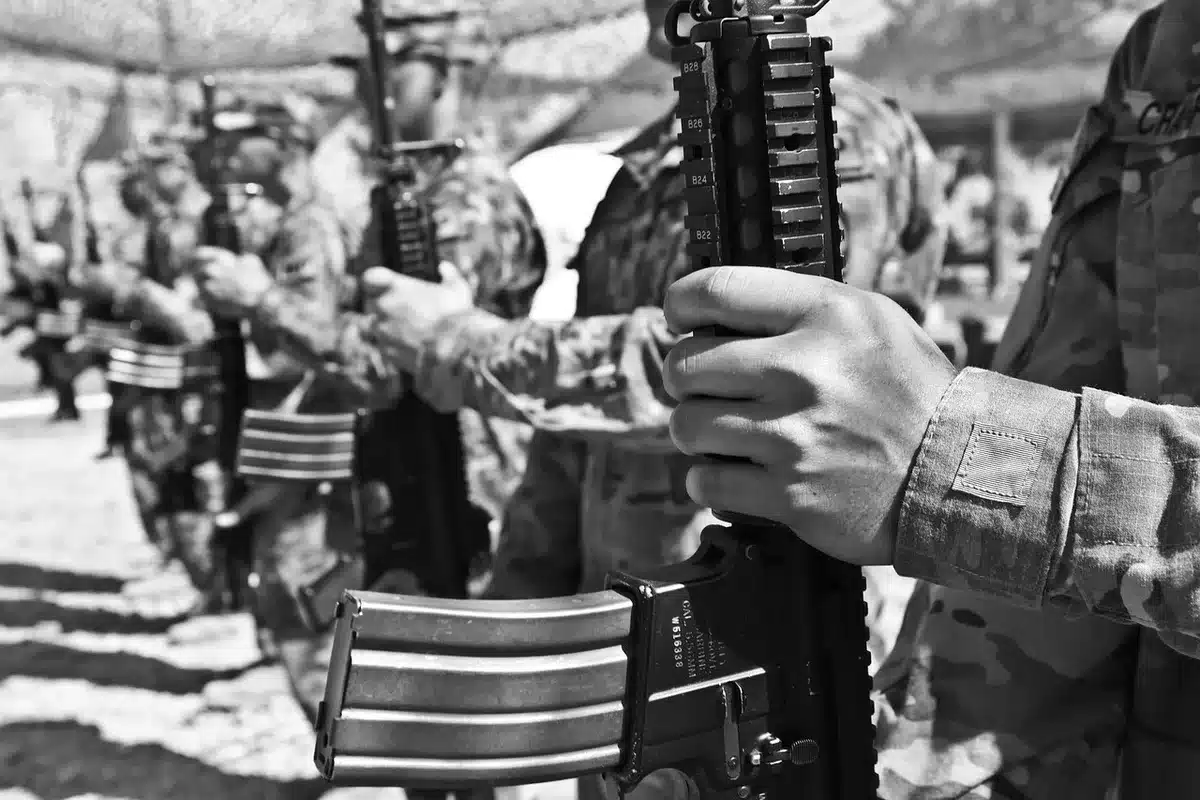
“The core handling remains largely the same,” Shoemaker explained during the interview with Military Times. “Those familiar with the M7 will find the M8 to be a welcome upgrade.”
A major design challenge was reducing the weight of the M8 compared to the M7, which weighed over eight pounds when unloaded, and nearly ten pounds with a suppressor, in stark contrast to the traditional M4A1 carbine, which weighs 6.34 pounds unloaded. Shoemaker noted that the weight difference between the M4 and the M8 has been reduced to just under a pound, excluding the suppressor for the M8.
“We’ve made significant efforts to cut down the weight wherever possible without compromising the performance. This includes making lightening cuts around the receiver and carefully reducing some weight from the barrel. It’s crucial to balance weight reduction with maintaining performance metrics like barrel life and heat resistance,” Shoemaker elaborated.
Adjustments to the barrel size have also shifted the weapon’s center of gravity, contributing to better handling and performance, especially with the suppressor attached to the shorter weapon system, he added.
Regarding the future of the M7 rifles, the Army has cut back on their procurement, with no additional units requested for Fiscal Year 2027, and about 50,000 units already delivered. The Army has not yet disclosed plans for the existing M7 inventory, especially in scenarios where M8s could replace M7s entirely.
Shoemaker suggested several possibilities for the M7s, such as reallocating these rifles to basic training or to National Guard and Reserve units. Another potential option could involve conversion kits that would allow the Army to transform existing M7s into M8s in a matter of minutes.
“Converting an M7 to an M8 could be accomplished quickly, involving only a few screws for the barrel and handguard. The lower-end serialized component remains the same,” he explained. “This conversion could be executed in under five minutes.”
While the Army has not publicly commented on this conversion possibility, Shoemaker noted, “There are numerous options available, and the Army is fully aware of these as they deliberate on the best course of action.”
Similar Posts:
- Revolutionary SOCOM Rifle Redefines Combat: Swap Barrels and Cartridges with Ease!
- Staccato Unveils New Handgun: See Top Firearms Including Short-Barreled Rifles at SHOT Show 2026
- Air Force Halts M18 Pistols After Fatal Incident: Investigation Underway
- KNDS Optimistic About Winning US Army Artillery Contest: ‘Excellent’ Prospects Ahead!
- US Army’s Latest Feat: Resupply Drone Transformed into Rocket Launcher!

Jamal Peterson reports on defense, aerospace, and tech policy. With a military background and a strategic mind, he dissects complex subjects with clarity, offering readers sharp, reliable insights.