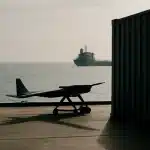
U.S. Air Force Expedited Plans for New Drone
The U.S. Air Force is hastening the development of an economical and more disposable drone to replace the MQ-9A Reaper, spurred by recent combat losses that have made waiting impractical, according to officials on September 3.
Lt. Gen. Christopher Niemi, the Air Force’s chief of modernization, informed journalists at the Pentagon that discussions for a successor to the aging MQ-9 were already underway.
“We have a sufficient number of MQ-9As currently, but the rate at which we are depleting our stocks is alarming,” he noted during a briefing covered by Breaking Defense.
According to Defense Daily, the Secretary of the Air Force, Troy Meink, has mandated that the program be accelerated, potentially advancing the original 2031 goal of having 20 operational drones by roughly two years.
In a May briefing to the Senate Armed Services Subcommittee on Airland, Lt. Gen. David Tabor reported that the drone fleet had dwindled to about 135 units, falling short of the intended minimum of 189 drones. Niemi did not provide an updated count.
Replacing the lost drones has been challenging. General Atomics ceased production of the MQ-9A in 2025, and Tabor noted that the Air Force was considering a one-time acquisition of existing MQ-9A models in fiscal year 2026. Due to budget constraints, Niemi pointed out on September 3 that purchasing numerous upgraded MQ-9B SkyGuardians was not feasible, dispelling the notion that the Air Force could simply purchase 100 new drones immediately.
A report updated on May 13 by the Congressional Research Service, citing an April 9 news article, noted that 24 Reapers had been lost since military actions against Iran began in February. It was unclear whether the Pentagon had provided Congress with detailed reports of these losses. The Washington Post, on August 13, citing three U.S. officials, reported that at least 45 drones had been lost, which constitutes about 25% of the fleet.
Niemi outlined the requirements in May for a more affordable, modular, and mass-producible aircraft. The Defense Innovation Unit initiated a competition on July 7, with the Air Force as a partner, under the Massed Modular Aircraft (MMA) program. The call for proposals, which closed on July 23, sought a drone capable of performing the same missions as the Reaper, including strike, intelligence, surveillance, reconnaissance, electronic warfare, and communications-relay, at a cost that would allow the force to sustain operational losses. The requirements specified a payload capacity of at least 2,800 pounds and a one-way ferry range of 8,000 nautical miles.
Defense Daily reported that Niemi compared the costs of the MMA with those of Collaborative Combat Aircraft (CCA), estimating CCA air vehicles at around $20 million each, with MMA costs projected to be about half that amount. A spokesperson clarified to Breaking Defense that these figures represent the cost of the air vehicle alone, not the fully equipped mission aircraft. In May, Niemi mentioned to senators that a fully equipped Reaper could cost up to $50 million. He projected that the Air Force would likely deploy at least 180 MMA drones.
Niemi emphasized that the value of the Reaper lies not in its physical structure but in its capabilities. “What distinguishes the MQ-9 is not the aircraft itself,” he stated, noting that its speed, altitude, and range capabilities are based on decades-old technology.
Initial versions of the MMA will focus on utilizing proven technologies rather than incorporating new systems to maintain affordability. Niemi described the proposed design as a long-aspect-wing turboprop, capable of more extended and heavier flights than the CCA but at slower speeds. The specifics of how this design would meet the 8,000-nautical-mile range requirement mentioned in July were not detailed at the briefing.
General Atomics has proposed a design named Wildfire, as reported by Aviation Week in August. Spokesman C. Mark Brinkley told Air & Space Forces Magazine that their design meets all the specifications listed for the MMA and surpasses most. However, details on capabilities and costs were not disclosed, and no images have been released. In an August interview with The War Zone, Brinkley mentioned that viewing Wildfire solely as a replacement for the Reaper overlooks the immediate need for additional drones, asserting that General Atomics could deliver Wildfires much sooner than currently planned.
He described the design goals as guidelines rather than fixed specifications, including a 10,000-nautical-mile ferry range, capacity for four Long Range Anti-Ship Missiles, and the ability to semi-autonomously control up to 100 aircraft.
Col. Todd Dye, a senior material leader in the Air Force’s medium-altitude intelligence, surveillance, and reconnaissance division, indicated that awards for refining the MMA concept were expected in the first quarter of fiscal 2027, as reported by Breaking Defense. However, no new timeline was announced at the September 3 briefing.
Similar Posts:
- US Companies Battle for Control of Norway’s Maritime Drone Market
- US Air Force Considers Northrop Grumman’s Autonomous Drone: A Leap for CCA Program!
- General Atomics Revolutionizes UK Airspace: Breakthrough in Drone Integration Unveiled
- Air Force Boosts F-47 Range for Pacific Dominance: A Strategic Combat Upgrade
- Revolutionary Development: US Air Force to Establish Dedicated Drone Wingman Squadrons

Jamal Peterson reports on defense, aerospace, and tech policy. With a military background and a strategic mind, he dissects complex subjects with clarity, offering readers sharp, reliable insights.