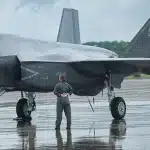
Lockheed Martin is exploring the integration of advanced stealth features, new armaments, and potentially an autonomous flight capability into its F-35 jets, aiming to incorporate sixth-generation fighter technology advancements.
During a live-streamed session at the Bernstein Strategic Decisions Conference in New York, Lockheed’s CEO Jim Taiclet shared that significant enhancements to the F-35 could be achieved within the next two to three years.
Originally, these innovations were part of Lockheed’s proposal to the Air Force for the Next-Generation Air Dominance (NGAD) program. However, the Air Force chose Boeing’s design, and the NGAD project was designated as the F-47 by President Donald Trump in March.
In the wake of losing the NGAD bid, Lockheed aims to enhance the F-35’s appeal and performance capabilities. Taiclet believes that integrating NGAD technologies into the F-35 could deliver approximately 80% of NGAD’s performance at half the price.
Taiclet likened the transformation of the F-35 to turning its framework into that of a high-performance Ferrari during an April financial briefing with investors.
Improvements may include enhancements to the F-35’s stealth coatings to better evade detection by infrared and radar, as well as modifications to the jet’s external structure, particularly around the engine inlets and outlets, to improve stealth, according to Taiclet.
The upgraded F-35 could also see advancements in electronic warfare, network capabilities, and autonomy, potentially leading to a jet that could operate with or without a pilot, Taiclet added.
Additionally, weapons systems initially designed for sixth-generation fighters might be incorporated into the F-35’s arsenal, he mentioned.
Taiclet indicated that some of these new features could be tested in flight and integrated into the F-35 within two to three years, although he noted that these technological developments would need to be implemented incrementally.
“Introducing a large amount of new equipment or software simultaneously could disrupt ongoing production processes,” he cautioned.
Lockheed is also exploring ways to enhance the F-35’s interaction with other aircraft, including those from the sixth generation, drones like collaborative combat aircraft, and other technologies, aligning with the Air Force’s broader “family of systems” strategy.
Taiclet emphasized that future air dominance would depend not solely on individual aircraft performance but on how effectively they integrate and operate within a larger ecosystem.
He also updated on the F-35’s Technology Refresh 3 (TR3) upgrades, which include a more powerful core processor, enhanced memory, and a more advanced display for pilots. The production of these components has been completed by L3Harris, and integration of the TR3 software has been finalized, he stated.
New F-35 units are now progressing through the assembly line at Lockheed’s facility in Fort Worth, Texas, with the TR3 enhancements being installed. These jets are also being equipped with a new distributed aperture system, consisting of six antennas to amplify sensing capabilities, marking a step toward the more comprehensive Block 4 upgrade.
However, Taiclet noted that integrating this new sensor system has faced some delays, though he expects these issues to resolve by year-end, enabling these jets to achieve combat readiness.
Similar Posts:
- Pentagon Stays Mum, Aviation Experts Stunned by Trump’s Fighter Jet Remarks
- F-22 Raptor Teams Up With Avenger Drone: A Pioneering Combat Flight Test!
- Lockheed Shatters Records: Delivers 191 F-35s, Clears TR-3 Backlog!
- Pentagon Escalates Efforts: Major Surge in Missile Production Announced!
- Breaking News: US Navy’s Next-Gen Fighter Decision Imminent, Sources Reveal

Jamal Peterson reports on defense, aerospace, and tech policy. With a military background and a strategic mind, he dissects complex subjects with clarity, offering readers sharp, reliable insights.