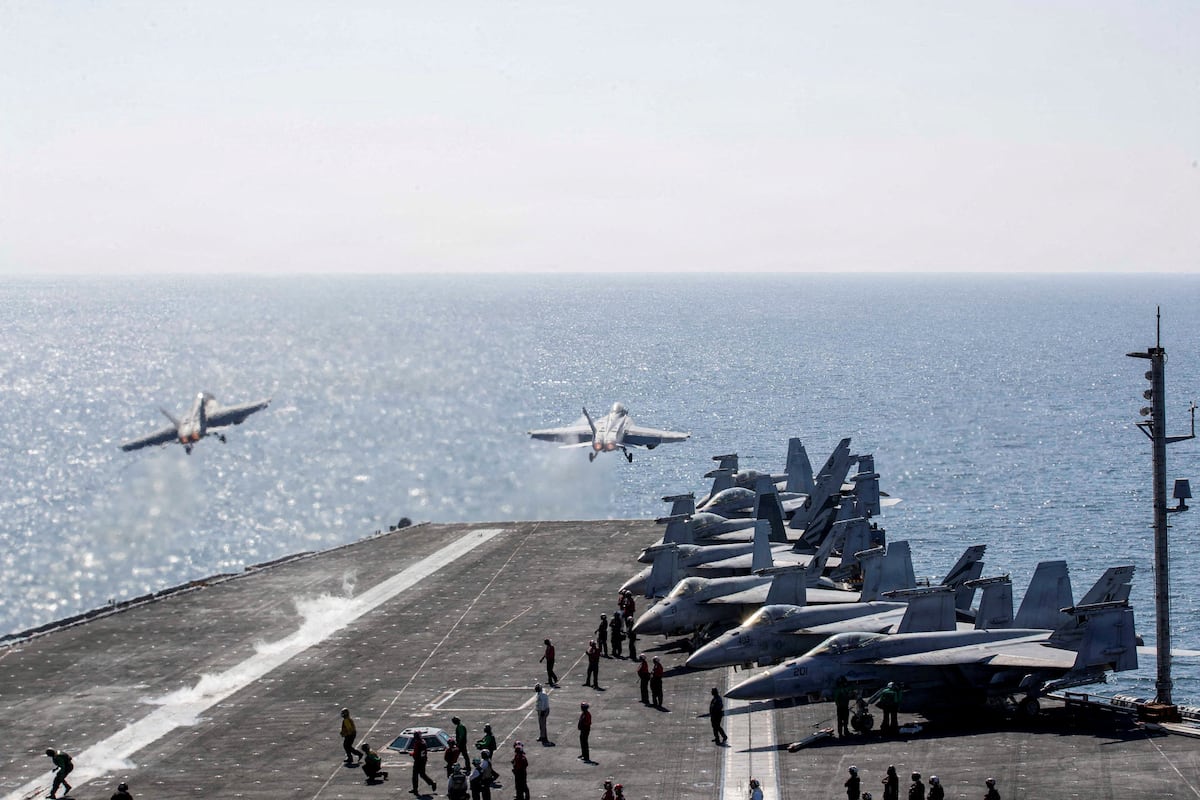
During the ongoing conflict with Iran, the U.S. Navy has been intensifying its operations around the Strait of Hormuz, leading to a blockade. Concurrently, a recent analysis criticizes the U.S. naval shipbuilding strategy and offers suggestions for enhancing the maritime industrial sector.
A new report from the Center for Maritime Strategy, unveiled last Friday, suggests that the United States should capitalize on its relationships with maritime allies to strengthen its shipbuilding capacity, as well as its technological and strategic prowess, especially given the decline of its maritime industrial base.
This recommendation arrives at a time when the Navy is heavily engaged in the Iran conflict, a situation that is exerting pressure on its already overstretched resources and showing no signs of abatement.
The Center for Maritime Strategy, a nonpartisan and independent research institution dedicated to U.S. maritime and national security issues, points out in its report that the Navy is still far from achieving its shipbuilding targets.
The report states, “To respond to the escalating threats against the U.S. and its allies, our maritime industrial base needs rapid modernization using cutting-edge technology and processes.”
President Donald Trump’s proposed budget for fiscal year 2027 earmarks $65.8 billion for shipbuilding, aiming to construct 18 battle force ships and 16 nonbattle force ships, which is twice the number constructed in the previous fiscal year.
This budget increase seeks to enhance the maritime industrial base by focusing on ships that are easier to build, lacking complex radar and nuclear propulsion systems found in larger battleships.
At the WEST Conference in February 2026, Marine Corps Commandant Gen. Eric Smith emphasized that the health of the industrial base hinges more on maintaining a skilled workforce than merely on the production of items. “We need to ensure that our workforce, including pipefitters, steamfitters, welders, and electricians, are well-compensated, even if the costs are high,” he remarked.
Presently, the Navy operates around 295 ships, with projections indicating a decrease as more ships are retired than commissioned. The Navy’s long-term goal is to maintain a fleet of 381 ships over the next 30 years to address global security challenges.
In response to the conflict in Iran, additional U.S. military personnel have been deployed to the Middle East, including the Tripoli Amphibious Ready Group and its associated Maritime Expeditionary Unit, which together comprise around 5,000 personnel and several warships, including USS Tripoli, USS New Orleans, and USS San Diego.
This deployment follows a 2025 Military Times report that revealed a significant decline in the readiness of the Navy’s amphibious assault ships, a situation exacerbated by efforts to tackle drug cartels in Latin America and the Caribbean under the Trump administration.
The Center for Maritime Strategy has set forth seven strategic goals to bolster the maritime industrial base. These include overhauling the design processes, adopting innovative technologies, and enhancing international cooperation.
The report particularly stresses the importance of engaging with international allies such as the Republic of Korea, Italy, Canada, Sweden, and the United Kingdom. These partnerships could help improve shipbuilding frameworks, utilize allied ports, and enrich the U.S. shipbuilding workforce with skilled labor from these nations.
Kenneth Braithwaite, the 77th Secretary of the Navy, noted in the foreword of the report, “To navigate the challenges ahead, it is crucial for the U.S. to leverage its robust naval alliances to collectively rejuvenate the allied maritime industrial base.”
Similar Posts:
- US Navy Cancels Constellation Frigate Program: Two Half-Built Ships Scrapped!
- Italy’s $4.2 Billion Naval Boost: State Firms to Construct Two Advanced Destroyers
- Pentagon’s $5 Billion Move: Accelerating Ship Manufacturing to Boost Defense!
- US Navy Plans Creation of New, Agile Class of Compact Combat Ships
- $275 Billion Price Tag for Trump-Class Battleships: CBO Reveals Staggering Costs

Jamal Peterson reports on defense, aerospace, and tech policy. With a military background and a strategic mind, he dissects complex subjects with clarity, offering readers sharp, reliable insights.