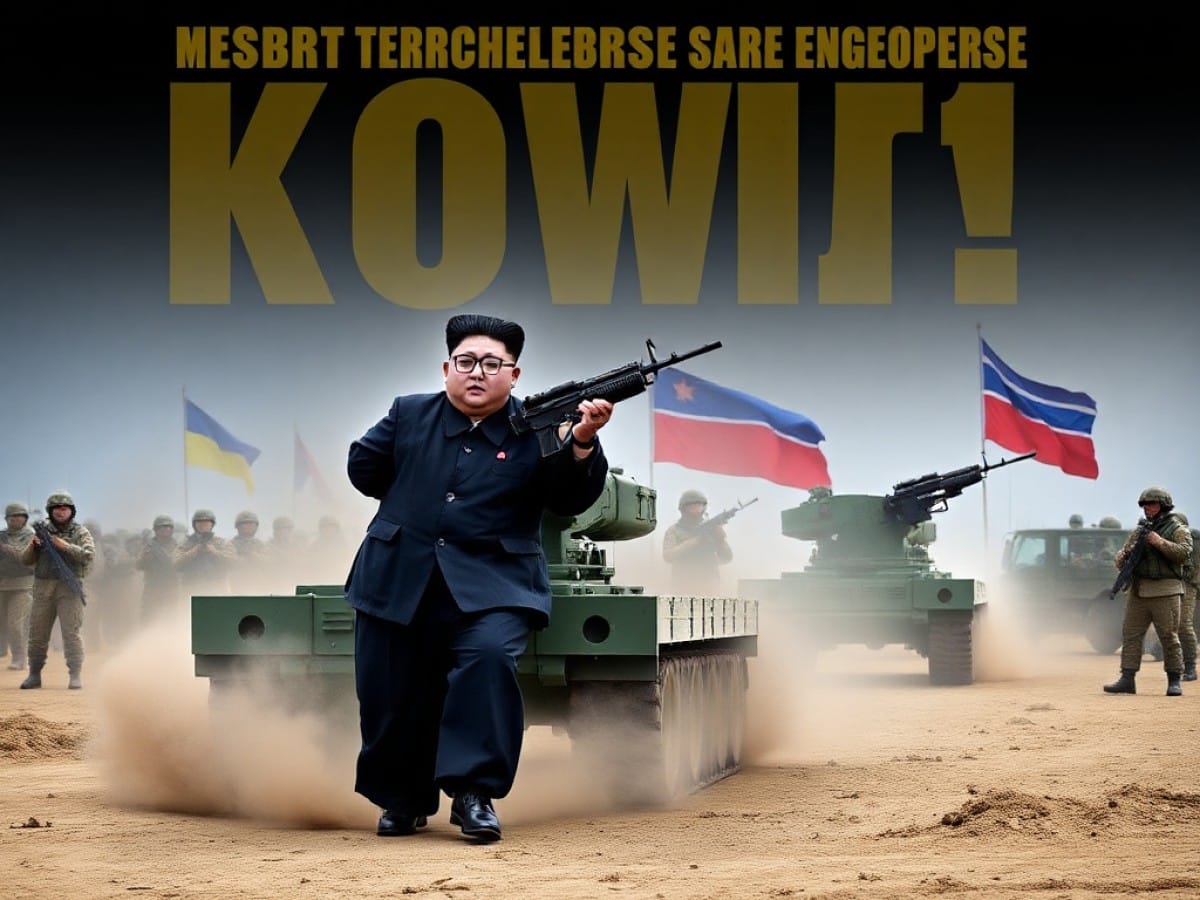
North Korea has significantly escalated its participation in global conflicts by deploying military personnel, armaments, and most recently, a missile brigade to assist Russia in its conflict with Ukraine. This represents the most substantial engagement by Pyongyang in an international conflict since the Korean War in the 1950s.
Below are details on the expanding military cooperation:
RECENT DEVELOPMENTS
A missile unit from North Korea has started to set up in western Russia, potentially equipped with as many as 120 ballistic missiles and six launch platforms intended for use against Ukraine, according to a Ukrainian GUR military intelligence agency official.
Approximately 90 North Korean military personnel are part of this unit, which is likely to be stationed in the Voronezh region of Russia, the official noted. The United States has knowledge of this North Korean movement, as confirmed by a source familiar with the developments to Reuters.
Already, 40 North Korean missiles have been delivered, with at least two being used last week in a lethal attack on Ukraine, according to the same Ukrainian source.
In July, Ukrainian President Volodymyr Zelenskyy mentioned that Russia was planning to incorporate 30,000 North Korean soldiers and was preparing facilities in Voronezh to accommodate them.
This statement could not be independently verified by Reuters.
EXTENT OF NORTH KOREAN TROOP DEPLOYMENT IN 2024
Between 14,000 and 15,000 North Korean soldiers have been deployed to Russia’s Kursk region, based on estimates from Ukrainian and South Korean sources, aiding Russian forces in countering a sudden Ukrainian ground attack.
In April 2025, both Russia and North Korea officially confirmed that North Korean forces had engaged Ukrainian troops in Kursk.
Following a successful operation to reclaim territory in Kursk, Russia’s top military commander lauded the North Korean troops. Meanwhile, Pyongyang disclosed that the deployment was directed by their leader Kim Jong Un.
This month, the Ukrainian official reported that approximately 9,500 North Korean soldiers remain in Kursk, although they are not currently engaged in direct combat against Ukraine.
FURTHER NORTH KOREAN MILITARY SUPPORT
In June 2025, Sergei Shoigu, the Secretary of the Russian Security Council, announced that North Korea would be sending 1,000 sappers and 5,000 military construction workers to Kursk to assist in mine clearance and reconstruct infrastructure damaged in the conflict.
That month, South Korean legislators reported, based on a briefing from the National Intelligence Service, that North Korea was recruiting additional personnel for deployment in Russia and continued to supply artillery ammunition and missiles in return for economic collaboration and technical support from Russia.
The specific numbers of engineers, deminers, or additional troops that have reached Russia, or their roles in combat, remain uncertain.
ARMAMENTS PROVIDED BY NORTH KOREA
North Korea has supplied Russia with millions of rounds of artillery and mortar, ballistic missiles, long-range artillery, and multiple-launch rocket systems, as per Ukrainian and independent evaluations.
An analysis done by Reuters in collaboration with the British-based Open Source Centre indicated that from September 2023 to March 2025, four Russian-flagged cargo ships made 64 trips to North Korea’s Rajin port, transporting nearly 16,000 containers of ammunition to Russian ports.
Ukrainian authorities assert that North Korea is providing roughly half of the munitions required by Russia on the front lines.
Since mid-2023, North Korea has delivered 4 million artillery shells, not including mortar rounds, and has provided 148 KN-23 and KN-24 ballistic missiles by early 2025, according to Ukraine’s military intelligence agency.
MOTIVATIONS BEHIND NORTH KOREA’S SUPPORT FOR RUSSIA
In June 2024, during a visit to Pyongyang, Russian President Vladimir Putin and North Korean leader Kim signed a comprehensive strategic partnership treaty, which includes a clause for mutual assistance in the event of external aggression.
North Korea describes its involvement as aid to a treaty ally. In May 2025, Kim stated that participation in the conflict was a legitimate exercise of North Korea’s sovereign rights in defense of a “brother nation.”
Analysts believe that through this cooperation, North Korea gains access to hard currency, oil, other economic aids, as well as Russian military technology and valuable battlefield experience for its troops and weaponry.
North Korean soldiers have been exposed to drone warfare, electronic warfare, artillery coordination, and contemporary battlefield tactics, while their missile and ammunition manufacturers have had the opportunity to test their equipment under war conditions.
GLOBAL RESPONSE
The United States and its allies have criticized the troop deployments and arms transfers as violations of UN Security Council resolutions concerning North Korea.
Since 2006, North Korea has been under UN sanctions related to its nuclear and ballistic missile programs. These sanctions prohibit any country from hosting North Korean military trainers, advisors, or other officials for military, paramilitary, or police training.
In December 2024, the US imposed additional sanctions on North Korean and Russian entities linked to military and financial support provided to Moscow. South Korea has also imposed sanctions on individuals and entities involved in unlawful military cooperation between the two nations.
NATO has expressed concern that Russia’s increasing military and economic ties with North Korea, along with China and Iran, pose a threat not just to Europe but also to the Indo-Pacific and North America.
Similar Posts:
- North Korea-Russia’s First Road Bridge Nears Completion: A New Era of Military Ties Begins!
- Ukraine Set to Deploy Advanced Ballistic Missiles: Combat Readiness Just Weeks Away
- CIA Director Reveals: Russian Troops Last Only 20-30 Minutes in Ukraine Frontline Combat
- Russia’s ‘Zapad’ Drill Sparks Fear in Europe: Concerns Rise Over Stealth Attacks
- Ukraine War: Victory Day Ceasefires Collapse Immediately Amid Conflict

Jamal Peterson reports on defense, aerospace, and tech policy. With a military background and a strategic mind, he dissects complex subjects with clarity, offering readers sharp, reliable insights.