Confusion Surrounds President Trump’s Remarks on Future U.S. Military Jets
Recent statements made by President Donald Trump in Qatar regarding the U.S. military’s future aircraft have left many puzzled, with no immediate response from the Pentagon.
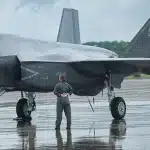
At a roundtable in Doha, surrounded by executives from Boeing and GE Aerospace, Trump unexpectedly mentioned that a new fighter jet, which he referred to as the F-55, a successor to the F-35 with two engines, was in development.
Trump elaborated, “We are upgrading the F-35, just a simple update. However, we’re also working on something I call the F-55, and it’s going to be a significant enhancement, featuring two engines.”
Additionally, Trump disclosed plans for an enhanced version of the F-22, which he called the “F-22 Super.”
Frank Kendall, former Air Force Secretary under President Joe Biden, expressed uncertainty about Trump’s mention of the “F-22 Super” in a Defense News interview, suggesting it might be linked to the F-47, a sixth-generation fighter jet previously known as Next Generation Air Dominance (NGAD).
The NGAD project aims to replace around 185 F-22 Raptors in the Air Force’s inventory. Boeing was awarded the contract for this new generation of fighters in March.
Despite the buzz generated by Trump’s comments on the F-55, further details have not been provided by the government.
When pressed about Trump’s remarks, both the Air Force and Navy deferred to the White House. A White House spokesperson, when contacted by Defense News, redirected inquiries to another spokesperson who has yet to respond.
Lockheed Martin, the manufacturer of both the F-35 and F-22, did not directly address Trump’s statements but issued a statement thanking him for his continued support of these jet programs.
Kendall also commented on the alleged F-55, stating, “President Trump seems to be speculating about future aircraft that, to my knowledge, don’t exist.”
Aviation analyst Richard Aboulafia suggested that Trump might be “trolling” the public with the F-55 concept. When asked if anything could potentially match Trump’s description of the F-55, Aboulafia responded skeptically, referencing outdated model kits.
It is also unclear if Trump’s F-55 comments were intended to relate to the Navy’s own sixth-generation fighter project, known as F/A-XX.
Trump also criticized the F-35’s single-engine design, suggesting that it poses a risk if the engine fails. “I don’t like single engines,” Trump stated, pointing out that having multiple engines is preferable, as evidenced by his preference for the four-engine Boeing 747.
Kendall pointed out the prevalence of single-engine jets like the F-16 and F-35A in the Air Force, highlighting their reliability despite their configuration.
Regarding upgrades to the F-35, Lockheed Martin and engine manufacturer Pratt & Whitney have been enhancing the jet’s performance through various modifications. These include the Block 4 upgrades to improve sensor capabilities and enable the jet to carry more weapons, scheduled to commence this summer.
Pratt & Whitney is also modernizing the F-35’s engines to increase power, thrust, and cooling efficiency.
Lockheed Martin executives hinted at integrating sixth-generation technologies into the F-35 and F-22, potentially elevating these jets to a “fifth-generation-plus” status and offering NGAD-like capabilities at a reduced cost.
Despite the ambiguity of Trump’s intentions regarding the F-35 and F-55 upgrades, Aboulafia emphasized the impracticality of retrofitting the F-35 with two engines, describing it as a massive and disruptive redesign.
Trump also revisited his views on stealth technology, critiquing its aesthetic compromises and questioning its longevity against adversaries’ advancements. This marks a shift from his previous administration, where he praised the F-35’s stealth features.
Despite Trump’s skepticism, Air Force leadership continues to prioritize advanced stealth capabilities for future aircraft to maintain a competitive edge, particularly against China.
The upcoming B-21 Raider and the F-47 are being designed with top-tier stealth features, and plans are being considered to incorporate stealth into new refueling tankers to support operations nearer to conflict zones.
While Trump expressed his admiration for the F-22’s design, calling it the “most beautiful fighter jet,” his recent comments reveal a complex stance on military aviation technology and its future direction.
Similar Posts:
- Lockheed Enhances F-35 Stealth Capabilities, Explores Unmanned Options
- Boeing Wins Big: Selected to Build US Navy’s Next-Gen F/A-XX Fighter!
- India Eyes Key Role in France’s Advanced Sixth-Generation Fighter Jet Program: Strategic Partnership Ahead?
- Allvin Reveals: Air Force’s Advanced Tech Dominates with F-47, Avoids F-35 Blunders
- F-22 Raptor Teams Up With Avenger Drone: A Pioneering Combat Flight Test!

Jamal Peterson reports on defense, aerospace, and tech policy. With a military background and a strategic mind, he dissects complex subjects with clarity, offering readers sharp, reliable insights.