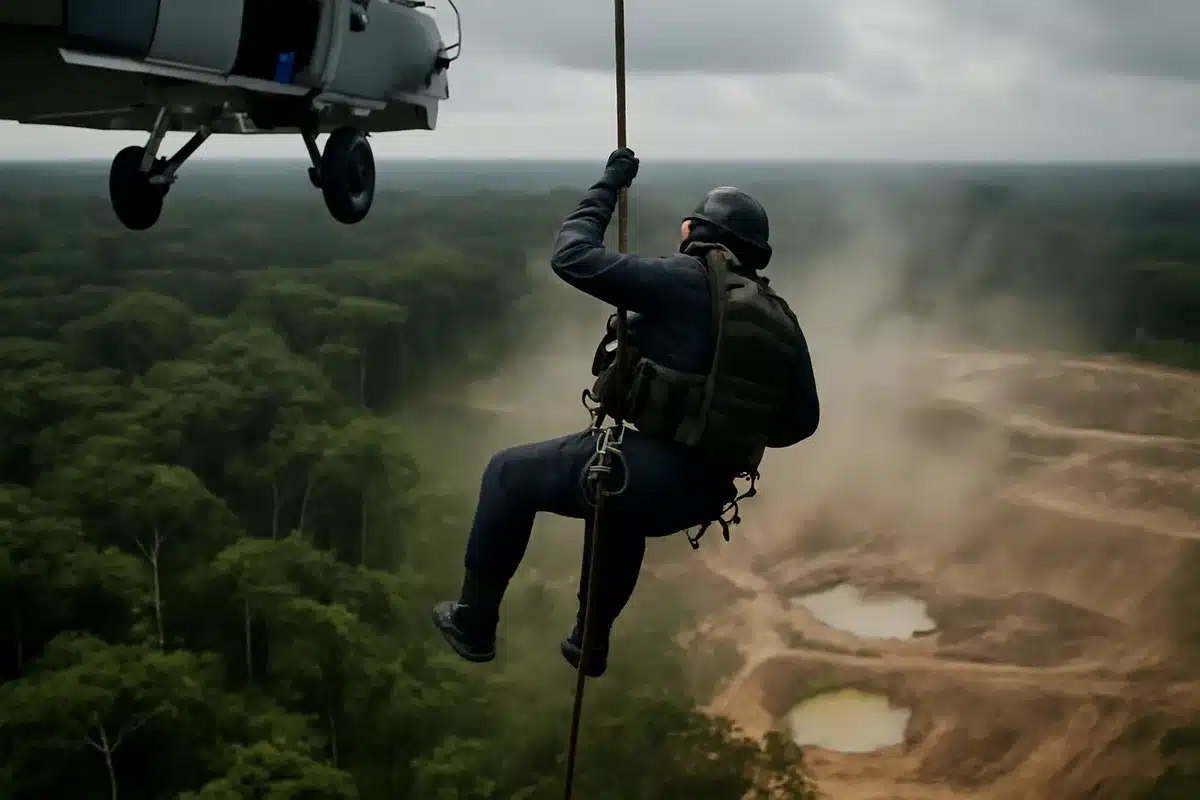
In PUERTO MALDONADO, Peru, a team of eight Peruvian navy members descended from a helicopter into a clearing within the Amazon rainforest along the Malinowski River in the Madre de Dios region. As they landed, clouds of dust and sand kicked up around them as they hurried towards an illegal mining operation.
The landscape transformed from dense forest into large, man-made pits filled with murky water, where gasoline and various chemicals shimmered on the surface. Rudimentary wooden mining structures loomed over these pits, equipped with pumps and heavy-duty plastic tubing designed to extract and process sediment for small quantities of gold.
As the navy personnel approached, a few miners observed from afar. The commanding officer issued a warning shot into the air, prompting the miners to quickly disappear back into the dense forest.
This operation, which spanned several days, was part of a broader governmental effort to combat illegal gold mining in one of Peru’s most ecologically rich regions. The illegal activity has left deep scars in the rainforest, resulting in vast stretches of deforested and contaminated land, with altered river courses all in pursuit of gold. This has had severe repercussions on the water quality and health of local wildlife and Indigenous communities who rely heavily on these ecosystems, particularly for fishing.
An abandoned campsite revealed the miners’ hasty retreat. The area was strewn with crushed cans, empty bottles, discarded mattresses, clothing, and tools. Unfinished meals of rice and plantain remained in plastic containers, while freezers and containers of fuel were left behind along with live chickens and guinea pigs intended for food.
The navy teams were among eight patrols deployed via helicopter to various locations along the Malinowski River, landing briefly to drop off each team before moving on to the next designated area.
Threats to Protected Amazonian Territories
Edy Reynaldo Dariquebe, a representative from FENAMAD, an Indigenous federation in Madre de Dios, reported that mining operations have encroached upon or even entered protected Indigenous lands. He explained that the mining not only devastates the forests but also pollutes the rivers with mercury, affecting aquatic life and communities far from the mines themselves.

Ronald Flores Yáñez, a deputy prosecutor with Peru’s Office of the Attorney General, highlighted that illegal mining has advanced perilously close to military checkpoints and into protected areas. “Today, we see hundreds of dredges operating within and around the Tambopata National Reserve,” Flores disclosed to the Associated Press.
Illegal mining saw a temporary decline in Madre de Dios following a significant military and police initiative, Operation Mercury, initiated in 2019. However, the miners have gradually moved back towards protected areas, prompting renewed and intensified governmental actions. U.S.-based nonprofit Global Conservation is collaborating with Peruvian authorities to launch operations involving satellite monitoring, aerial reconnaissance, and law enforcement raids over the next year to locate and dismantle illegal mining operations.
Targeting Essential Mining Equipment
Before commencing an operation, Navy Lt. Cmdr. Renato Miranda briefed his troops that their mission was to “neutralize and dismantle” the mining operations. This involved locating and destroying key operational components like pumps, batteries, fuel, dredging equipment, and temporary structures.

Miranda emphasized the importance of incapacitating the main machinery, particularly the motors, which are crucial for the mining operations. These engines, being among the most expensive assets at the sites, represent a significant financial investment for the miners. Larger motors, which can extract substantial amounts of gold daily, are a primary target due to their high cost and operational value.
Miranda reported that over three days, the operation managed to destroy 56 motors, 78 mining rafts, and approximately 13,751 gallons of fuel. The cumulative value of the destroyed equipment was over 15 million soles (around $4 million). Over the past three months, about 115 motors had been neutralized in frequent raids.
The remote locations of these mining sites typically give miners enough lead time to hide their equipment and escape at the sound of approaching helicopters or boats. Navy divers are tasked with retrieving submerged motors from contaminated waters, attaching explosives to them for destruction. In one instance, troops discovered a motor buried under sand, which they then drenched in gasoline and set on fire. In a rare lighter moment, a dog left behind at one site was adopted by the soldiers and brought back to their base.
At another site, troops discovered a more established camp that showed signs of daily life, with supplies and personal belongings that were all destroyed to prevent further use. The contrast between the valuable equipment and the destitute living conditions of the miners was stark.
Challenges in Curbing Illegal Mining
While the destruction of vital machinery aims to increase the financial burden on miners, officials recognize that raids alone are insufficient to halt the illegal activity. Miranda noted that the lucrative nature of gold mining enables operators to quickly replace equipment and resume operations, often in the same locations or new areas.
Flores emphasized the need for a dual approach: continuing to target physical operations and also tracing and targeting the financial networks that fund these operations. This strategy is crucial to break the cycle of destruction and renewal that characterizes the illegal mining along the Malinowski River.
“These operations need to be ongoing and permanent,” Flores concluded.
Similar Posts:
- Mercury Crisis in Senegal: Toxic Gold Mining Poisons Locals!
- Ghana’s Illegal Gold Mining Surge: Residents Resort to Community Patrols
- Indonesia’s Mining Boom Driven by Global Demand: Local Communities Pay the Price
- Interpol Rescues 30,000 Trafficked Animals: Global Crackdown Reveals Shocking Wildlife Trade
- Amazon Tribes to UN: Stop Organized Crime Without Militarizing Our Lands!

Morgan Ellis is an investigative journalist passionate about environmental policy and corporate accountability. With a background in climate science and years of reporting for nonprofit media, Morgan brings depth, clarity, and purpose to every story.