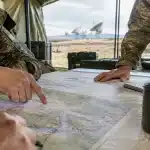
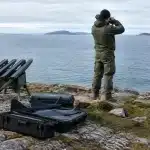
In the quiet town of Churchill, Manitoba, Sgt. Ian Van Nest patrols the area with a vigilance born of necessity. His vehicle, equipped with a rifle and a secure compartment for detaining suspects, moves slowly. His gaze shifts rapidly before focusing on a group gathered around a van. He approaches, cautiously assessing the leader’s armament before engaging in polite conversation.
“How are you today?” he inquires. The reply comes cautiously, “We OK for you here?”
“You’re good. There’s a good distance between you and the wildlife. Remember, if you’re unloading people here, you ought to have a bear monitor,” advises Van Nest, a conservation officer in Manitoba. He continues, “Keep your shotgun handy, equipped with slugs and cracker shells, or a scare pistol just in case.”
With the onset of polar bear season in Churchill—a small peninsula town reaching into Hudson Bay—the challenge of keeping tourists safe from the increasingly frequent and sometimes aggressive polar bears has intensified. The melting sea ice, critical for their hunting, forces the bears to venture inland more often and earlier than usual, according to a team of scientists monitoring endangered species.
The frequency of bear sightings has increased due to their prolonged presence on land and their growing boldness around humans, explains Geoff York, the research and policy director at Polar Bears International. The Western Hudson Bay is home to some 600 polar bears, nearly half the number from four decades ago, but still equivalent to nearly one bear per Churchill resident.
Despite the dangers, Churchill not only accommodates but cherishes its relationship with these majestic creatures. The influx of visitors keen to see polar bears breathed new life into the town following the closure of a military base in the 1970s, which had significantly reduced its population. A 2011 study found that each polar bear tourist contributes approximately $5,000 per visit, injecting over $7 million into Churchill’s economy, which boasts upscale dining and numerous small lodgings despite its rustic setting.
Mayor Mike Spence notes the town’s familiarity with bears, “We’re obviously used to bears so you don’t start to tremble when you see one. It’s their area too. We coexist with the bears and the wildlife, which is vital for our community. We’re all connected.” More than a decade has passed since a bear attack on Halloween night injured two people before a third managed to drive the bear away.
“It was the scariest thing that’s ever happened in my life,” shared Erin Greene, a survivor of the attack and a tourist industry worker who finds solace in Churchill’s other wildlife, such as beluga whales and her rescued sled dogs.
Since that incident, no attacks have been reported, but the town remains vigilant. During Halloween, when bears are most desperate for food, volunteers patrol the streets to ensure safety. Throughout the year, bears that frequent the town are temporarily housed in the polar bear jail—a large facility with 28 reinforced cells—before being released back into the wild. The facility rarely reaches capacity, but it can be quite active, according to Van Nest.
Local pride in their polar bear cohabitants is a mix of thrill and fun, akin to a rollercoaster ride, residents say.
“You know we’re the polar bear capital of the world, right? We have the product, it’s just about seeing them safely,” says Dave Daley, a local entrepreneur. He half-jokingly informs visitors, “They’re the T. rex of the Arctic. They’ll eat you. But usually, they don’t.”
The closure of the military rocket launch site in the 1970s seemed to encourage more bears to visit the town. Since then, Churchill and provincial authorities have developed a polar bear alert program to ensure community safety, Mayor Spence explains.
Despite a nightly curfew siren at 10 p.m. urging residents indoors, the community often gathers for bonfire parties at the town beach—a known hotspot for bears. Government-employed guards keep watch, ready to use non-lethal methods to deter any approaching bears.
“It’s just everybody watches out for everybody,” Spence adds. “Living alongside polar bears, you naturally watch your surroundings as you step outside. It becomes part of your instinct.”
Georgina Berg recounts growing up near Churchill, where her reactions and those of her parents to bear encounters varied greatly over the years. While her father would nonchalantly pass a bear rummaging through trash, her mother became more frightened after his passing, leading to heightened alertness whenever a bear was near.
For Van Nest, the situation he encountered with the tour group was well-controlled, with the bear sufficiently distant and undisturbed by the observers. “This is a great situation,” he remarked. “The tourists are safe, and the bear is behaving naturally without any harassment.”
Similar Posts:
- Stunning Photos Reveal: Churchill, The World’s Polar Bear Capital!
- Polar Bear Tourism at Risk from Climate Change: How One Canadian Town is Adapting and Thriving
- Arctic Crisis: Polar Bears, Ice, and Fat Under Threat – Vital Ecosystems at Risk!
- Beluga Whales Heal Visitors: Playful Creatures in a Warming Hudson Bay
- Manitoba’s Essential Train Route: Now a Tourist Favorite Too!

Morgan Ellis is an investigative journalist passionate about environmental policy and corporate accountability. With a background in climate science and years of reporting for nonprofit media, Morgan brings depth, clarity, and purpose to every story.