A New Homage to Picasso’s Legacy at Reina Sofía
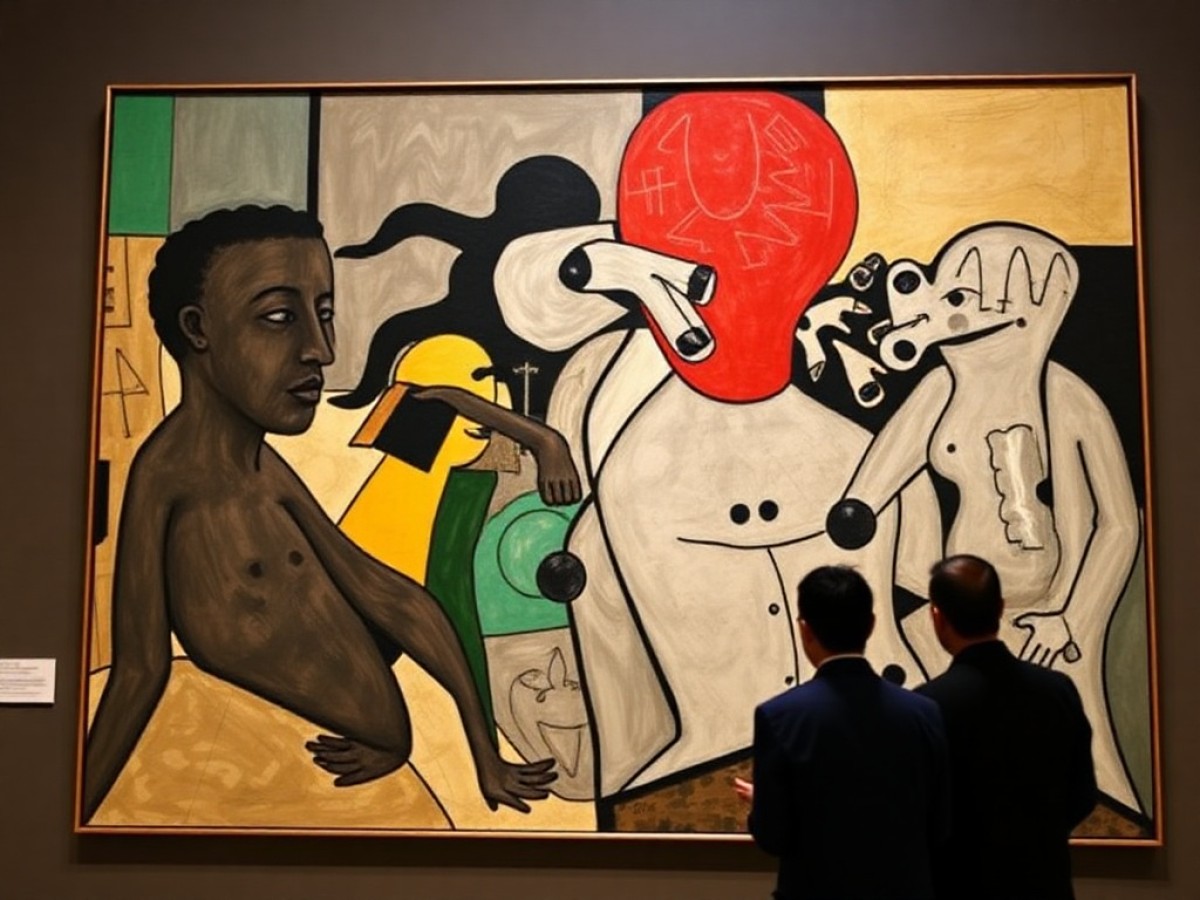
In the Reina Sofía Museum in Madrid, where Picasso’s Guernica once debuted, a similarly provocative piece has taken its place. Though smaller in size, the ‘African Guernica’ by the late South African artist Dumile Feni, drawn in 1967, resonates with a comparable intensity and complexity as its famed counterpart.
The artwork, executed in charcoal and pencil, captures a world teeming with unsettling imagery: a three-legged man with a grotesque mask-like face holding a stick, a cow with a swollen udder nursing a baby, birds scavenging for scraps, all under the watchful eyes of obscured, shadowy figures in the backdrop.
Unlike Picasso’s anger which was ignited by the Nazi bombing of a Basque town, Feni’s fury stemmed from the oppressive realities of apartheid in South Africa. This historical and emotional context imbues ‘African Guernica’ with its potent sense of depth and disturbance.
Introducing History Through Artistic Rhymes
This piece stands as the central exhibit in Reina Sofía’s new annual exhibition series titled “History Doesn’t Repeat Itself, But It Does Rhyme.” According to Manuel Segade, the museum’s director, the series aims to juxtapose works from diverse cultural and geographical contexts with Picasso’s Guernica. The initiative not only encourages fresh interpretations of the iconic painting but also seeks to address historical biases in art representation.
Segade pointed out the often overlooked or marginalized status of African art in the history dominated by Western perspectives, noting how it has been unfairly categorized as mere handicrafts or branded as primitive.
The ‘African Guernica’, which had never been displayed outside of South Africa before and is currently on loan from the University of Fort Hare, represents a significant shift and offers a unique perspective on global artistic narratives.
Dumile Feni, who passed away in 1991 in New York after nearly 25 years in exile, was largely a self-taught artist. His early life in South Africa was marked by an intense engagement with indigenous African art forms, from rock paintings to traditional mask crafting. Upon moving to Johannesburg in his late teens, he immersed himself in the city’s thriving cultural scene, which pulsated with life despite the oppressive apartheid regime.
It was here that Feni would have encountered European art influences, including the works of Goya, Bosch, and notably Picasso, who himself was deeply influenced by African art traditions.
Tamar Garb, a professor of art at University College London and curator of the exhibition, emphasized the foundational impact of African sculpture on Picasso’s work, particularly his development of cubism. She noted that this artistic dialogue highlights the cyclical influence between African and European art traditions.
Garb also clarified that it is not certain if Feni himself named his work ‘African Guernica’. The title may have been attributed by a gallerist or critic, but Feni embraced it and chose to exhibit the work under this name, signifying his acceptance and perhaps a reclamation of narrative through the title.
The curator was keen to stress that despite surface similarities, the two Guernicas should not be viewed as sharing a common theme. While Picasso’s work is an outcry against wartime atrocities, Feni’s piece confronts the endemic, everyday violence and racial injustices of apartheid—a different, though no less brutal, form of societal harm.
The exhibition also features five other works by Feni, including a 53-meter-long scroll created during his time in London and a haunting charcoal drawing of Hector Pieterson from 1987, encapsulating the tragic violence of apartheid through the depiction of a well-known photograph.
Despite the inevitable comparisons to Picasso and Feni’s nickname as “the Goya of the townships,” Garb argues that Feni holds a unique position in 20th-century art, particularly noted for his use of drawing materials to create works of an almost unprecedented scale during the 1960s.
Similar Posts:
- Madrid’s PhotoEspaña 2025: A Visual Feast at Spain’s Premier Photography Festival
- Africa’s Clean Energy Push Stalls: How Credit Ratings Hinder Funding
- Gulf Investors Continue Funding Africa’s Renewable Energy: Impact of Iran War Unlikely
- London Art Scene Alert: Exclusive Bob Dylan Painting Exhibition Opens!
- Shocking Moment Photographer Steps on Cow’s Head: Gulshan Khan’s Unforgettable Shot

Fatima Clarke is a seasoned health reporter who bridges medical science with human stories. She writes with compassion, precision, and a drive to inform.