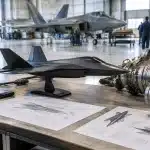
According to a recent analysis by the consulting firm Oliver Wyman, the expenses involved in maintaining, repairing, and overhauling military aircraft are expected to increase significantly in the coming years. This rise is anticipated as more sophisticated aircraft begin to constitute a larger share of military fleets globally.
Oliver Wyman’s analysts, Doug Berenson, Livia Hayes, and Ian Ferguson, highlighted in their study that the worldwide market for military aircraft maintenance, repairs, and overhauls (MRO) was valued at approximately $97 billion in 2025. This figure has seen little change over the past six years.
However, this scenario is set to evolve over the next decade, with MRO expenses increasing at an annual rate of about 1.4%. By 2035, it is projected that global military spending on MRO will exceed $111 billion.
The study, titled “The Military’s Mounting Cost for Cutting-Edge Technology: Why Global Air Forces Will Spend More on their Fleet MRO,” was shared with Defense News by Oliver Wyman.
One major factor contributing to these escalating costs is the increasing prevalence of high-tech aircraft like the F-35 Joint Strike Fighter in military inventories. These aircraft, equipped with stealth capabilities and advanced technologies, require more maintenance time and have higher operating costs compared to older models.
Lockheed Martin has reportedly delivered over 1,170 F-35s globally, with the U.S. Air Force currently operating about 471 F-35As. The service plans to acquire a total of 1,763 of these jets.
The report also notes that approximately 310 fighter jets are purchased annually by military forces worldwide, with around half of these being F-35s. Currently, F-35s represent 2.2% of the global fleet, a figure expected to rise to 4.7% over the next decade.
“By 2035, spending on MRO for the F-35 alone will make up 9.5% of the global total, more than doubling its current share,” the analysis predicts.
In addition to the F-35s, other advanced military aircraft like the B-21 Raider stealth bomber and the F-47 fighter, also known as the Next Generation Air Dominance, are being developed by the Air Force.
The Air Force is also advancing plans for over 1,000 semi-autonomous drone wingmen, known as collaborative combat aircraft, which will accompany manned fighters. These are being developed in collaboration with General Atomics and Anduril Industries.
The U.S. Navy and several European and Asian military forces are also exploring sixth-generation fighters. The report cautions these nations to consider the impact of MRO costs on their budgets as these advanced planes are designed.
Additionally, the report references complex European military aircraft such as the Airbus A400M Atlas transport plane and the NHIndustries NH90 helicopter, which are expected to join military fleets soon.
Currently, complex aircraft make up about 11% of military fleets, but this is anticipated to increase to 17% within a decade.
NATO’s spending on complex aircraft MRO is also expected to rise, from 16% of their MRO budgets today to 26% by 2035.
The growing role of drones in warfare, notably demonstrated in Ukraine, is another factor driving the increase in MRO expenditures. Over the past five years, the number of unmanned aerial vehicles in major air forces has increased by 350, reaching a total of over 1,400. This number is expected to more than double in the next decade, reaching 3,460 worldwide.
“MRO spending [on drones] is rising faster than the expansion of the global fleet,” the report notes. “This surge is fueled by the increased complexity of newer platforms and the urgent demand stemming from the ongoing conflict in Ukraine. For governments operating these drones, this period of heightened growth poses significant challenges and raises questions about readiness levels.”
The report emphasizes the need for governments to balance multiple priorities, including the trade-off between high aircraft readiness and the escalating maintenance costs that come with it.
It also underlines the importance of expanding supply chains for spare parts to avoid reliance on dwindling or defunct sources, a problem that has become particularly acute for older aircraft such as the B-52 Stratofortress.
The report concludes by discussing whether air forces should continue to rely on original equipment manufacturers for MRO tasks, despite the potentially higher costs, or look for alternative solutions.
If air forces fail to adequately budget for these rising MRO costs, other aspects of their airpower capabilities may suffer, as highlighted by the U.S. Air Force’s recent decisions to reduce flying hours and struggle with declining mission-capable rates while prioritizing new technologies and aircraft.
“As it focuses on modernization, the Air Force is attempting to manage these readiness risks,” the report states.
Similar Posts:
- Israel Boosts Air Power: Massive Purchase of F-35 and F-15 Jets Confirmed
- $131 Billion Deal Sealed: Boeing to Ramp Up F-15 Production, Modernization
- US Air Force Faces $14 Billion Deficit: Officials Highlight Urgent Supply Shortage
- Singapore Set to Receive Its First F-35 Fighters: A Milestone Arrival Expected This Year
- US Air Force Considers Northrop Grumman’s Autonomous Drone: A Leap for CCA Program!

Jamal Peterson reports on defense, aerospace, and tech policy. With a military background and a strategic mind, he dissects complex subjects with clarity, offering readers sharp, reliable insights.