Ukraine Enhances Naval Capabilities with Innovative Drone Technology
In Ukraine, an innovative transformation of naval warfare has been achieved by repurposing its notable naval drone, known as the small boat that previously expelled the Russian fleet from the western Black Sea. This transformation involves the drone being adapted into a launching pad for first-person-view (FPV) attack drones, significantly extending Kyiv’s offensive capabilities beyond its shores.
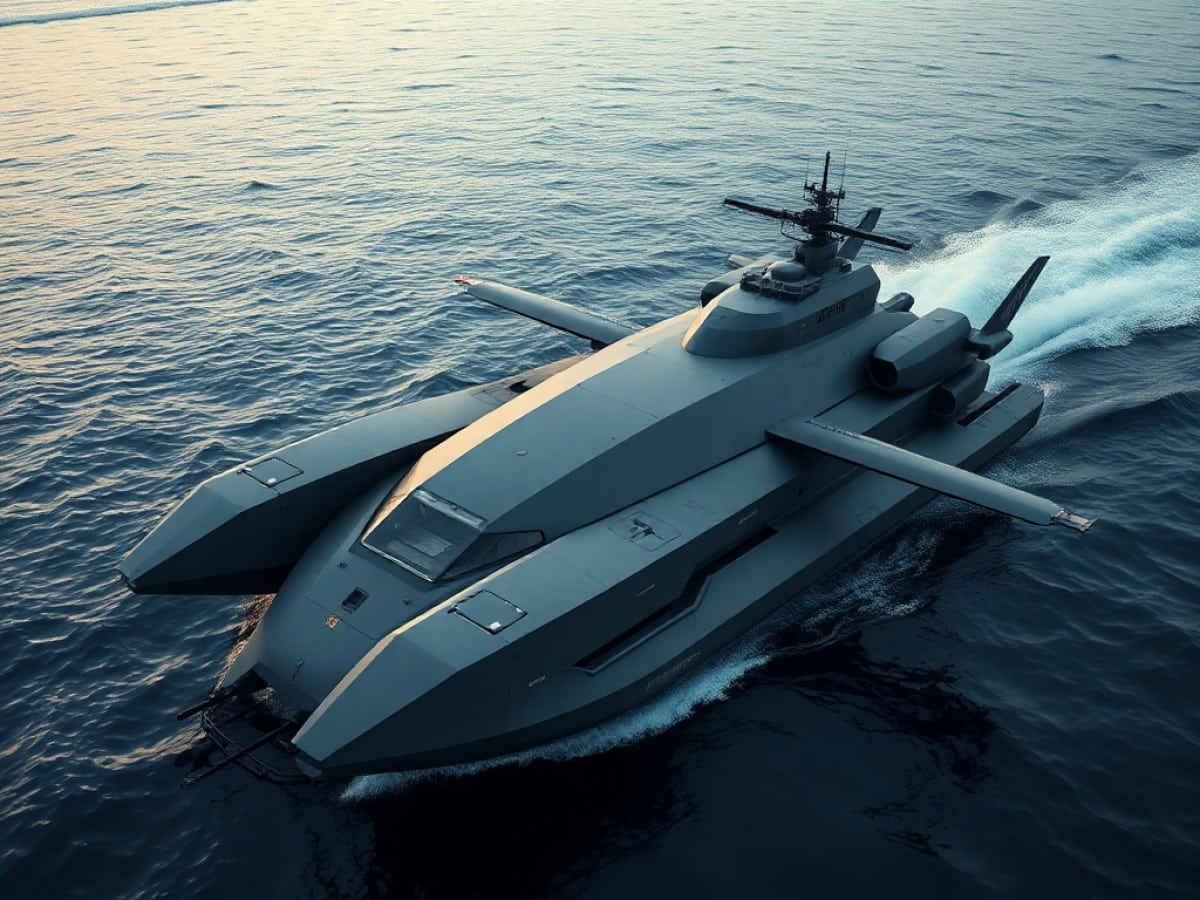
The “Sea Baby,” a strike vessel designed and maintained by the Ukrainian Security Service (SBU), has been equipped to transport six to eight FPV drones. These drones are housed within side compartments that open during combat operations. Additionally, the vessel carries thermobaric Shmel rockets. This information comes from Russian descriptions of the vessel’s activities around the Kinburn Spit, located about 40 miles east of Odesa, as reported by Forbes.
Ukrainian authorities are leveraging these autonomous ships for their ability to approach closer to Russian military installations than any land-based systems. The SBU projects these vessels can travel up to 930 miles (1,500 kilometers) carrying a payload of 4,400 pounds (2,000 kilograms). Some of the onboard drones are controlled via fiber-optic cable, which protects them from the radio jamming that typically affects standard FPVs, according to details from Forbes.
Ukraine has ingeniously converted nearly all available platforms into FPV launchers. In September, sea drones equipped with fiber-optic FPVs targeted the Russian ports of Tuapse and Novorossiysk. Additionally, various companies have modified ground robots to deploy these drones, and both conflict parties have utilized balloons for this purpose.
“The SBU pioneered this new type of naval warfare globally,” stated Brig. Gen. Ivan Lukashevych during an October 2025 presentation of the latest generation of the Sea Baby, “and we are continually advancing this technology.”
Diverse Drone Systems in Ukrainian Naval Strategy
The Ukrainian naval forces utilize two primary types of naval drones. The Sea Baby, operated by the SBU, and the Magura, developed by Uforce for the GUR, Ukraine’s military intelligence directorate, each have distinct designs and operational capabilities.
Primarily operated via remote control from a mobile ground station, the Sea Baby is equipped with AI-assisted systems for targeting and navigation, allowing it to function autonomously when communications are disrupted or jammed—a critical feature given the intense electronic warfare environment over the Black Sea.
American military forces have also started to adopt these innovative vessels. On June 24, during the Balikatan 2026 exercises in the Philippines, U.S. special forces successfully used a Ukrainian Magura to sink a target ship, marking the technology’s first deployment in the Indo-Pacific region.
The U.S. military’s interest in these drones is not merely experimental. The relatively low-cost, expendable boats that can deliver a cluster of attack drones close to targets align well with American strategic needs, especially considering the potential for conflict across the expansive Pacific Ocean.
Oleg Roginsky, CEO of Uforce, confirmed the operational success of the Magura on the Ukrainian-Russian front and its potential utility in the Indo-Pacific, in a recent interview with Bloomberg. Following the lifting of an export ban in 2025, Uforce is exploring production possibilities in the Indo-Pacific region to meet growing demand.
Since 2022, Ukrainian naval drones have sunk or damaged approximately a dozen Russian warships, compelling the Black Sea Fleet to relocate its primary operations to Novorossiysk, as reported by the U.S. Naval Institute in September. Each drone vessel costs a few hundred thousand dollars, significantly less than a single modern torpedo.
This cost-effective strategy has not gone unnoticed by the Pentagon, which is reevaluating its own tactical approaches as it prepares for potential conflicts, notably with China. The U.S. Navy plans to deploy thousands of these small uncrewed surface vessels across the Indo-Pacific by 2030, according to Capt. Garrett Miller of the Surface Development Group One, as reported by USNI News in April.
The Center for Strategic and International Studies has also recommended that the U.S. military adopt Kyiv’s practical and battlefield-tested defense acquisition strategies.
Continuing its trail of innovation, Ukraine achieved a significant milestone with its Sub Sea Baby underwater drone, which struck an Improved Kilo-class submarine in its dock at Novorossiysk on December 15, marking the first instance an unmanned underwater vehicle has hit a submarine in port. Despite Russian denials of any damage, satellite imagery revealed significant effects from the attack, suggesting a successful mission kill.
NATO forces are now also incorporating Ukraine’s advanced tactics, evidenced by the Ukrainian navy leading a NATO red team to victory against the alliance’s blue force in all five scenarios during the REPMUS naval-drone exercise in Portugal last September.
Similar Posts:
- Kyiv’s Drone Strategy Influences US: Top Ukrainian Official Predicts Moscow Will Be Next
- Finland Shuts Airspace, Limits Sea Traffic Near Russia: Drone Threats Escalate
- Swedish Navy Captures Russian Drone Near French Carrier: Tensions Rise in Baltic Sea
- Ukraine’s Ingenious Warfare: Pringles Cans Transformed into Drone Weapons
- CIA Director Reveals: Russian Troops Last Only 20-30 Minutes in Ukraine Frontline Combat

Jamal Peterson reports on defense, aerospace, and tech policy. With a military background and a strategic mind, he dissects complex subjects with clarity, offering readers sharp, reliable insights.