Ukraine’s Innovative Stratospheric Missile System
KYIV, Ukraine — Ukraine is currently developing an advanced missile that is launched from a balloon positioned at the brink of the stratosphere. This new weapon is designed to navigate through Russian electronic interferences, marking a significant addition to Kyiv’s expanding arsenal for mid-range offensive operations. The aim is to compel the Kremlin to withdraw its troops and revisit peace talks.
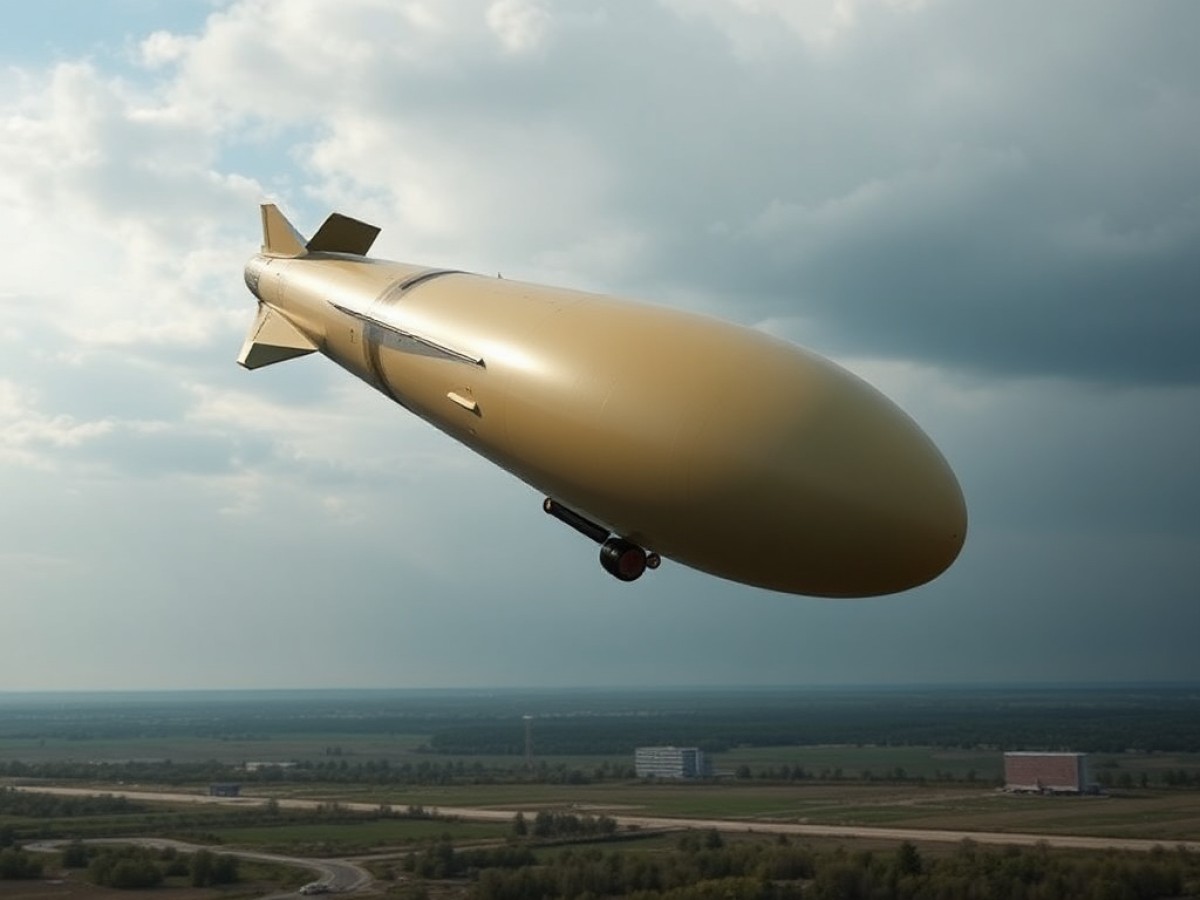
The missile, named DART, is released from a balloon floating approximately 7 to 11 miles above ground. It utilizes satellite navigation down to about 4 miles altitude, after which it continues its trajectory on a preset course powered by a solid-fuel engine, as reported by the designers at the Ukrainian Center of Innovative Technologies Program.
By design, once the missile’s navigation system deactivates, it becomes impervious to Russian jamming technologies, ensuring the missile remains on its intended path.
Developed as a cost-effective and stealthy solution capable of penetrating electronic defenses, the DART missile is launched from balloons instead of traditional aircraft or ground launchers. This method provides a silent and economically viable means to deliver guided munitions deep into Russian territory.
The missile is equipped with a warhead weighing roughly 22 pounds, packed with conductive graphite filaments intended to disrupt Russian electrical grids. However, it has not yet been officially included in the Ukrainian military’s arsenal, according to Militarnyi.
Strategic Deployment of Balloons by Ukrainian Forces
Retired Colonel Viktor Kevliuk, a veteran with 35 years of service in the Ukrainian Army and currently affiliated with the Kyiv-based Center for Defense Strategies, explained to Euromaidan Press the strategic uses of balloons by the Ukrainian Defense Forces. These platforms are primarily utilized for support, medium, and deep strike operations due to their cost-efficiency, radar evasion capabilities, prolonged air time, and payload capacity.
Colonel Kevliuk disclosed that over 1,000 such balloons have been deployed over Russian territories. These balloons take advantage of prevailing westerly winds to travel deep into Russia, even reaching Moscow, where they have been detected by air defenses at altitudes around 6 miles during a past offensive in September.
The introduction of these balloon-launched guided missiles represents a pivotal moment in the conflict, with Ukraine reclaiming more territory than it has lost since the start of its 2023 counteroffensive. This development is linked to Ukraine’s superior drone technology, which has been instrumental on various fronts, according to the Institute for the Study of War.
This technological advantage has started to alter the dynamics at the negotiation table, drawing interest from the United States in Ukraine’s military technologies. Ukrainian President Volodymyr Zelenskyy has been actively promoting a strategy of deploying cruise missiles and drones, capable of striking targets up to 600 miles inside Russia, a tactic he describes as “long-range sanctions” against Moscow’s war efforts.
Utilizing balloons for such long-range engagements offers a strategic advantage by allowing payloads to drift over a hundred miles before releasing drones or missiles that can travel several hundred additional miles, effectively extending their operational range beyond what each platform could achieve independently.
Operational Tactics and International Interest
Traditionally, Ukraine has employed military balloons for surveillance and as decoys. These cost-effective balloons can provoke expensive defensive responses from Russian forces, which include firing high-cost interceptors at low-value targets.
A notable combined strike operation involving several balloons was carried out over Moscow and Tatarstan, which analysts believe was designed to confuse Russian air defenses, as reported by United24 citing Russian sources.
The offensive utility of balloons was showcased publicly in May when footage surfaced online of an American-made attack drone, known as the Hornet, descending from a Ukrainian balloon. This event, widely shared across Ukrainian military channels, marked the first visual confirmation of Kyiv integrating a balloon with a precision strike drone. The Hornet, developed by the American company Perennial Autonomy and extensively used by Ukrainian forces, was launched from a balloon, significantly conserving its battery life for extended operational reach.
The founder of Perennial Autonomy, former Google CEO Eric Schmidt, has been instrumental in the drone’s development, which stems from his previous ventures in Ukraine. These ventures recently secured a significant counter-drone contract from the American military, worth up to $500 million.
The U.S. Army is also exploring the potential of balloon-based systems for drone deployment and communications, reflecting a growing interest in this low-cost, high-efficiency technology. Meanwhile, despite geographical challenges that hinder the effectiveness of similar Russian initiatives, Moscow continues to test its own balloon systems for military purposes.
This ongoing development and deployment of balloon-assisted weaponry and surveillance tools underscore a significant evolution in military tactics employed by Ukraine, potentially setting a precedent for future conflicts worldwide.
Similar Posts:
- Ukrainian Unmanned Vessel Destroys Shahed Drone: A First in Maritime Warfare!
- Ukraine Set to Deploy Advanced Ballistic Missiles: Combat Readiness Just Weeks Away
- CIA Director Reveals: Russian Troops Last Only 20-30 Minutes in Ukraine Frontline Combat
- Kyiv’s Drone Strategy Influences US: Top Ukrainian Official Predicts Moscow Will Be Next
- Ukraine Unleashes Strike-Drones From All Platforms: Including Innovative Black Sea Robo-Boats

Jamal Peterson reports on defense, aerospace, and tech policy. With a military background and a strategic mind, he dissects complex subjects with clarity, offering readers sharp, reliable insights.