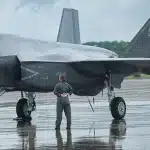
Northrop Grumman and Kratos Defense and Security Solutions have joined forces to develop autonomous aerial drones to serve as wingmen for the U.S. Marine Corps, as declared by the companies on Thursday.
The collaboration focuses on enhancing Kratos’ autonomous Valkyrie drone, aiming to swiftly adapt it for operation alongside manned Marine Corps fighters in high-risk areas, according to a joint statement by Northrop and Kratos. The initiative is part of the Marine Air-Ground Task Force Uncrewed Expeditionary Tactical Aircraft, or MUX TACAIR, program which focuses on collaborative combat aircraft.
Krys Moen, the Vice President for Advanced Mission Capabilities at Northrop, mentioned in a statement to Defense News that the contract is structured as an other transaction agreement, initially valued at $231.5 million over a 24-month period.
“Northrop Grumman continues to lead in advanced sensing technologies, providing innovative, reliable solutions at remarkable speeds to support both manned and unmanned systems,” Moen elaborated in the release.
No immediate comment was available from the Marine Corps at the time.
The Valkyrie drone, also known as the XQ-58, has undergone thorough testing by both the U.S. Air Force and the Marine Corps, especially under the Air Force’s Skyborg initiative. This program has been pivotal in establishing the foundation for what the military terms as collaborative combat aircraft (CCA).
Designed to operate with minimal human guidance, CCAs enhance the capabilities of nearby manned fighters, improving effectiveness and reach economically. They are capable of performing strike operations, jamming communications, carrying out reconnaissance missions, or even acting as decoys to divert enemy fire.
The Air Force has prioritized integrating CCAs into their operations, to accompany manned aircraft like the F-35 and the forthcoming F-47. The U.S. Navy and Marine Corps are also developing their CCA capabilities.
In 2025, the Marine Corps officially recognized the Valkyrie as a program of record. Following this decision in August, Kratos’ CEO Eric DeMarco informed investors about plans to manufacture new Valkyrie variants in the U.S. specifically for the Marine Corps, marking their first foray into CCAs.
The Valkyrie CCA for the Marine Corps will be capable of handling various missions thanks to its modular design and adaptable payload bays. It also features conventional takeoff and landing capabilities.
“The merging of Kratos Valkyrie with Northrop Grumman’s top-tier multifunction mission systems creates a highly capable CCA, priced to allow mass deployment alongside manned aircraft,” explained Steve Fendley, president of Kratos’ unmanned systems division.
Northrop Grumman is set to equip the Valkyrie with an advanced mission kit that includes sensors and software-defined technologies, customized for unmanned aircraft and compactly packaged. These technologies are versatile and capable of both kinetic and non-kinetic operations, preparing the Valkyrie for diverse combat roles.
The drone will operate using Northrop’s proprietary open architecture autonomy software called Prism.
This marks Northrop Grumman’s second significant advancement in the CCA market recently. In December, the Air Force named Northrop’s new Talon drone the YFQ-48A, recognizing it as a promising candidate for their CCA program.
Kratos has also seen substantial growth in its defense revenues, bolstered by its specialization in autonomous drones. Last year, the company climbed to 91st in the Defense News Top 100 list, with defense revenues amounting to $988.7 million.
Similar Posts:
- US Air Force Considers Northrop Grumman’s Autonomous Drone: A Leap for CCA Program!
- Navy’s Massive Drone Deal: Top Five Defense Contractors Secure Lucrative Contracts!
- F-22 Raptor Teams Up With Avenger Drone: A Pioneering Combat Flight Test!
- US Companies Battle for Control of Norway’s Maritime Drone Market
- Boeing’s MQ-28 Ghost Bat Debuts: See the Future of Drones at Farnborough Airshow!

Jamal Peterson reports on defense, aerospace, and tech policy. With a military background and a strategic mind, he dissects complex subjects with clarity, offering readers sharp, reliable insights.