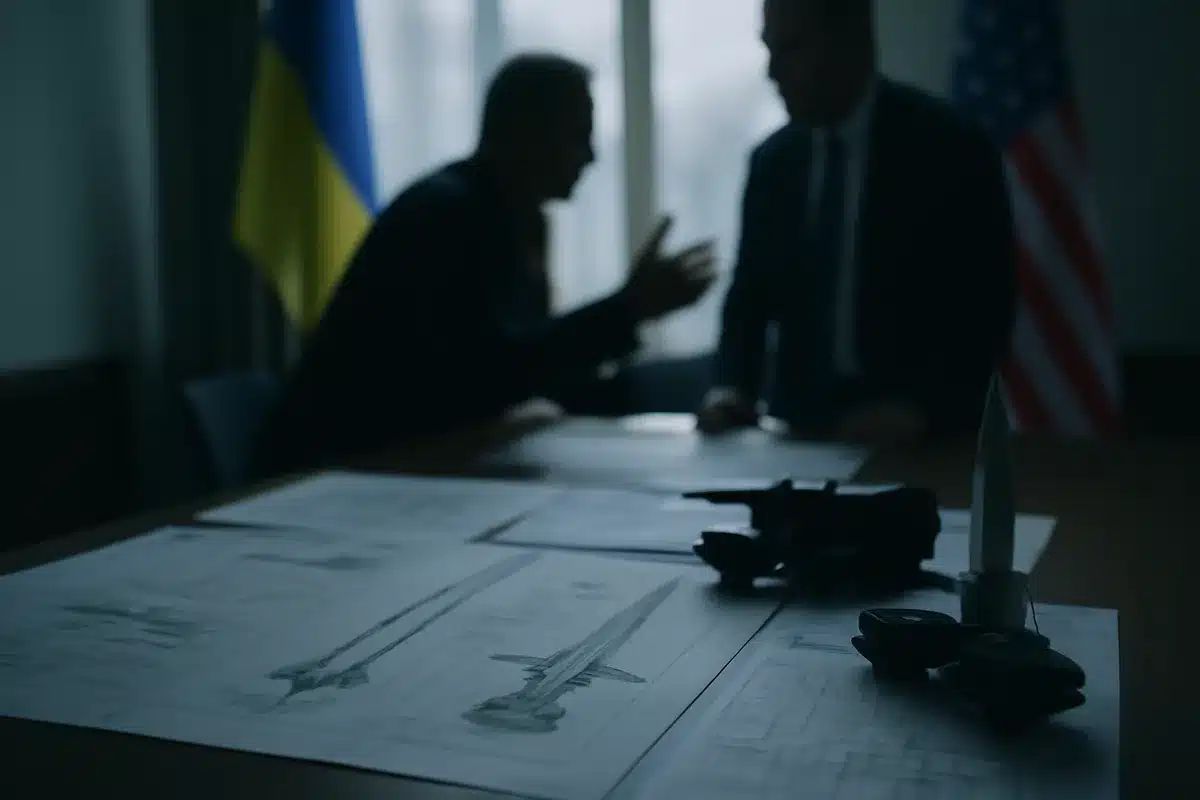
KYIV, Ukraine — Despite U.S. President Donald Trump’s recent announcement promising Kyiv the rights to manufacture Patriot missile systems, complications have arisen as Lockheed Martin and Raytheon reassess the viability of such a partnership amid bureaucratic challenges in Washington.
U.S. authorities are also showing signs of hesitation. Trump expressed concerns in a July 20 interview with the Financial Times, stating that the U.S. must be “somewhat cautious about licensing.” Nevertheless, Ukrainian President Volodymyr Zelenskyy communicated via X on Saturday that an agreement has been finalized between the two parties.
The slow pace of progress may stem from fears among U.S. defense leaders that Kyiv might emerge as a rival in the defense market, rather than any immediate risk to technology or intellectual property, according to a Republican Capitol Hill official speaking to The Atlantic.
“The genuine concern is that the Ukrainians might enhance the Patriot systems and then mass-produce them more quickly and cheaply than current U.S. production capabilities,” the official noted, stating that the firms would likely publicly cite concerns over “IP theft and technology transfer” instead.
The Ukrainian arms industry has seen significant growth, sharpened by nearly five years of intense conflict following Russia’s full-scale invasion and exacerbated by the U.S.-Israel conflict with Iran this spring. This latter conflict has reportedly depleted about two-thirds of America’s pre-conflict Patriot interceptor stocks, prompting urgent discussions about military inventory and strategy.
Several defense collaborators are keen to partner with Ukraine, recognizing its valuable experience in managing a large-scale land war, and are interested in developing cost-effective, rapid-production alternatives to expensive weaponry.
This emerging competitive landscape poses a challenge for defense giants—not because of a direct threat of technology theft by Ukraine, but rather the potential for Ukraine’s partners to surpass existing production levels, thereby disrupting the current monopoly on anti-ballistic capabilities and associated revenues.
Trump originally committed to the licensing during the July NATO summit in Ankara, offering Ukraine the chance to produce Patriot missiles domestically for the first time.
“We’re granting you a license to produce Patriots. That’s pretty impressive. This way, you won’t say we’re not providing enough,” Trump remarked, mentioning that the involved companies had not been consulted about the decision yet.
Zelenskyy later clarified that the issue had been “politically resolved,” urging that technical teams begin work immediately to expedite the licensing process and initiate production in Ukraine as soon as feasible.
Shortly after Trump’s commitment, Ukraine and nine European nations, along with defense giants such as Eurosam, Leonardo, Thales, and Saab, formed a coalition in Paris to develop Freyja, a new anti-ballistic system centered around a Ukrainian interceptor priced at about one-fifth the cost of a Patriot missile.

Subsequently, at the Farnborough International Airshow, Lockheed introduced a less expensive, quicker-to-produce Patriot missile variant, the PAC-3 ACE, priced at approximately $2 million per round—less than half of what Ukraine currently pays to counter Russian ballistic missiles.
The development timeline for Patriot missiles is typically lengthy. The current top model, the PAC-3 MSE, was first accepted by the U.S. Army in 2015 and reached full-rate production three years later, according to the Missile Defense Advocacy Alliance.
On July 21, a day after unveiling the ACE, Tim Cahill, president of Lockheed Martin Missiles and Fire Control, described the production discussions with Ukraine as still “in the early stages,” committing to support the U.S. Army and Trump administration’s decisions, as reported by Breaking Defense.
Raytheon’s exploration into the feasibility of this partnership has just begun, according to Tom Laliberty, its president of land and air defense systems, who spoke at the same airshow.
Following these discussions, Zelenskyy praised Raytheon’s willingness to elevate their partnership to include joint production of critical air defense assets like the Patriot interceptors, after meetings with company representatives.
However, when Zelenskyy requested “several hundred” interceptors during a July 28 meeting in the Oval Office, Trump declined, citing depleted American stockpiles, as per a report by The Atlantic.
Three days later, Trump completely reversed his stance on the licensing agreement.
“We have not agreed to that,” he stated during a Camp David Cabinet meeting. “We’re considering it, but it’s difficult to part with such technology.”
Subsequently, U.S. NATO Ambassador Matthew Whitaker tempered expectations further on August 3, informing Fox News that “we do not permit anyone but U.S. manufacturers to produce these in the United States,” and indicating that a long-term production agreement “will not be concluded before this winter,” according to Euronews.
The current status of the agreement remains uncertain.
“The decision has been made,” Zelenskyy stated during a weekend interview on Ukrainian television, as reported by United24. “It was decided by the President of the United States and other significant American government bodies.”
As of now, American officials have not responded to Zelenskyy’s latest remarks.
Similar Posts:
- Germany Aims to Produce U.S. PAC-3 Interceptors: Boosting Global Defense Capabilities
- Lockheed Martin Receives Key Patriot Interceptor Parts: General Motors Delivers First Batch!
- EU Official Warns: Europe Must Develop Its Own Air-Defense Missiles, Can’t Depend on US
- Ukraine Seeks EU Funding for First Patriot Missiles Purchase: A Strategic Defense Move
- US-Ukraine Intel Skyrockets as Kyiv Scores Big Wins: Everybody Loves a Winner!

Jamal Peterson reports on defense, aerospace, and tech policy. With a military background and a strategic mind, he dissects complex subjects with clarity, offering readers sharp, reliable insights.