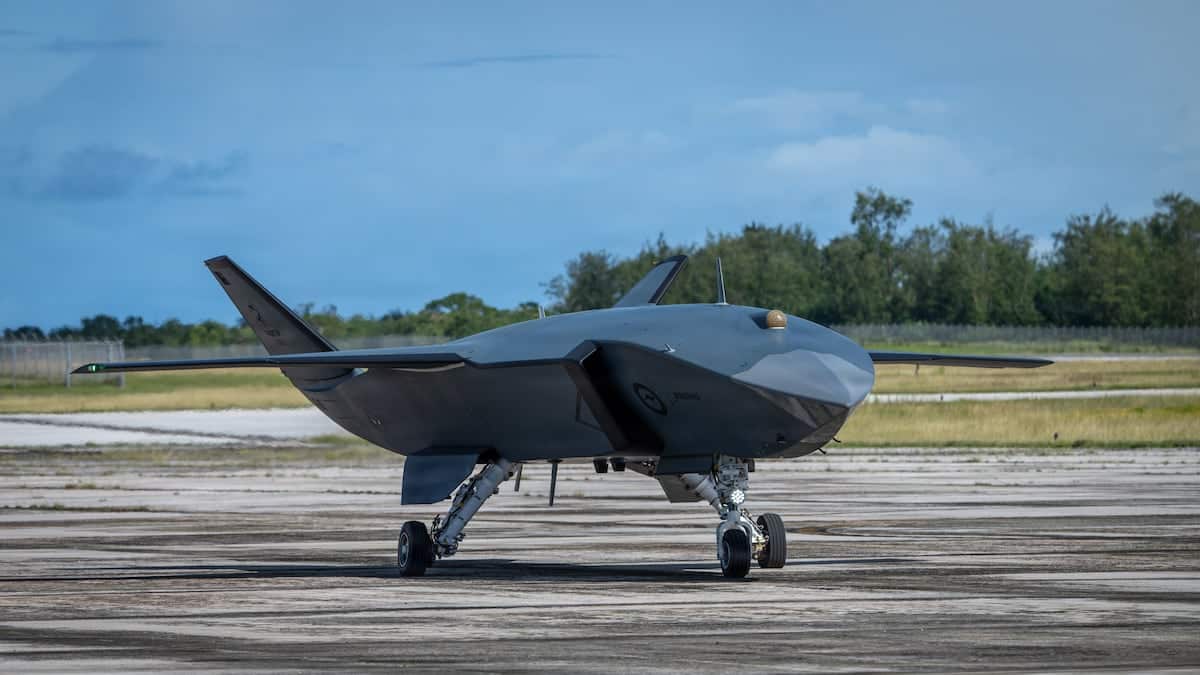
LONDON — On a particularly warm day in London, the sun illuminated the metallic surface of an aircraft, its sleek, streamlined design possibly leading an uninformed passerby to mistake it for a small fighter jet.
Though it may operate alongside fighter jets, no pilot will ever strap into the Boeing MQ-28 Ghost Bat, as it is designed to fly without a human on board.
This week at the Farnborough International Airshow, Australia showcased its unmanned, flight-ready aircraft, the Ghost Bat. This marked its first appearance in what the company describes as the inaugural multinational collaborative combat aircraft (CCA) to partake in a joint operational exercise.
In June, the Ghost Bat was tested alongside manned aircraft over the Marinas Island Range Complex in the Western Pacific during Exercise Valiant Shield 2026. Boeing reports that the CCA flew in formation with F-35A and F-35B jets, among others, refining tactical maneuvers.
These exercises were conducted with the support of the U.S. Pacific Command and were integral to the operations of the U.S. Air Force’s Experimental Operation Unit.
“The involvement of the MQ-28 in such a pivotal military exercise marks a premiere event, and it’s just the beginning of how sophisticated human-machine teaming can expand the capabilities and situational awareness of manned aircraft, improving joint operational effectiveness,” stated Steve Parker, President and CEO of Boeing Defense, Space and Security. “This proves its readiness for combat,” he added.
Following these exercises, the Ghost Bat demonstrated its combat capabilities by successfully firing an AIM-120 AMRAAM missile and destroying a drone during a live-fire test.
Designed with a mission radius exceeding 2,000 nautical miles, the Ghost Bat supports manned jets in roles such as surveillance and electronic warfare.
According to Boeing, the aircraft possesses the length typical of a trainer jet and the wingspan comparable to that of a modern stealth fighter, capable of reaching altitudes above 40,000 feet.
For years, the potential for growth in autonomous aircraft has been recognized by industry leaders, who advocate for manned-unmanned teaming as a strategic advantage against competitors like China.
This year, advancements have been made as industry prepares for a new era of air combat dominated by unmanned aerial systems, such as the Ghost Bat.
With the increasing data demands on pilots, BAE Systems introduced a new helmet designed to help pilots manage large volumes of information and control drone wingmen—fleets of drones under human command.
The U.S. Air Force is also embracing the integration of unmanned aircraft in their missions, having recently awarded CCA contracts to Anduril for its FQ-44A “Fury,” and to General Atomics for its FQ-42A, both of which were featured at the airshow.
Similar Posts:
- Australia Readies for ‘Ghost Bat’ Warplane Drones: A New Era in Military Technology!
- F-22 Raptor Teams Up With Avenger Drone: A Pioneering Combat Flight Test!
- Revolutionary Development: US Air Force to Establish Dedicated Drone Wingman Squadrons
- Boeing Wins Big: Selected to Build US Navy’s Next-Gen F/A-XX Fighter!
- US Navy and Boeing Seal Deal on First MQ-25A Stingray Drones: Revolutionizing Aerial Refueling!

Jamal Peterson reports on defense, aerospace, and tech policy. With a military background and a strategic mind, he dissects complex subjects with clarity, offering readers sharp, reliable insights.