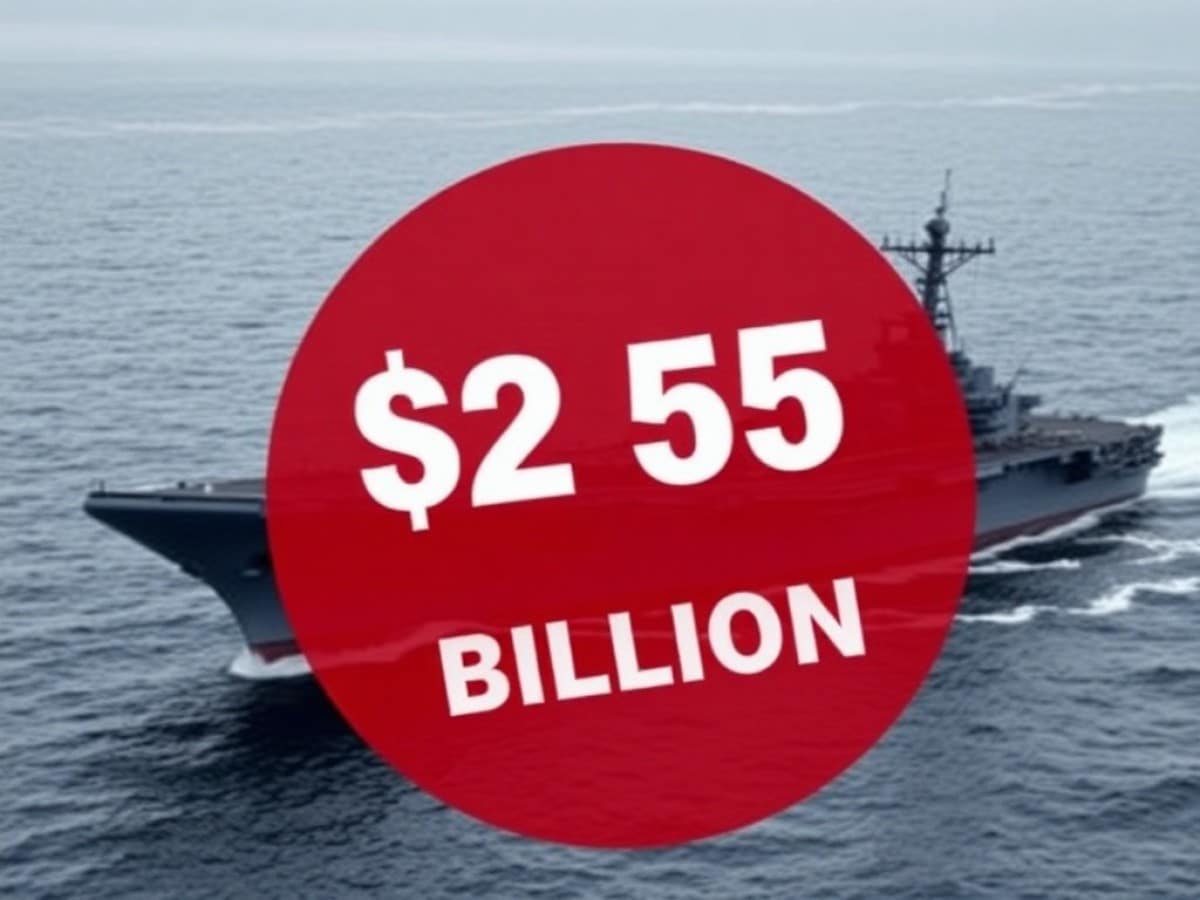
The projected expense for acquiring the Navy’s new nuclear-powered battleships, known as the Trump-class battleships (BBG(X)), could reach an astonishing $275 billion. A report from the Congressional Budget Office released on Wednesday indicates that the initial ship in this class would cost about $23.4 billion.
In December, the Trump administration disclosed plans to construct a new series of large surface combatants, termed the Trump-class guided missile battleships.
Should these plans materialize, the 35,000-ton nuclear battleship would be equipped with the most formidable array of weaponry ever seen on a U.S. Navy vessel, including anti-air and anti-ship missiles, land-attack capabilities, hypersonic and nuclear cruise missiles, as well as advanced large lasers and a railgun, as per the report.
“The design specifications would make this ship the largest surface combatant globally and the biggest the Navy has built since the Second World War,” the report states. “It would be over three and a half times larger than the Navy’s Arleigh Burke-class guided missile destroyer and more than double the size of the Zumwalt-class guided missile destroyer.”
The Navy aims to construct 15 Trump-class guided missile battleships from 2028 to 2056, with each of the subsequent 14 ships projected to cost $18 billion. For comparison, the USS Gerald R. Ford, a leading nuclear-powered aircraft carrier of the U.S. Navy, was built at an approximate cost of $13.3 billion.
By 2058, the total tonnage of “large surface combatants” planned for construction would need to increase by 60 percent, presenting a significant challenge to the shipbuilding industry, according to the report.
A shift from smaller surface combatants to these larger ships would require shipyards to produce 12% more tonnage in 2035 under the 2027 plan than was projected in the 2025 version, the Congressional Budget Office estimates.
To meet these ambitious goals, the Navy would need to construct a battleship approximately every other year between 2028 and 2056, while also continuing to build two DDG-51 destroyers annually, the report notes.
In a related report last March from the Government Accountability Office, nearly two decades of subpar achievements in U.S. shipbuilding were highlighted. This included insufficient numbers of ships being built, operational failures in newly built ships, and delays in delivery times by up to three years.
In testimony to the Senate Armed Services Committee, Shelby S. Oakley, a director at the GAO, criticized the unrealistic expectations for costs and scheduling that have led to resource diversion and delays in shipbuilding, forcing Navy programs and shipbuilders to continually operate in crisis management mode.
Furthermore, the report suggests that although the initial investment for these nuclear-powered battleships is substantial, the operational costs could be lower over time due to the elimination of the need to purchase fuel, although no specific savings estimates were provided by the GAO.
Since the announcement in December, the estimated cost of Trump-class battleships has fluctuated, with the latest figure of $23.4 billion being around six billion higher than the initial projections by the Navy.
Similar Posts:
- Navy Set to Launch Construction of Two ‘Trump Class’ Battleships: Find Out More!
- China’s Military Experts Eagerly Anticipate New Era of U.S. Navy Battleships
- US Navy Plans Creation of New, Agile Class of Compact Combat Ships
- Navy’s Massive $76.6 Billion Deal: Boosting Virginia and Columbia-class Submarines
- Boost Your Maritime Strength: How US Navy Can Leverage Allies, New Report Reveals

Jamal Peterson reports on defense, aerospace, and tech policy. With a military background and a strategic mind, he dissects complex subjects with clarity, offering readers sharp, reliable insights.