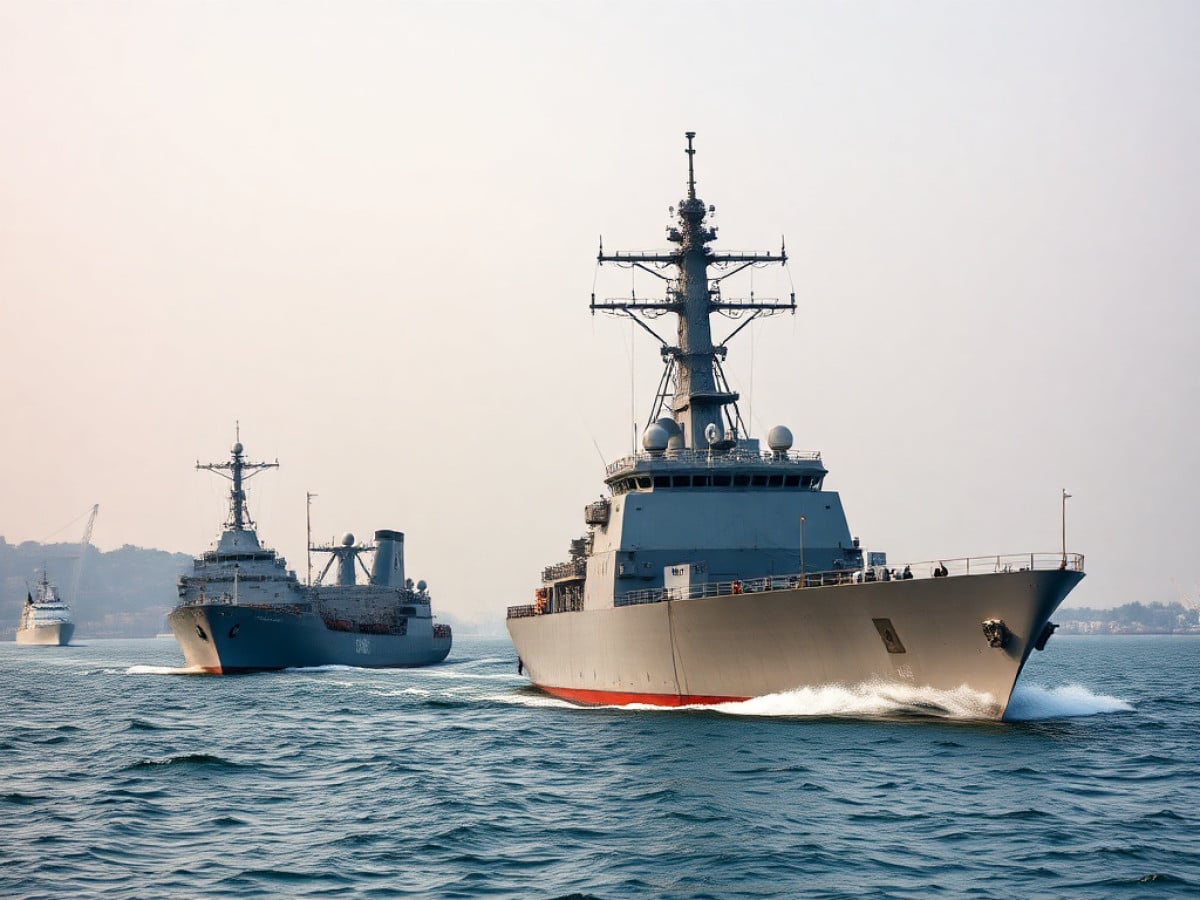
NEW DELHI — Recent events saw two Iranian naval vessels docking in India and Sri Lanka following an incident where a U.S. submarine struck down an Iranian warship in the Indian Ocean near Sri Lanka.
The destruction of the Iranian warship Iris Dena on March 4th marks the first occurrence of military action outside the Middle East since the onset of the conflict. This event has sparked fears among analysts that the ongoing U.S.-Israeli military operations against Iran might extend beyond the Persian Gulf region.
This incident has also caused diplomatic discomfort for India, which had previously welcomed the now-sunken ship as part of peaceful, multilateral naval exercises.
All three Iranian ships involved — including the two that recently entered ports in India and Sri Lanka, along with the targeted vessel — were navigating the Indian Ocean following their participation in naval drills off the eastern coast of India.
The governments of India and Sri Lanka have described their decision to allow these ships into their ports as a humanitarian measure.
India’s Foreign Minister, Subrahmanyam Jaishankar, addressed parliament, stating that the Iranian vessel Iris Lavan entered the southern port of Kochi last week due to a technical issue. The ship’s crew, largely composed of young cadets, is currently accommodated at Indian naval facilities. Jaishankar emphasized that assisting the crew was the appropriate action to take.
Sri Lanka also played a crucial role by taking in Iran’s Irins Bushehr at the Trincomalee port after the ship reported an engine failure. This intervention came shortly after the Sri Lankan navy had saved 32 sailors and retrieved 87 bodies from the sunken Dena.
Amidst the ongoing conflict, Sri Lanka has chosen to remain neutral, declaring that it will not take sides.
India maintains cordial relationships with all parties involved in the conflict — the U.S., Israel, and Iran — and has carefully avoided taking a definitive stance since the conflict erupted. The Indian government has not officially commented on the destruction of the Dena. Foreign Minister Jaishankar remarked that the ships found themselves “on the wrong side of events.”
The U.S. has publicly committed to disrupting Iran’s military capabilities, including its naval forces.
U.S. Defense Secretary Pete Hegseth recently declared that an American submarine had sunk an Iranian warship, which was believed to be secure in international waters, describing the attack as a “quiet death.”
This strike, executed close to the shores of Sri Lanka, has raised concerns about the potential broadening of the military campaign against Iran. According to Arun Prakash, a former chief of the Indian navy, the sinking suggests that the conflict could spread beyond the Persian Gulf. Prakash also speculated that this act might serve as a warning to India and others about the extensive reach of U.S. military capabilities.
The naval exercises hosted by India, which saw participation from 74 countries and 18 foreign warships, were meant to underline India’s influence in its maritime neighborhood. India has been actively building up its naval strength, aspiring to become the “preferred security partner” in the strategically crucial Indian Ocean, which is vital for the global oil trade.
However, analysts have pointed out that the sinking of the Dena has overshadowed India’s regional ambitions. Manoj Joshi, a distinguished fellow at the Observer Research Foundation in New Delhi, commented that this incident exposes a gap between India’s stated position as a protector in the Indian Ocean and the reality. Although India was not obliged to defend the ship, there was a moral dimension to consider since the ship was participating in an event hosted by India.
Joshi also noted that the defense partnership between New Delhi and Washington, despite being strong, has its asymmetries and limitations, highlighting that the U.S. operates independently in the region according to its interests.
During his visit to New Delhi last week, Iranian Deputy Foreign Minister Saeed Khatibzadeh expressed that India should question the U.S. regarding its targeting of Iranian ships in the Indian Ocean.
The legitimacy of the Dena as a wartime target remains a point of contention between Iran and the U.S. While Iran insists the ship was unarmed, this claim has been dismissed by the United States Indo-Pacific Command.
Similar Posts:
- India Supercharges Submarine Fleet: Boosting Nuclear and Conventional Combat Capabilities!
- India Advances in Defense: Homegrown Long-Range Air Defense System Nears Completion
- India Eyes Key Role in France’s Advanced Sixth-Generation Fighter Jet Program: Strategic Partnership Ahead?
- Australian Submariners’ Close Encounter: Tense Moments with Iran Warships Unveiled!
- US-Iran Blockade: Experts Warn of Major Military Challenges Ahead

Jamal Peterson reports on defense, aerospace, and tech policy. With a military background and a strategic mind, he dissects complex subjects with clarity, offering readers sharp, reliable insights.