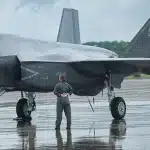
Shield AI Introduces Advanced AI-Driven Unmanned Fighter
Shield AI has recently unveiled a groundbreaking uncrewed combat aircraft, capable of vertical takeoffs and landings, dubbed the future of military aviation and a significant development in the drone wingmen strategy.
The X-BAT Drone: Designed for Challenging Environments
The newly introduced drone, named X-BAT, is engineered for use in expeditionary and maritime settings where the environment is highly contested. Central to its operation is Shield AI’s Hivemind software, which serves as the autonomous control system, as announced by the company this Wednesday.
According to Shield AI, the X-BAT’s vertical takeoff and landing capabilities eliminate the dependency on runways, potentially revolutionizing air combat tactics for the U.S. and its allies.
Brandon Tseng, co-founder and president of Shield AI, emphasized the strategic advantage of this capability, stating, “Airpower without runways is the holy grail of deterrence. It ensures our forces have persistence, reach, and survivability, extending the window for diplomatic engagements.”
The X-BAT, leveraging the Hivemind technology, can autonomously navigate contested airspaces, collaborate with manned aircraft, and execute coordinated tactics without the need for continuous communication. This enables it to function independently or as part of a team, aligning with the Air Force’s concept of collaborative combat aircraft (CCA).
Prior Successes and Capabilities of Hivemind Technology
The U.S. Air Force has previously employed Hivemind technology to pilot the X-62A VISTA jet, an autonomously flown modified F-16 capable of engaging in air combat, which former Air Force Secretary Frank Kendall experienced firsthand in May 2024.
The X-BAT boasts an impressive range exceeding 2,000 nautical miles when fully armed, allowing operations from ships, islands, or other austere locations lacking traditional runways. Its versatility supports a variety of missions such as strike, counter-air operations, electronic warfare, and intelligence, surveillance, and reconnaissance tasks.
Armor Harris, Shield AI’s senior vice president of aircraft, described the X-BAT as a “revolution in airpower,” citing its vertical takeoff and landing capabilities, extended range, autonomy, and multifunctional roles. “VTOL plus range addresses survivability on the ground and reduces tanker dependency. Its multirole capabilities are crucial as threats evolve, and its autonomous operations simplify complex mission execution,” Harris stated.
Economic and Strategic Benefits of X-BAT
While specific cost details were not disclosed, Shield AI indicated that the acquisition and operational expenses of the X-BAT would be considerably lower than those of fifth-generation fighter jets, making it an economically viable and expendable option during high-risk missions.
Emphasizing affordability and expendability, the Air Force has prioritized these attributes in its CCA program, aiming to enhance mission capabilities without fiscal strain, a strategy described as “affordable mass.”
It’s noteworthy that CCAs, including the first two prototypes from General Atomics and Anduril, carry mission design series designations beginning with YFQ, indicating their dual role as fighters and drones, following Air Force nomenclature conventions.
Shield AI also highlighted the compact size of the X-BAT, with up to three units able to fit within the space typically required for one conventional fighter or helicopter. Moreover, its design is platform-agnostic, facilitating integration with both existing and future Air Force and Navy systems.
Similar Posts:
- Poland Considers Joining X-BAT Program: A Leap Towards Autonomous Vertical-Takeoff Fighters
- Boeing’s MQ-28 Ghost Bat Debuts: See the Future of Drones at Farnborough Airshow!
- F-22 Raptor Teams Up With Avenger Drone: A Pioneering Combat Flight Test!
- US Air Force Considers Northrop Grumman’s Autonomous Drone: A Leap for CCA Program!
- Revamped Air Force Fleet Takes Flight Under Wilsbach’s Command

Jamal Peterson reports on defense, aerospace, and tech policy. With a military background and a strategic mind, he dissects complex subjects with clarity, offering readers sharp, reliable insights.