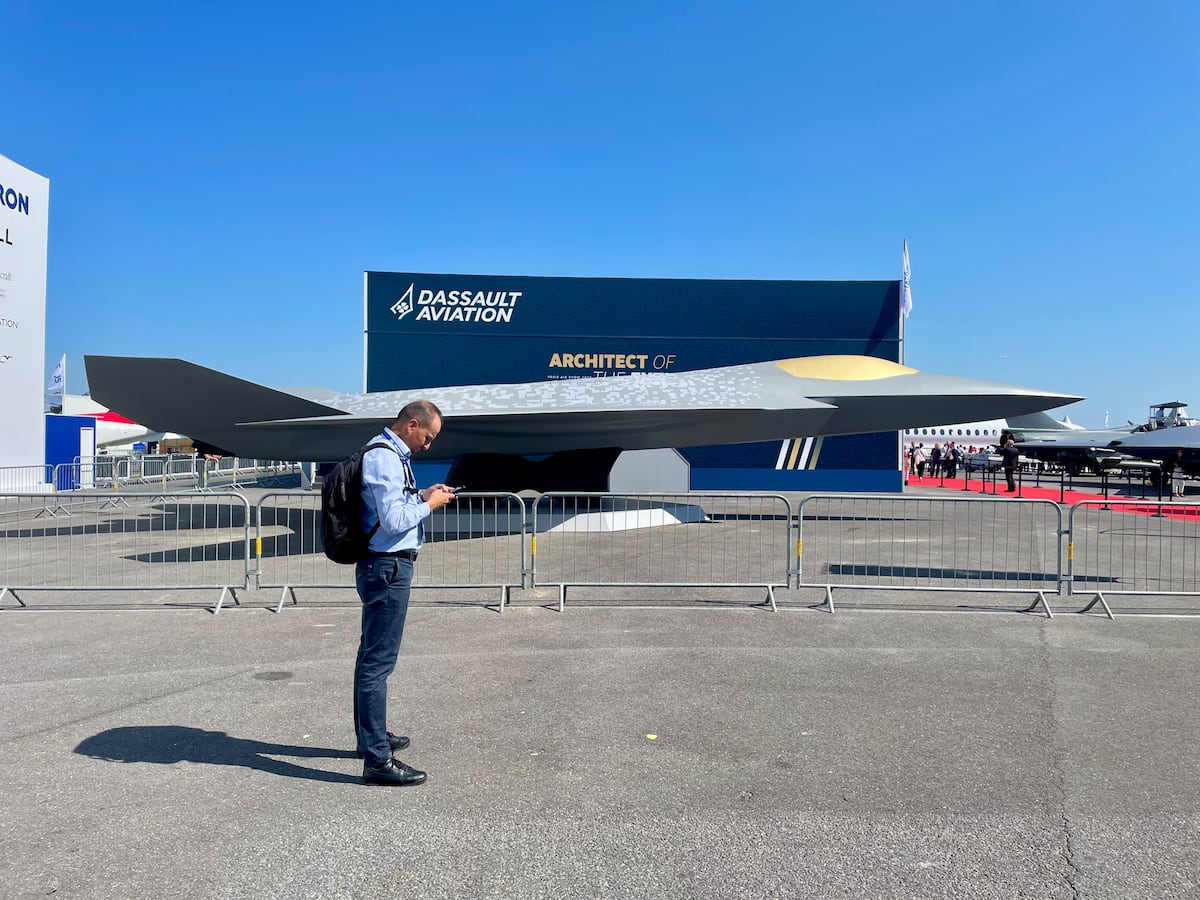
PARIS — France will pursue the development of a domestically produced, next-generation fighter to replace the Rafale, following the breakdown earlier this year of a joint Franco-German-Spanish program for a future combat air system, Air and Space Force Chief of Staff Jérôme Bellanger said.
The project, now named Avion de Combat du Futur (ACF), is being treated as a national undertaking, with officials aiming for the aircraft to be operational for conventional missions by 2040, Bellanger told the National Assembly’s defense committee during a hearing on Wednesday.
“We are moving forward with work that will define and enable the emergence of this ACF as a national program,” Bellanger said, adding that France remains receptive to cooperation with other nations but only in forms that would not be essential to the platform’s creation.
France and Germany abandoned the FCAS program in June after prolonged disputes over technical requirements and industrial leadership, primarily between Dassault Aviation and Airbus. The end of FCAS has left both countries without a clear follow-on to their current Rafale and Eurofighter fleets, although Germany has begun to receive F-35 aircraft ordered in 2022 as replacements for its Tornado jets.
Dassault Aviation’s CEO Éric Trappier has maintained that Dassault, together with engine-maker Safran and electronics firm Thales, has the expertise required to build the next-generation fighter. Trappier has suggested the company could deliver the program for well under €50 billion (about US$56 billion).
Bellanger said the years invested in FCAS were not wasted, noting that work advanced across multiple domains — including the manned aircraft, unmanned systems, stealth technologies, connectivity and the combat cloud. The FCAS effort had been organized into several “pillars,” one of which focused on a new engine, while Dassault and Airbus had been responsible for the next-generation fighter pillar central to the system.
“The termination of FCAS does not mean discarding all progress,” Bellanger said. He stressed that industrial teams have been developing the next-generation fighter (NGF), stealth features, the combat cloud and related capabilities, and that those efforts provide a foundation for continuing on a national path while keeping interoperability in view.
Bellanger emphasized that France must continue collaborating with Germany and other partners on the combat cloud, since interoperability among European crewed platforms will be critical. He framed the objective as fighting “together” rather than merely “side by side,” underlining the operational importance of shared systems and standards.
Although FCAS failed to deliver industrially, Bellanger said his working relationship with his German counterpart remains strong. The two commanders reportedly share a common vision for future air combat and agree on the need for harmonized operational requirements for the cloud component.
Bellanger explained that the Rafale’s successor must be capable of carrying the ASN4G hypersonic nuclear cruise missile by 2050. Back-calculating from that requirement, he said, means the new aircraft must be flying for conventional tasks by around 2040 to meet long-term deterrence timelines. Pursuing the program nationally, he argued, will help France meet deadlines essential to its nuclear posture by that date.
He added that France should field a Rafale F5 standard by 2035 that already embeds early elements of the future combat aircraft — advancements in propulsion, sensors and the inclusion of the Stratus RS missile intended to suppress hostile air defenses.
Commenting on the British-Italian-Japanese Global Combat Air Programme (GCAP), Bellanger described that consortium’s effort to build a sixth-generation aircraft as aiming at a different class of platform, likening it to something closer to a strategic bomber. He warned that GCAP, like any multinational venture, faces internal strains and will require compromises.
Bellanger said the Air and Space Force will receive its first long-range, one-way munitions in the summer of 2027: MBDA’s Deluge loitering munitions. Those systems will form the backbone of France’s initial squadron dedicated to bombing and reconnaissance drones. The force is also trialing interceptor drones with a view to establishing a specialized drone-interceptor unit.
In addition, the service plans to stand up a very-high-altitude squadron to operate stratospheric balloons that can serve as communications relays or carry intelligence sensors. The force is also exploring other long-endurance systems, including tethered balloons.
For future offensive operations into adversary territory, Bellanger described a doctrine that begins with a large first wave of low-cost, expendable drones intended to degrade and overwhelm enemy air defenses — a role assigned to the new squadron. Those expendable systems would be tasked with both kinetic effects and non-kinetic missions such as jamming, saturation and deception.
A subsequent wave of reusable, though potentially attritable, drones would then exploit openings created by the initial strike to allow deeper penetration by both crewed and uncrewed assets, he said.
“To attack an opponent on their own ground, we must now consider saturating air defenses with low-cost strike drones and employing offensive jamming,” Bellanger said, summing up the envisioned approach to combining massed unmanned effects and electronic warfare.
Similar Posts:
- Crisis in French-German Fighter Jet Program: Dassault Points Finger at Airbus!
- France Aims for Key Deal on Cutting-Edge Fighter Jet: Progress Toward ‘Mutually Acceptable’ Accord
- Germany and France Abandon Joint Fighter Jet Initiative: What’s Behind the Shocking Decision?
- India Eyes Key Role in France’s Advanced Sixth-Generation Fighter Jet Program: Strategic Partnership Ahead?
- France Urges FCAS Partners to Redefine Roles: Future of Fighter Jet Project at Stake!

Jamal Peterson reports on defense, aerospace, and tech policy. With a military background and a strategic mind, he dissects complex subjects with clarity, offering readers sharp, reliable insights.