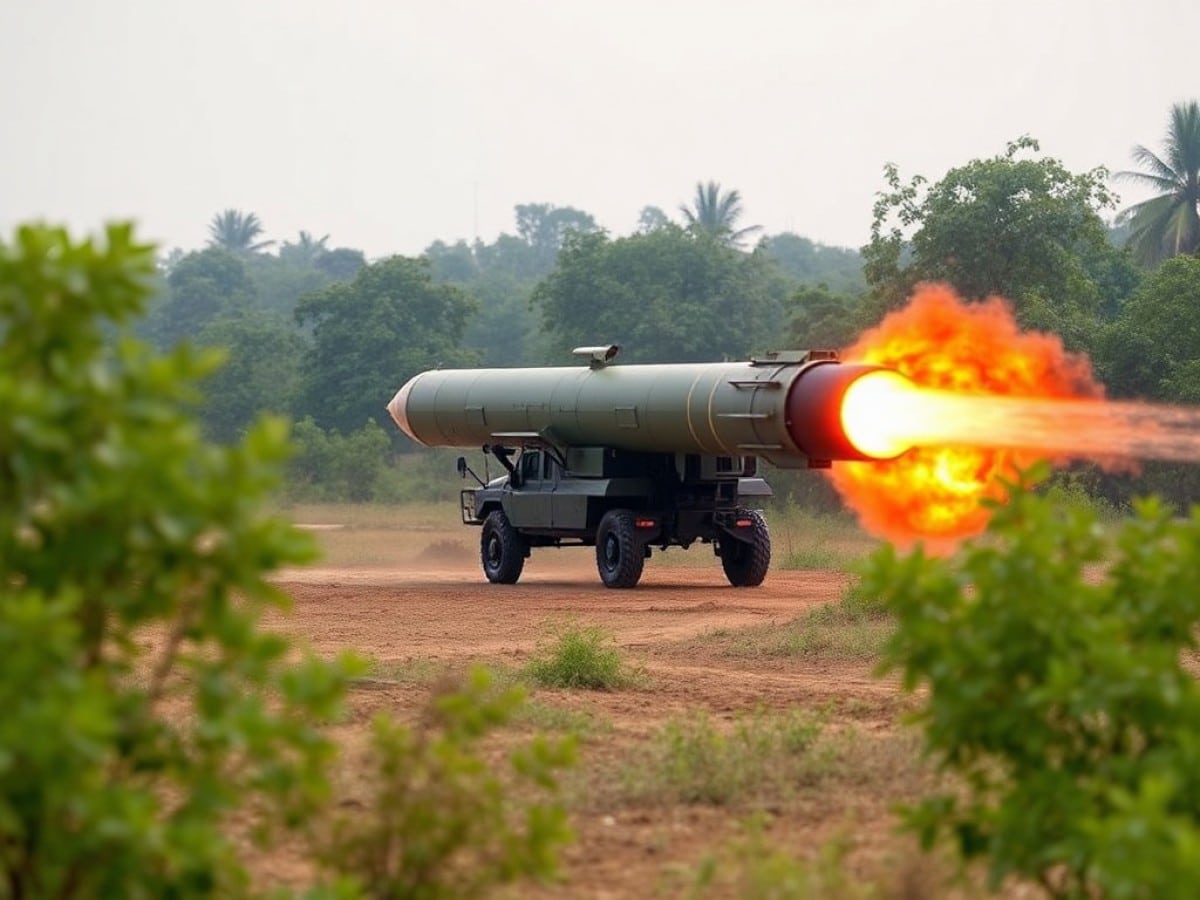
NEW DELHI — India has recently completed a successful test of its advanced long-range surface-to-air missile, marking significant progress in its efforts to develop a homegrown air defense system aimed at addressing high-altitude aerial threats.
The Defense Ministry announced that this initial test successfully destroyed a high-speed, high-altitude electronic target, representing a critical achievement in the ongoing development of the system. The test was carried out on Thursday from A.P.J. Abdul Kalam Island, located off the eastern coast of Odisha state in India.
India has previously developed air defense systems for short and medium ranges but has largely depended on the Russian S-400 Triumf systems for its long-range defense capabilities. The newly tested missile, named Kusha, is expected to help close this capability gap.
“Currently, the S-400 system covers a range of about 400 kilometers, and the Barak-8 systems, which were developed in collaboration with Israel, cover up to 70 kilometers. There’s a significant gap that Kusha aims to fill,” explained Dinakar Peri, a Fellow at Carnegie India’s Security Studies Program.
The development project for this missile system includes three variants that are expected to cover distances of approximately 150 kilometers, 250 kilometers, and 350–400 kilometers. The specific range of the interceptor tested was not disclosed in the official statement.
The missile is designed to neutralize a broad spectrum of aerial threats, including fighter jets, missiles, unmanned aerial vehicles, and large enemy aircraft across a wide range of altitudes and distances, according to the Defense Ministry.
This test represents the first public demonstration of India’s strategic intent to develop an air-defense system that could be comparable to the Russian S-400 Triumf system.
“This development not only reduces our reliance on imported systems but also represents a significant advancement in our national air defense capabilities,” stated Indian Defense Minister Rajnath Singh following the test.
Security analyst Peri mentioned that the variant with a range of 350 to 400 kilometers is expected to perform similarly to the S-400 and could complement the systems India already has in place. Given the extensive borders India shares with Pakistan and China, a wide-ranging air defense coverage is crucial.
“The S-400 played a critical role in the recent conflict with Pakistan, and while our current air defenses are robust, they might be insufficient for future conflicts. Kusha will play a vital role in scaling up our long-range air defenses, especially given the limited reaction time along the Pakistan border,” added Peri.
As part of its military modernization efforts, India is prioritizing the enhancement of its air defense capabilities in response to emerging threats like drones, cruise missiles, long-range rockets, and advanced combat aircraft. The Defence Acquisition Council recently approved a $5.4 billion budget for acquiring weapons and systems, including counter-drone measures and layered air-defense solutions.
The successful test has fueled hopes in New Delhi for a substantial reduction in dependency on foreign air defense technology.
Following the test, it was noted that all elements of the weapon system, including missiles, radar, and command centers, were indigenously developed by India’s Defense Research and Development Organization and various industry partners.
While India will continue to depend on foreign technology in the short term, as the indigenous system requires further trials and is expected to be operationally ready in three to four years, the government has also approved the acquisition of five additional S-400 systems from Russia to bolster its defenses.
India remains one of the largest defense importers globally but has been pushing aggressively for self-reliance by expanding domestic development and manufacturing of advanced military technologies and equipment over the last two decades.
Similar Posts:
- India Bolsters Military: Acquires Advanced Air Defense Systems and Drones for Modern Warfare
- Pakistan Uses Chinese Weapons Against India: Global Analysts Pay Close Attention
- India Supercharges Submarine Fleet: Boosting Nuclear and Conventional Combat Capabilities!
- India Eyes Key Role in France’s Advanced Sixth-Generation Fighter Jet Program: Strategic Partnership Ahead?
- Australia Unveils Cutting-Edge Hybrid Air Defense System: A Game Changer in Military Tech

Jamal Peterson reports on defense, aerospace, and tech policy. With a military background and a strategic mind, he dissects complex subjects with clarity, offering readers sharp, reliable insights.